Every Nigerian secondary school issues documents that decide a student's future — result slips, testimonials, transcripts, leaving certificates, recommendation and admission letters — and almost none of them can be verified. WAEC and NECO results can be checked against an official portal. The documents your school issues itself cannot, which is exactly why they are forged so easily: a doctored result slip for admission, an invented testimonial for a visa, a fabricated reference for a job — all carrying your school's name.
This guide explains the exposure and shows how your school can issue documents that any university, embassy, or employer can confirm in seconds.
The documents your school issues are a forgery target
Think about everything that leaves your school office with a signature and a letterhead on it: termly and annual result slips and report cards, testimonials and leaving certificates, academic transcripts, recommendation and reference letters, admission and attestation and confirmation letters, and mock or internal examination results.
Each of these is used to make a real decision somewhere else — a university place, a scholarship, a visa, a job. And each is, in its current form, trivial to fake. A scanned PDF with your crest at the top and a signature at the bottom can be edited in minutes, and the person receiving it has no way to check whether it is genuine short of telephoning your registrar. In 2026, with AI making convincing forgeries effortless, the receiving institution's default assumption is no longer that a document is real — it is that it might not be.
Why this is your problem, not the receiving institution's
It is tempting to think a forged document is the receiving university's problem to catch. It is not — the reputational damage lands on you.
When a fabricated testimonial bearing your school's name surfaces at an embassy, or a doctored result slip turns up in a university admissions office, it is your institution's name attached to the fraud. Admissions officers and visa officials remember which schools' documents they cannot trust. Over time that quietly erodes the one thing a school sells hardest to parents: the credibility of its name and the onward success of its students. You did nothing wrong — you issued a genuine document — but with no way to tell your genuine document apart from the fake, you carry the cost anyway.
There is also a daily, invisible tax. Every time a university or employer cannot verify one of your documents, someone calls or emails your registrar for confirmation. Those verification letters and phone calls add up to hours your office spends re-proving documents it already issued.
What verifiable actually means for a school document
A verifiable document is one that any recipient can confirm is genuine without contacting you. In practice it carries four things.
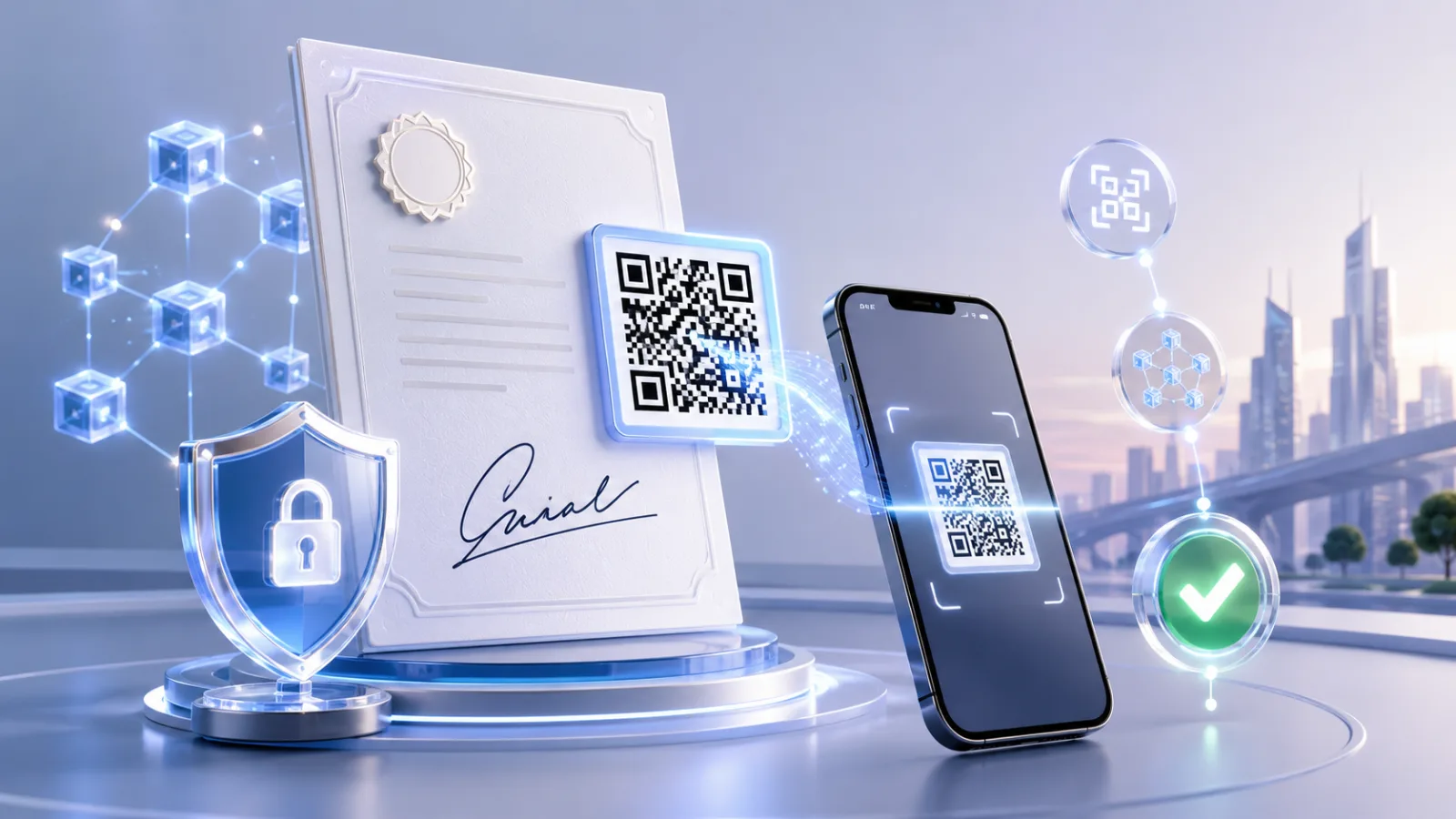
A Certificate of Authenticity — proof the document was issued by your school. A scannable QR code — so verification takes seconds with a phone camera, no app or account. Tamper-evidence — if a single grade or word is altered, the change is detectable. And a hosted proof page — a live page the recipient lands on that confirms the document is authentic and unaltered.
This is the same model WAEC and NECO use for results, brought to the documents your school issues. If you want the recipient's-eye view of how this scanning works, see QR code document verification.
The school documents to make verifiable
These are the documents most worth making verifiable, and who relies on each one downstream.
| Document | Who verifies it downstream | Why it is targeted |
|---|
| Result slip or report card | Universities, scholarship bodies | Grades are altered for admission |
|---|
| Testimonial or leaving certificate | Embassies, universities, employers | Character and attendance claims are fabricated |
|---|
| Transcript | Tertiary institutions, local and abroad | Subject grades and totals are edited |
|---|
| Recommendation or reference letter | Universities, employers | Invented entirely or attributed to staff who never wrote them |
|---|
| Admission or attestation letter | Banks, embassies, agencies | Used as proof of enrolment or status |
|---|
If your school issues it and someone else relies on it, it belongs on this list.
How verifiable issuance works
For your registrar, the workflow barely changes — you issue documents much as you do now, with verification attached automatically.
Create the document — a result slip or testimonial — as usual, in your normal tools. Issue it through VerifyDoc.ai, which attaches a QR-backed Certificate of Authenticity and a hosted proof page. Send or print it; the QR code and proof stay attached whether the document is emailed, printed, forwarded, or archived.
The recipient then scans the QR. A university, embassy, or employer instantly sees that the document is genuine, issued by your school, and unaltered. And it stays verifiable for years — so a result slip you issue today still verifies when your alumnus applies abroad in a decade.
What your school gains
Making your documents verifiable is not a compliance chore — it is a competitive asset. There are three concrete gains.
First, you protect your school's reputation. Forged versions of your documents stop passing silently. You become the single source of truth for anything issued in your name, and a fake is exposed the moment someone checks it.
Second, you strengthen your students' onward credibility. Verifiable results and testimonials sail through admissions and visa checks. For parents, that is a tangible benefit they understand instantly — and a reason to choose your school over the one down the road.
Third, you end the verification-letter grind. Universities and employers verify by scanning, not by calling. Your registrar stops re-proving documents by hand and gets that time back.
There is a positioning gain too: a school that can say every document we issue is verifiable has something concrete to show at open days and to admissions offices — a modern, premium credential service most Nigerian schools simply do not offer yet.
But we already use WAEC and NECO — the distinction
This is the most common question, and it is an important one. WAEC and NECO verification covers the national examination results those bodies issue — and you should always direct third parties to the official WAEC Verify and NECO e-Verify portals for those.
But WAEC and NECO results are only part of a student's file. Everything your school issues — internal result slips, testimonials, transcripts, references, admission letters — sits entirely outside that system and has no portal at all. VerifyDoc.ai does not verify WAEC or NECO results; it makes your school's own documents verifiable in the same way WAEC and NECO made theirs. The two are complementary: national results through the national portals, your documents through your own verification.
A note on data protection (NDPA)
Your documents are full of students' personal data — names, grades, attendance, sometimes more. Under the Nigeria Data Protection Act 2023, your school, as the issuer, is expected to keep that data accurate, protect it against unauthorised alteration, and be able to demonstrate it did so. Issuing documents with tamper-evidence and a verification trail supports exactly those duties — integrity, accuracy, and accountability — so verifiable issuance helps your school meet its NDPA obligations rather than adding to them.
How to roll it out in your school
You do not need to convert everything at once. The simplest path starts with result slips, because they are issued in volume and forged most often, so the impact is immediate. Add testimonials and transcripts next — the documents that travel furthest, to universities and embassies.
Train your registrar once; the issuing step is quick, and most schools are comfortable within a single session. Tell parents and partner institutions, and make your verifiability visible — it is a selling point, not a back-office detail. Then expand to letters and admissions documents as it becomes routine.
Within a term, every document your school issues can be one a university or embassy trusts on sight.
Make your school's documents impossible to fake
Give every result slip, testimonial, transcript and letter your school issues a QR-backed Certificate of Authenticity that any university, embassy or employer can scan to confirm it is genuine, unaltered, and yours — for years to come. Start free or see how it works.
Related reading: How to spot a fake WAEC or NECO result and How to verify a degree certificate or transcript with QR codes.