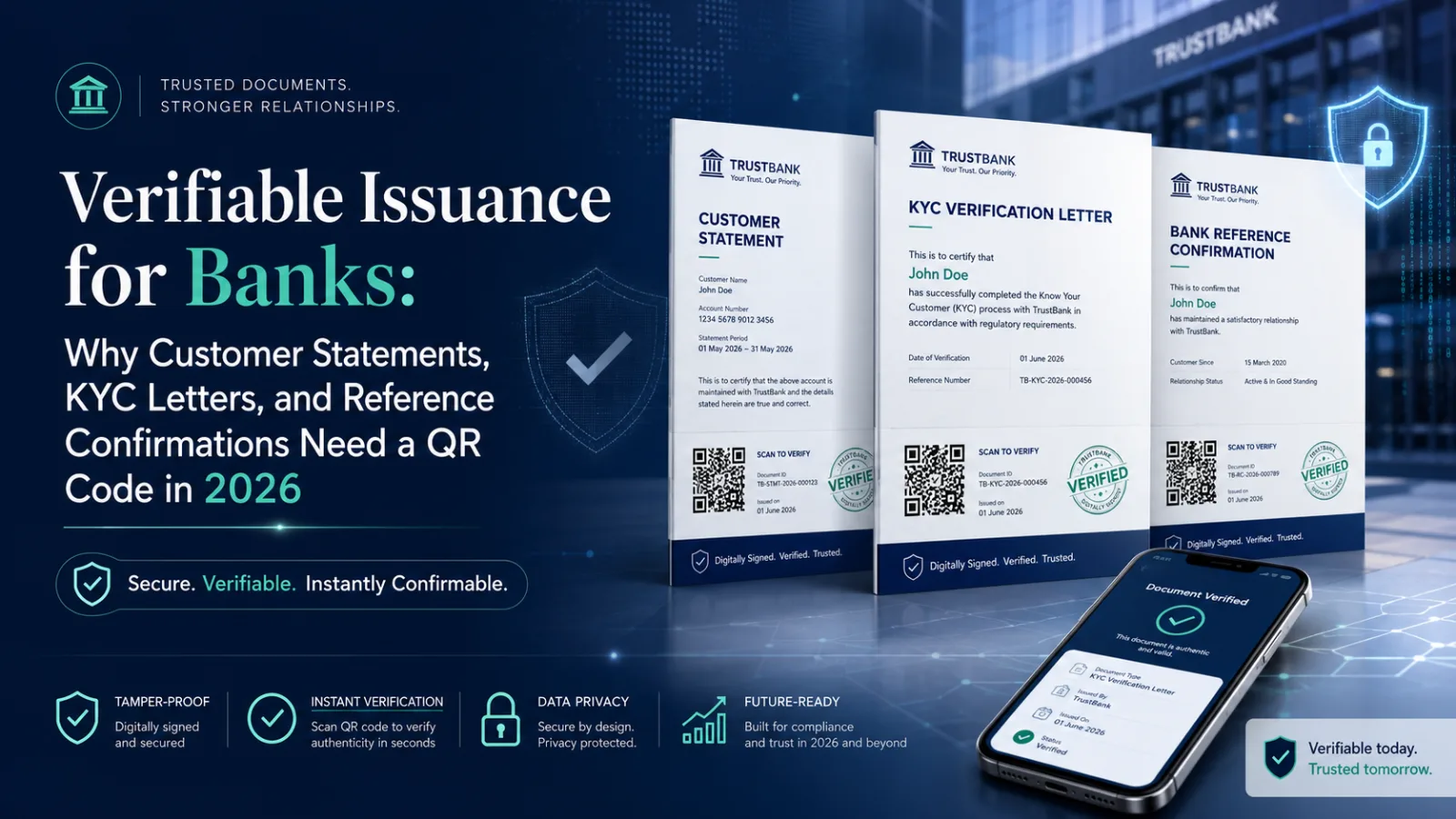
The Nigeria Data Protection Act 2023 (NDPA) is Nigeria's principal data protection law. It was signed on 12 June 2023, replaced the 2019 Nigeria Data Protection Regulation (NDPR), and is enforced by the Nigeria Data Protection Commission (NDPC). If your organisation issues documents that contain people's information — certificates, transcripts, payslips, account statements, employment and reference letters, medical records, KYC letters — then you are processing personal data, and the NDPA applies to you.
This guide explains what the Act requires, what it costs to get wrong, and the specific duties that bite hardest for document issuers: keeping issued documents accurate, secure, and provable.
What the NDPA is, in one minute
The NDPA 2023 is Nigeria's comprehensive framework for how organisations collect, use, store, share and protect personal data. It took effect on 12 June 2023, repealing the older NDPR 2019, and it created an independent regulator — the Nigeria Data Protection Commission (NDPC) — with real powers to register organisations, investigate complaints, audit processing activities, and impose financial penalties.
To operationalise the Act, the NDPC issued the General Application and Implementation Directive (GAID) 2025 in March 2025, which sets out the practical detail of registration tiers, audits, and compliance expectations. Together, the NDPA and the GAID are the rulebook every Nigerian data controller now works to.
Who the NDPA applies to — and why every document issuer is caught
The NDPA applies to any organisation established in Nigeria that processes personal data, and to foreign organisations that process the personal data of people in Nigeria — for example by offering them goods or services, or monitoring their behaviour. The Act has extraterritorial reach, so a UK or US business serving Nigerian customers is in scope.
Processing is broad: collecting, recording, storing, using, sharing, and issuing personal data all count. And here is the part document issuers often miss — the documents you produce are personal data. A payslip contains a salary and an employee's identity. A transcript carries a student's full academic record. A bank statement is months of someone's financial life. An employment letter ties a named person to a role and an income. The moment you create, send, store, or verify one of these, you are processing personal data under the NDPA, and frequently sensitive personal data such as health, financial, or biometric data that attracts stricter rules.
In other words: you do not have to think of yourself as a data company to be a data controller. If you issue documents about people, you already are one.
The core concepts you need
A few terms recur throughout the Act. These are the ones that matter most for document issuers.
| Term | What it means under the NDPA |
|---|
| Personal data | Any information that can identify a person directly or indirectly — name, ID number, address, location data, online identifiers, account details. |
|---|
| Sensitive personal data | A special category (for example health, financial, biometric, religious or ethnic data) that requires stricter grounds to process. |
|---|
| Data subject | The individual the data is about — your employee, student, customer, or applicant. |
|---|
| Data controller | The organisation that decides why and how personal data is processed. If you issue the document, this is usually you. |
|---|
| Data processor | A third party that processes data on the controller's behalf, such as a vendor or platform. |
|---|
| DCPMI | A Data Controller or Processor of Major Importance — larger or higher-risk organisations that face enhanced obligations and higher penalties. |
|---|
The obligations the NDPA puts on you
The NDPA is built on a set of data-protection principles that will be familiar to anyone who has met the GDPR. Through a document issuer's lens, these are the duties that matter most.
Lawful basis. You need a valid reason to process — typically consent, performance of a contract, a legal obligation, or legitimate interest. Issuing a payslip rests on different grounds than sharing a student's record with a third party.
Accuracy. Personal data must be accurate and kept up to date. An issued document that is wrong, or a stale version circulating after you corrected the original, is an accuracy failure.
Integrity and confidentiality. You must protect personal data against unauthorised access, loss, and alteration, using appropriate technical and organisational measures. A tampered version of a document you issued is a data-integrity breach.
Data minimisation. Process and disclose only what is necessary. When a third party only needs to confirm a document is genuine, they do not necessarily need the entire underlying dataset re-exposed.
Storage limitation. Do not keep personal data longer than you need it.
Accountability. You must be able to demonstrate compliance — keep records, audit trails, and evidence of your safeguards. Saying you are careful is not a defence; showing the trail is.
Respecting data-subject rights. Individuals can request access to their data, ask you to correct or erase it, object to processing, and more. You need a process to handle these requests.
What this means when you issue a document
Put those principles next to a real issuance workflow and the exposure becomes concrete.
A student disputes a transcript you issued years ago. This is accuracy and accountability: can you show what you issued and that it has not been altered since?
A forged copy of one of your employment letters surfaces at a bank. This is integrity: a document bearing your name has been tampered with, potentially a reportable breach.
An embassy or foreign employer needs to confirm a certificate is real. This is data minimisation and cross-border transfer: can they verify authenticity without you re-sending the full personal dataset abroad each time?
The NDPC opens an audit. This is accountability: can you produce evidence of the safeguards protecting the documents you issue?
Each of these is an NDPA question dressed up as an everyday document problem.
NDPA penalties and enforcement — this is not theoretical
The NDPA uses a tiered penalty system, and the NDPC has shown it will use it.
| Organisation type | Maximum penalty for non-compliance |
|---|
| Data Controller or Processor of Major Importance (DCPMI) | The greater of ₦10,000,000 or 2% of annual gross revenue from the preceding financial year. |
|---|
| All other organisations | The greater of ₦2,000,000 or 2% of annual gross revenue from the preceding financial year. |
|---|
Enforcement is active. The NDPC has levied significant fines — including a reported ₦766.2 million against a major broadcaster and a US$220 million penalty against a global technology platform — and in 2025 it issued compliance notices to over 1,300 organisations, with financial institutions and insurers heavily represented, giving each a short window to evidence compliance or face sanctions. If you are a bank, insurer, university, employer, or any high-volume issuer, you are exactly the profile the NDPC is scrutinising.
Registration, DPO, and breach notification — the operational must-dos
Beyond the principles, the NDPA imposes concrete operational duties.
| Duty | What is required |
|---|
| Registration | Data controllers and processors of major importance must register with the NDPC and keep their registration current; the GAID 2025 sets the tiers and the annual compliance-return requirements. Material changes must be reported to the Commission. |
|---|
| Data Protection Officer (DPO) | Organisations must appoint a DPO where required. Many Nigerian organisations appoint one as a matter of good practice even when not strictly mandatory. |
|---|
| Breach notification | A data controller must notify the NDPC of a personal-data breach that could harm individuals' rights within 72 hours of becoming aware of it. Processors must promptly inform their controller. |
|---|
| DPIAs | A Data Protection Impact Assessment is expected for high-risk processing, including certain processing of sensitive personal data. |
|---|
| Cross-border transfers | Allowed where the destination provides adequate protection, where appropriate safeguards are in place, or under specific exceptions such as explicit consent or contractual necessity. |
|---|
NDPA vs GDPR — a quick orientation
If your team already knows the GDPR, the NDPA will feel familiar — but the differences matter.
| Area | NDPA (Nigeria) | GDPR (EU/UK) |
|---|
| Regulator | Single national authority — the NDPC | A data-protection authority in each member state (the ICO in the UK) |
|---|
| Breach notice | 72 hours to the NDPC | 72 hours to the supervisory authority |
|---|
| Maximum penalty | Greater of ₦10m / ₦2m or 2% of gross revenue (tiered) | Up to €20m or 4% of global turnover |
|---|
| Cross-border | Adequacy, safeguards, or specified exceptions | Adequacy, SCCs, BCRs |
|---|
| DPO | Required in defined cases; NDPC has interpretive flexibility | Required for public bodies and large-scale or sensitive processing |
|---|
The headline: the shape of compliance is GDPR-like, the penalties are lower but very real, and the obligations around accuracy, security, and accountability fall directly on anyone who issues documents.
Where verifiable issuance fits your NDPA obligations
Most NDPA compliance work — appointing a DPO, mapping data, building a breach process, registering with the NDPC — sits with your privacy and legal function. But a specific cluster of the Act's duties lands squarely on the documents themselves, and that is where verifiable issuance does real work.
On integrity and security, VerifyDoc.ai attaches tamper-evidence to every document you issue, so any later alteration is detectable rather than invisible. A forged copy of your letter no longer passes silently.
On accuracy, each document becomes a single, verifiable source of truth. A recipient can confirm they are holding the genuine, current version rather than an out-of-date or doctored one.
On accountability, issuance produces a verification record you can point to — exactly the kind of demonstrable evidence the NDPC looks for in an audit. You are not asserting integrity; you can show it.
On data minimisation, a QR-backed Certificate of Authenticity and a hosted proof page let a third party confirm a document is genuine without you re-broadcasting the full dataset on every request — useful when documents are verified repeatedly, including across borders.
A candid scope note: a verification platform is not a complete NDPA compliance programme. It will not choose your lawful basis, register you with the NDPC, appoint your DPO, or run your breach process. What it does is close the document-integrity, accuracy and accountability gaps that are otherwise very hard to evidence — turning the documents you issue from a liability you can only assert is genuine into an asset you can prove is genuine. See how it works.
A practical NDPA checklist for document issuers
Use this as a quick readiness check. Map the documents you issue and the personal — and sensitive — data each one carries. Confirm a lawful basis for issuing and for any onward sharing. Secure documents against alteration, not just access, because integrity is an explicit NDPA duty. Make issued documents independently verifiable, so recipients can confirm authenticity without you re-sending data.
Keep an audit trail you can show the NDPC on request. Have a breach process ready, including the 72-hour clock. Check your status — if you are a DCPMI, register and keep your filings current. Appoint a DPO where required, and review high-risk processing with a DPIA. And take qualified advice for your sector, because financial services, education, health and insurance carry extra rules.
Make the documents you issue defensible under the NDPA
The NDPA expects issued documents to be accurate, protected against alteration, and provable on demand. VerifyDoc.ai gives every document you issue a QR-backed Certificate of Authenticity and a verification record — so integrity and accountability stop being claims and become evidence. Start free or see how it works.
Related reading: Are electronic signatures legally binding in Nigeria?
This article is for general information and does not constitute legal advice. The NDPA, the GAID and NDPC guidance evolve; consult a qualified Nigerian data-protection practitioner for advice on your organisation's specific obligations.