Editorial26 April 2026VerifyDoc Editorial

Verifiable Bank Statements

How Lenders and Landlords Can Confirm a Document Is Real in Seconds

Verifiable Bank Statements- How Lenders and Landlords Can Confirm a Document Is Real in Seconds

Last spring, a landlord in north London — call her Priya — listed a one-bedroom flat at £2,100 a month. The applicant who topped her shortlist looked perfect on paper: a stable job at a recognisable consulting firm, a salary of £78,000, three months of bank statements showing tidy deposits and a healthy balance, and a smiling LinkedIn photo. The references checked out. Priya signed a twelve-month tenancy and handed over the keys.

The first month's rent paid. The second did not. By month four, the tenant had vanished, the flat had been used as a short-let by people Priya had never met, and the locks had been changed twice. When Priya finally got the bank statements re-examined by a fraud specialist, the picture became clear. The statements were genuine PDFs from the right bank, in the right template — but the deposits had been edited. The "tenant" was not employed by the consulting firm, did not earn £78,000, and almost certainly did not exist under that name.

Priya's situation is not unusual. UK fraud-prevention surveys consistently rank doctored income and bank-statement evidence among the top three categories of rental and mortgage fraud, and the same pattern shows up in US mortgage-quality reports, where misrepresentation of assets and income drives a meaningful share of post-funding fraud findings every year. Landlords and lenders are losing tens of millions of pounds and dollars to a fraud category that, structurally, is now solvable.

This guide is for the people on the receiving end of bank statements — mortgage brokers, lenders, property managers, KYC analysts, fintech underwriters — and for the banks that issue them. It walks through how doctored statements get past human review, the five tells trained reviewers should look for, and the verifiable-statement model that turns the verification question from a forensic exercise into a two-second QR scan.

Why bank statements are so easy to fake in 2026

A bank statement is, from a fraud perspective, an unusually attractive document. It carries a high evidentiary weight in lending and tenancy decisions. It is presented as a PDF, which is trivially editable. And the "look" of authenticity — bank logo, account masking, transaction columns, totals — is well understood and easily reproduced.

Three things have made the problem worse over the last twenty-four months:

Generative AI flattened the production cost. A reasonably motivated fraudster can prompt a free-tier model to generate plausible transaction lines that match a target salary and lifestyle, drop them into the right bank's PDF template, and produce something that looks correct down to the running balance. Fraud-prevention teams at major UK and US banks have publicly reported a sharp uptick in AI-assisted bank-statement forgeries since 2024.

Statement templates are widely available. Real PDFs from every major retail bank circulate freely in fraud forums as templates. The fraudster does not need to design from scratch.

The verifier is usually time-poor and decentralised. A landlord with one flat does not have a forensic-document team. A mortgage broker assessing fifteen applications a week cannot spend twenty minutes per statement. The asymmetry between the patient attacker and the rushed reviewer is what the entire fraud category exploits.

Five tells of a doctored bank statement

Detection is the first line of defence even after verifiable statements arrive, because most issuers will not be on board for some time. These are the patterns reviewers should be trained on.

Tell 1: Running balances that don't add up

The most reliable signal, by a wide margin. When a fraudster edits a deposit or removes an outgoing payment, they often forget to recompute every subsequent running balance correctly. A rigorous reviewer adds and subtracts every line for one column. If a single line is out, the whole statement is suspect. Free spreadsheet tools and AI-document review services now do this automatically — adopt one.

Tell 2: Font drift and microscopic alignment errors

Authentic bank statements are produced by automated rendering systems. Every numeric field uses the same monospaced or tabular-numeric font, every column is pixel-aligned, every decimal is in the same vertical position. Edited statements often show a subtly different font for one digit, a number that is a hair off-axis, or a thousands-separator that varies between rows. Zoom to 400% on any line that looks "fine."

Tell 3: Missing or mismatched bank metadata

Real statements carry metadata in the PDF (creator software, producer, embedded fonts) that almost always names the bank's statement-generation system. Edited statements typically show the editor used to alter them — Adobe Acrobat, Foxit, even iLovePDF. Right-click → Document Properties (or pdfinfo from the command line) takes ten seconds and exposes most amateur edits.

Tell 4: Transaction patterns that don't match the claimed life

A genuine current account has texture: small subscriptions on the same day each month, a coffee-shop transaction every weekday morning, the same supermarket twice a week, payroll on a predictable date. Fabricated statements often have the big numbers right (salary in, rent out) and miss the small numbers entirely, or have small numbers that are all rounded to whole pounds and clustered on the same dates. If the transaction texture looks too smooth, it usually is.

Tell 5: Format that doesn't match the bank's current statement

Banks update their statement templates more often than fraudsters do. A 2026 applicant submitting a statement in the bank's 2022 layout is either someone with a very old copy of an export, or someone whose template is six versions out of date. Most major banks' current and recent statement layouts are visible on their personal-banking help pages — bookmark them.

Why detection alone will not hold

The five tells reduce losses; they do not eliminate them. The reason is the same as in every other document-fraud category: the attacker only has to win once, the reviewer has to win every time, and the cost of producing convincing fakes is collapsing while the time available to review them is shrinking.

A reviewer working through forty applications a week, catching 95% of fakes, will let through two doctored statements a week. At an average loss per incident of several thousand pounds — for a landlord — or several tens of thousands of pounds — for a lender — that adds up to a six-figure annual loss, even with a control that, on paper, "works."

The structural fix is to stop trying to detect fakes and start verifying real statements at source. That is what verifiable bank statements do.

What a verifiable bank statement looks like

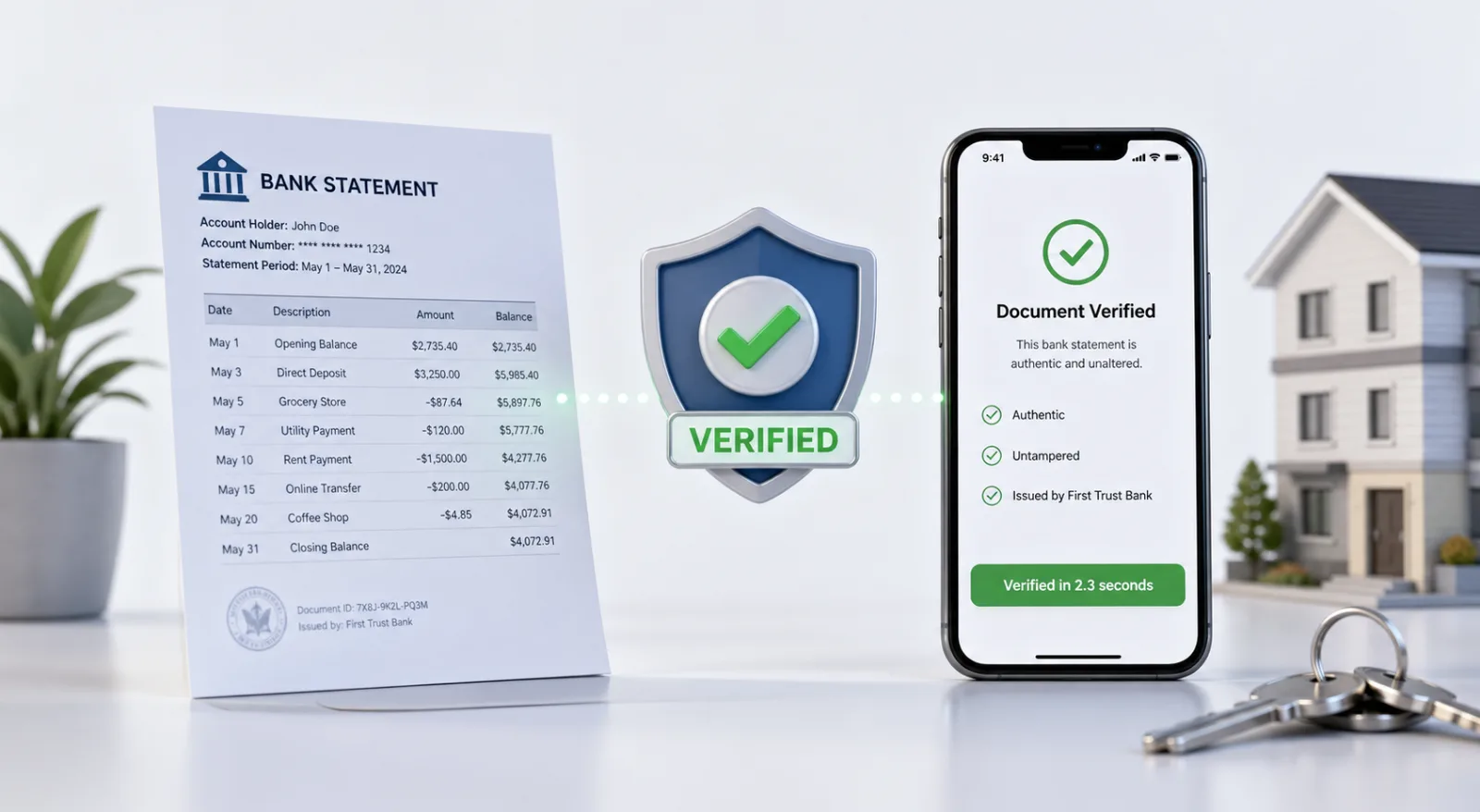
A verifiable bank statement is a statement that the issuing bank has stamped with a QR code (or an equivalent verification block) at the moment of generation. The QR resolves, when scanned, to a hosted proof page on the bank's verification domain. The proof page shows:

The original statement as the bank issued it, side-by-side with the version the verifier received, so any tampering is visible.

The bank's verified identity and regulatory reference (FCA registration in the UK, FDIC certificate in the US, etc.).

The account holder's name as the bank holds it.

The statement period and the date of issuance.

A short, plain-English statement of what is being attested ("This is a true copy of the current-account statement issued by Example Bank to Jane Doe for the period 1 March – 31 March 2026").

A change log if the statement has been re-issued, and a revocation flag if the underlying account has been closed or flagged.

The verifier opens the PDF, scans the QR with a phone camera, and reads the proof page. Two to five seconds. No account, no fee, no callback to the bank's call centre.

A doctored statement fails the check in three independent ways. There is no QR at all (most fraudsters using legacy templates), or the QR opens at the wrong domain (clearly visible in the browser address bar), or the proof page shows a different document than the one the verifier has in front of them. The fraud category that depends on "send a PDF that looks right" stops working, because the verifier is no longer judging the PDF.

The architecture is the same one that universities are starting to use for QR-verified degree certificates and that finance teams are adopting for verifiable invoices. Bank statements are an unusually high-value application of the same model.

How to verify a bank statement (verifier side)

The verifier-side workflow is intentionally trivial.

Step 1. Open the statement. PDF on screen, scanned image, or printed copy — all work.

Step 2. Scan the QR code. Use any phone camera. Both iOS and Android decode QR natively without an app. On desktop, click the QR if the PDF supports embedded links, or use an in-browser QR reader.

Step 3. Read the proof page. Confirm three things:

The URL in your browser belongs to the issuing bank or its named verification provider — not a lookalike domain.

The original statement shown on the proof page matches the one the applicant sent you (transaction lines, dates, balances).

The account holder name matches the applicant.

Step 4. Make the decision. A pass on all three is very strong evidence the statement is genuine. A fail on any one is grounds to refuse the application or escalate.

That is the entire workflow. For a property manager screening tenants, this can be added to the existing reference-check step at no marginal cost. For a lender, it sits alongside open-banking pulls (which are stronger but only available where the applicant consents and the bank is connected) as a fall-back for the cases open banking does not cover.

How banks can issue verifiable statements (issuer side)

For the bank, the rollout is more substantial but not complicated. There are two common patterns.

Pattern A: Add the QR to the statement-generation system

The bank's batch statement-generation pipeline is updated to call a verification service for each statement, register the document hash and metadata, and stamp the returned QR onto the PDF before delivery to the customer. This is the highest-fidelity path and gives the bank full control of the proof page.

Implementation typically takes one to three sprints for a mid-size bank, depending on whether statement generation runs in-house or via a vendor (Fiserv, Jack Henry, FIS, Tata Consultancy Services, etc.). Most major statement-generation vendors are now publishing roadmaps for QR verification as a standard feature.

Pattern B: Add the QR at the customer-download step

For digital-first banks, an interim option is to stamp the QR at the moment the customer downloads the statement from the mobile app or online banking portal — rather than rebuilding the batch generator. This is faster to ship and covers the dominant download path for most retail banks today, with the caveat that paper statements posted to customers will continue without a QR until the batch path is updated.

  • What the bank gets in return

The economics for the bank are favourable, even ignoring the broader public-good argument:

A meaningful reduction in support load: today, banks field a steady stream of "is this statement real?" enquiries from landlords, brokers and lenders. Most of those calls disappear when verification is self-service.

A reduction in the bank's own exposure to claims that doctored statements bearing its brand were used to defraud third parties.

A trust-and-safety story for retail customers, who increasingly expect digital documents to be verifiable as a matter of course.

A defensible position in the compliance conversations now underway in several jurisdictions about authenticated digital evidence.

For the typical statement volume of a mid-size retail bank, the per-statement verification cost is well under a penny at scale.

  • Frequently asked questions

Isn't open banking a better answer than verifiable PDFs?

For the cases it covers, yes. An open-banking pull, with the applicant's consent, is the strongest possible signal: the lender or landlord sees the live data direct from the bank. But open banking does not cover all banks in all countries, does not work for all account types, and frequently encounters consent and integration friction. Verifiable statements cover the long tail — and, importantly, they work for the historical statements (last six months, last year) that lenders often need.

What about applicants who submit statements from a country that does not yet issue verifiable statements?

For those cases, the existing controls (the five tells, callbacks where possible, open banking where available) remain. Verifiable statements are an additive control, not a replacement. As more issuing banks adopt verification, the residual risk shrinks.

Won't fraudsters just generate fake QR codes?

They can generate a QR, but it has to resolve somewhere. If the QR opens at the issuing bank's verification domain (or a known third-party verifier like verifydoc.ai), the proof page comes from the real source. If it opens at a lookalike domain, the verifier sees the wrong URL in the browser. The trust anchor moves from the document to the resolved domain, which is much harder to spoof than a PDF.

Does this work for proof-of-funds letters as well as monthly statements?

Yes. The same QR-verification model applies to any document the bank issues — monthly statements, proof-of-funds letters, mortgage redemption statements, balance certificates. Banks adopting verification typically roll it out across all customer-facing PDFs in a single programme.

Is there a privacy risk from the proof page?

The proof page only shows what the bank chooses to publish, field by field. Most issuing banks publish the account holder name, statement period, and a hash or thumbnail of the original document — not the underlying transaction data. The verifier sees enough to confirm the document is genuine, not the customer's full financial picture.

What is the verifier supposed to do if the QR fails to scan?

Treat that the same as any other red flag. A failed QR scan is not, on its own, evidence of fraud — the document might be old, or the applicant might have downloaded it before verification was rolled out — but it should trigger one of the existing controls (callback to the bank's published verification line, open-banking pull, or refusal to advance the application).

The bottom line

Doctored bank statements are an end-stage problem in a fraud category that has finally become structurally solvable. The five-tell detection model is necessary and is not enough. The verifiable-statement model — issuer-side QR at the moment of generation, verifier-side scan in seconds — closes the loop and changes the question from "did our reviewer spot the fake?" to "did the bank confirm the document?"

For lenders and property managers, the immediate move is to start asking applicants for QR-verified statements where their bank supports it, and to make the absence of a QR a soft negative in the application process. Market pressure pulls issuers along faster than waiting for regulation.

For banks, the move is to put QR verification on the next quarter's roadmap. The cost is small, the customer benefit is real, and the alternative is to keep absorbing the reputational and operational drag of being the named brand on every doctored statement that gets used to defraud a tenant or a borrower.

If you want to see how the issuer side works end-to-end, read how QR document verification works or talk to the team about verifiable account statements for financial institutions.

Back to blog