Yes — and verification helps, rather than hinders, acceptance. In Nigerian courts, a QR-verified document is an electronic document, and electronic documents are admissible under Section 84 of the Evidence Act 2011 (as amended in 2023), provided the standard foundation is laid. For embassies and foreign use, a document an embassy can scan and confirm at source is more trusted, not less.
The one nuance to understand: QR verification strengthens a document's authenticity, but it does not replace formal requirements that still apply — a court's evidential foundation, or, for cross-border use, Nigeria's authentication-and-legalisation chain. This guide explains both, so you can adopt verifiable documents with confidence.
Courts: electronic documents are admissible (Evidence Act 2011, Section 84)
Nigerian law expressly provides for electronic evidence. Section 84(1) of the Evidence Act 2011 makes a statement in a document produced by a computer admissible as evidence, provided the conditions in Section 84(2) are met. Those four conditions, in essence, require that the document was produced by a computer in regular use, that information of that kind was regularly supplied to it, that the computer was working properly, and that the information was supplied in the ordinary course of business. The Evidence (Amendment) Act 2023 modernised this framework further, introducing new provisions, Sections 84A to 84D, addressing electronic and public records.
So an electronically generated, QR-verified document is squarely within the category of evidence Nigerian courts can admit.
Courts: the foundation you must lay (Kubor v Dickson)
Admissibility is not automatic. In the landmark Supreme Court case Kubor v Dickson, the court held that a party relying on an electronically generated document must do more than simply hand it up — it must lay the Section 84(2) foundation, either through a certificate under Section 84(4), identifying the document and describing how it was produced, or through oral evidence. Skip that step and the document can be ruled inadmissible, however genuine it is.
The practical lesson: getting an electronic document admitted is a matter of proving its reliability and origin — exactly the thing a verification trail is built to do.
Courts: what QR verification adds — and what it doesn't replace
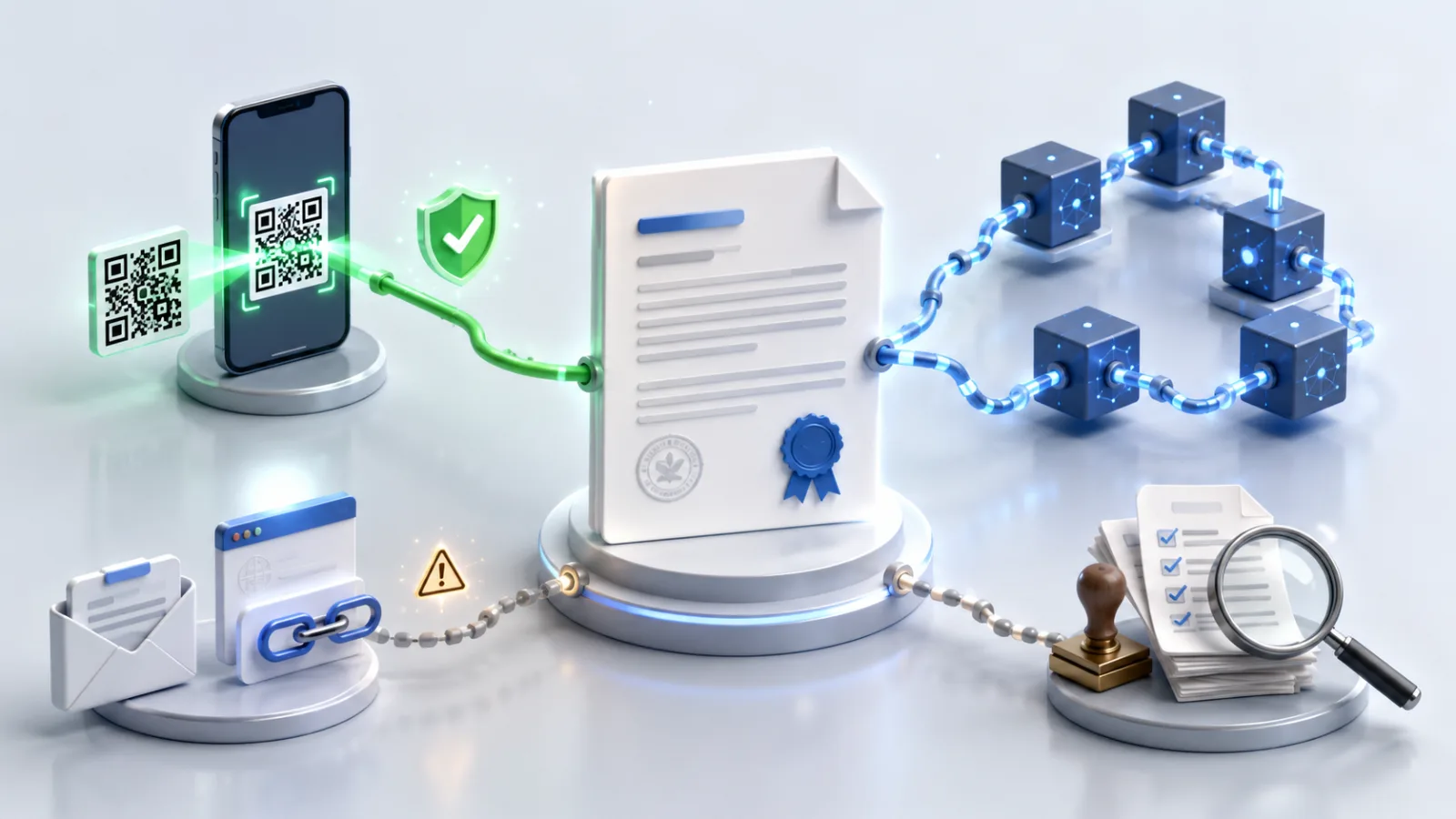
A QR-backed Certificate of Authenticity does not bypass Section 84, but it makes that section much easier to satisfy and the document far harder to attack.
It supports authentication: a scannable, issuer-confirmed verification record is strong evidence that the document is genuine and originates where it claims, helping lay the foundation and discharge the burden of proof. It demonstrates integrity: tamper-evidence shows the document has not been altered since issuance, directly addressing the reliability question courts focus on. And it strengthens evidential weight: even once admitted, a document a court can independently verify is more persuasive than a bare PDF.
What it does not do is remove document-specific formalities. Public documents still require certified true copies as their admissible secondary evidence, and any document needing stamping or registration still needs it. QR verification complements those requirements; it does not substitute for them.
Embassies: what they actually care about
Embassies and foreign institutions care about one thing above all: is this document genuine? Given the well-documented concerns about forged Nigerian documents, set out in our document-fraud data hub, a document the recipient can scan and confirm at source is a direct answer to that question — which makes a QR-verified document more readily trusted than one that cannot be checked. For straightforward authenticity confirmation — a university confirming a transcript, an employer confirming a letter, a visa officer sanity-checking a supporting document — verifiability is an asset.
Embassies: the legalisation chain (Nigeria is not in the Apostille Convention)
For formal cross-border use, there is an important procedural reality. Nigeria is not a member of the Hague Apostille Convention, so Nigerian documents cannot be apostilled. Instead, documents for official use abroad typically go through a two-step chain.
First, authentication by the Federal Ministry of Foreign Affairs (MFA) in Abuja — sometimes preceded by notarisation, and by the relevant ministry, for example the Ministry of Education for academic documents — which verifies the signatures, seals, and stamps. Second, legalisation by the embassy or consulate of the destination country, which certifies the MFA's authentication for its own government.
Some countries accept MFA authentication alone; others require both steps. This chain applies regardless of whether a document carries a QR code.
Embassies: where QR verification helps — and where it complements rather than replaces
A QR-verified document strengthens every link in that chain — the MFA, the embassy, and the destination institution can each confirm the underlying document is genuine at source, reducing the risk of a forged document entering the process. But QR verification does not replace the authentication-and-legalisation steps where a destination country requires them.
The right way to think about it: legalisation proves the document to a foreign government through diplomatic channels; QR verification proves the document to anyone, instantly, at source. They serve different purposes, and for formal use you may need both.
So, will adopting QR-verified documents cause acceptance problems?
No — and this is the heart of the objection. Making your documents QR-verifiable does not put you on the wrong side of any court or embassy requirement. It does the opposite.
In court, a QR-verified document is admissible and easier to authenticate than a plain one. With embassies and foreign institutions, it is more trusted because it can be confirmed at source. And where a notarisation, certified copy, or legalisation step is required, you carry it out as normal, and the QR verification sits alongside it without conflict.
The net effect of verifiable issuance is fewer authenticity disputes, not more friction.
What this means if you issue documents
If your organisation issues documents — a school issuing transcripts, a university issuing degrees, a fintech issuing letters, a firm issuing agreements — verifiable issuance makes those documents both easier to defend in court and easier to trust abroad. VerifyDoc.ai attaches a QR-backed Certificate of Authenticity and a hosted proof page to each document you issue, giving you the verification trail that supports admissibility and the at-source confirmation embassies and institutions look for. It pairs naturally with legally binding e-signatures.
One important scope note: VerifyDoc.ai is not a legalisation, notarisation, or court-certification service. It does not replace Ministry of Foreign Affairs authentication, embassy legalisation, certified true copies, or the evidential foundation a court requires. What it does is make the underlying document independently verifiable — strengthening it through every one of those processes. For your specific documents and jurisdictions, take qualified legal advice. See how it works.
Issue documents that hold up — in court and abroad
VerifyDoc.ai gives every document you issue a QR-backed Certificate of Authenticity and a verification trail — supporting admissibility in court and making your documents easy for embassies and institutions to trust at source. Start free or see how it works.
Related reading: Are electronic signatures legally binding in Nigeria? and How Nigerian universities can issue QR-verifiable degrees and transcripts.
This article is for general information and does not constitute legal advice. The Evidence Act, court practice, and legalisation requirements change and vary by document and destination; consult a qualified Nigerian legal practitioner for advice on your specific circumstances.