Yes. Electronic signatures are legally binding and admissible in Nigerian courts. Two statutes settle the question: the Evidence Act 2011 makes an electronic signature legally equivalent to a wet-ink one, and the Cybercrimes (Prohibition, Prevention, etc.) Act 2015 states that electronic signatures shall be binding for purchases of goods and other transactions. For companies, the Companies and Allied Matters Act (CAMA) 2020 confirms that an electronic signature satisfies signing requirements for corporate documents.
There are a handful of exceptions — wills, birth and death certificates, and family-law matters cannot be signed electronically — and one practical catch most businesses miss: being binding is not the same as being provable. This guide covers both.
The quick answer, in plain terms
If you sign a contract, an NDA, an employment letter, a loan agreement, a board resolution, or almost any commercial document electronically in Nigeria, that signature is valid and enforceable. A Nigerian court can admit it as evidence. You do not need a special licence, a notary, or a particular brand of software for the signature to count.
What the law cares about is not how fancy the signature is, but whether it shows a genuine intention to be bound and whether you can demonstrate it belongs to the person who supposedly signed. A typed name, a scanned signature, a finger-drawn squiggle on a touchscreen, or a click on an "I agree" button can all qualify.
The nuance — and the reason this article runs longer than "yes" — is that the same laws that make e-signatures binding also decide who has to prove what when a signature is disputed. Get that part right and an e-signature is stronger than paper. Get it wrong and you are holding a document you cannot defend.
The two laws that make e-signatures binding in Nigeria
Nigeria does not have a single, dedicated Electronic Signatures Act. Instead, legal recognition comes from two principal statutes working together, reinforced by company law.
| Statute | What it does for e-signatures |
|---|
| Evidence Act 2011 (s. 93, s. 84) | Makes an electronic signature legally equivalent to a handwritten signature, and makes electronically generated documents admissible as evidence. |
|---|
| Cybercrimes Act 2015 (s. 17) | Declares electronic signatures binding for commercial transactions, sets the burden of proof when authenticity is challenged, and criminalises e-signature forgery. |
|---|
| CAMA 2020 (s. 101) | Confirms an electronic signature satisfies the signing and authentication requirement for documents executed by a company. |
|---|
Evidence Act 2011 — equivalence and admissibility
The Evidence Act 2011 is the foundation. Section 93(2) provides that where a rule of evidence requires a signature, an electronic signature satisfies that requirement. In effect, the law treats an e-signature as legally equivalent to a wet-ink signature — clicking "I accept" or typing your name to conclude an agreement meets the signing requirement.
Section 93(3) then explains how an electronic signature can be proved: by any means, including by showing that a procedure existed requiring the signer to execute a symbol or security procedure to verify that the electronic record is genuinely theirs. Hold on to that phrase, a procedure to verify, because it is the hinge of the whole subject.
Underneath all of this sits Section 84, which governs the admissibility of computer-generated evidence. Because an electronic signature only ever exists on an electronic document, Section 84 is what lets that document, and the signature on it, come into a Nigerian court in the first place.
Cybercrimes Act 2015 — shall be binding
The Cybercrimes (Prohibition, Prevention, etc.) Act 2015 removed any lingering doubt. Section 17(1)(a) states that electronic signatures in respect of purchases of goods, and any other transactions, shall be binding. That short clause is widely read as giving e-signatures general validity across commercial dealings — contracts, NDAs, commercial agreements, consumer agreements, and the like.
Two further parts of Section 17 matter to anyone who relies on signed documents. On the burden of proof, Section 17(1)(b) provides that where the authenticity of an electronic signature is in question, the burden falls on the person disputing it. In other words, a validly executed e-signature is presumed to belong to the signer unless the challenger can show otherwise. That presumption is valuable, but, as we will see, it only helps you if you can produce the record that anchors it.
On forgery, the Act treats tampering with an e-signature as seriously as any other forgery. Forging another person's electronic signature with intent to defraud is punishable by up to 7 years imprisonment, a fine of up to ₦10,000,000, or both.
CAMA 2020 — e-signatures for companies
For corporate documents specifically, Section 101 of CAMA 2020 confirms that an electronic signature satisfies the requirement for signing where a document needs to be authenticated by a company. That closes the loop for board resolutions, corporate agreements, and the day-to-day paperwork of running a registered Nigerian business.
What counts as an electronic signature in Nigeria?
Nigerian law takes a deliberately broad, technology-neutral view. An electronic signature is essentially any electronic symbol, sound, or process attached to a document that shows the signer intended to adopt it. In practice that covers a typed name at the foot of an email or letter, a scanned image of a handwritten signature pasted into a document, a signature drawn with a finger or stylus on a touchscreen, a click on an "I agree" or "I accept" button to conclude an online transaction, and a signature applied through a digital signing platform.
The common thread is intention to be bound. The Court of Appeal has described a signature, in essence, as a person's mark made consistently to identify them and signify consent to a document. The format is flexible; the intention and the ability to attribute it to a real person are what give it force.
Electronic signature vs digital signature — do not confuse them
These two terms are used interchangeably in everyday conversation, but they are not the same thing, and the difference becomes important the moment a document is challenged.
An electronic signature is the broad legal category above — any electronic indication of intent to sign. A digital signature is a specific, cryptographic type of electronic signature. It uses encryption to bind the signature to the document and to the signer's identity, so any later alteration breaks the seal.
Every digital signature is an electronic signature; not every electronic signature is digital. For low-stakes documents, a basic e-signature is fine. For anything you might one day have to defend — loan agreements, high-value contracts, title and corporate documents — the more cryptographically robust and verifiable the signature, the stronger your position. We go deeper on this in Electronic Signature vs. Digital Signature.
What you cannot sign electronically in Nigeria
E-signatures are valid for the vast majority of transactions, but Section 17(2) of the Cybercrimes Act 2015 carves out categories that must still be executed the traditional way. The excluded documents include wills, codicils, and other testamentary documents; death certificates; birth certificates; and matters of family law such as marriage, divorce, and adoption.
If your document falls into one of these categories, an electronic signature will not make it binding, and you should treat wet-ink execution — and, where relevant, the appropriate registry or court process — as mandatory. The full list in Section 17(2) is worth reviewing with a lawyer if you operate in a regulated area, because some sector rules add their own formalities on top of the statute.
Binding is not the same as provable — the burden-of-proof trap
Here is the part that separates businesses that are merely compliant from businesses that are actually protected.
The law says an e-signature is binding and presumed valid. But read the statutes together and a clear expectation emerges. The Evidence Act, in Section 93(3), says an e-signature is proved by showing a procedure existed to verify the record belongs to the signer. The Cybercrimes Act, in Section 17(1)(b), puts the burden on the challenger — but a presumption only protects you if there is a credible record to point to when the challenge comes.
Now picture the realistic scenario. A counterparty defaults and disputes the contract, claiming they never signed it, or that the version you are holding was altered after signing. You produce a PDF with a typed name at the bottom. What can you actually show? When was it signed? By whom? Has a single figure in it changed since? With a bare e-signature, the honest answer is nothing independently verifiable. You are now trying to discharge an evidential burden with a document that carries no proof of its own integrity.
That is the gap. The signature can be legally binding and still be practically indefensible, because nothing about the file lets a third party — a court, a bank, an embassy, an auditor — confirm who signed it, when, and whether it has been tampered with since.
How to make a Nigerian e-signature actually hold up
The fix is to sign in a way that produces exactly what Section 93(3) describes: a verification procedure that travels with the document. A defensible Nigerian e-signature should give you four things.
First, attribution — a record of who signed, tied to a real, identifiable person. Second, a timestamp — when each party acted. Third, tamper-evidence — proof that the document has not changed since signing, so any alteration is detectable. Fourth, independent verifiability — a way for any recipient to confirm all of the above without taking your word for it or calling your office.
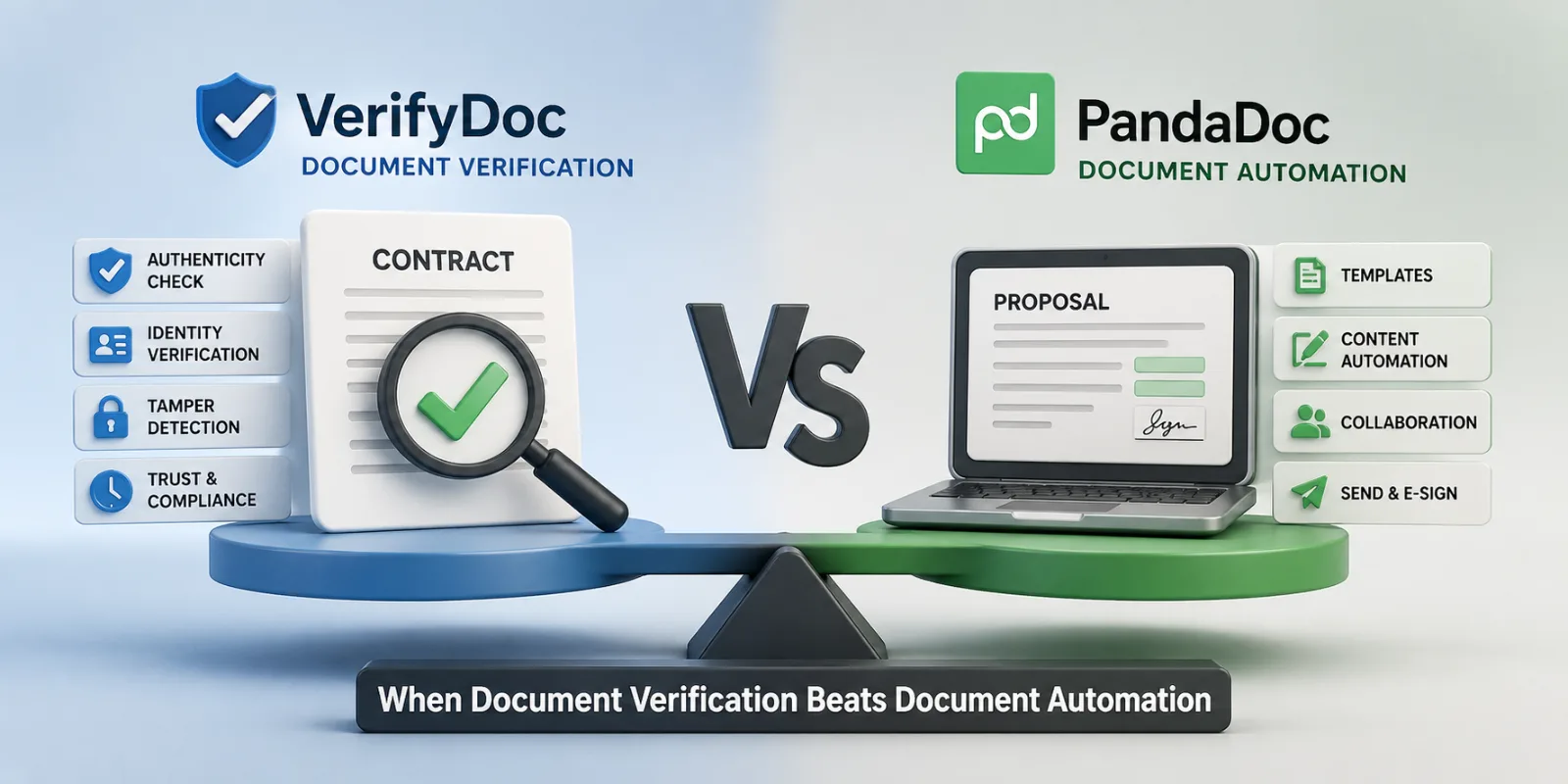
This is precisely what VerifyDoc.ai is built to do. Every document you sign and issue carries a QR-backed Certificate of Authenticity and a hosted proof page: a bank, a court, an embassy, or a counterparty can scan the code and confirm in seconds that the document is genuine, unaltered, and issued by you — no account, no special software, no phone call to your registrar. The verification record stays attached to the document even after it is forwarded, printed, or archived, which is exactly the procedure to verify that the Evidence Act rewards.
In other words: Nigerian law already makes your e-signature binding. VerifyDoc.ai makes it provable — so if the day ever comes when someone disputes it, you are not arguing from a bare PDF. See how it works.
What this means for your business — a practical checklist
If you sign or issue documents in Nigeria, use this as a quick readiness check.
Treat e-signatures as the default for contracts, NDAs, employment and offer letters, loan agreements, invoices, and corporate documents — they are binding and admissible. Keep wet-ink for the excluded categories — wills, birth and death certificates, and family-law documents. Do not rely on a bare typed name or scanned signature for anything valuable; it is legal, but it gives you nothing to prove with.
Capture a verification trail for every meaningful document — who, when, and proof of integrity — and make it independently checkable by the recipient. Issue, do not just send: the party that issues a document is the one who can make it verifiable at source, so build that into your process now, before a dispute forces the question. And when in doubt on a regulated document, take legal advice on any extra formalities your sector requires.
Get those right and your e-signatures are not just compliant with Nigerian law — they are an asset you can stand behind.
Make your Nigerian documents binding and provable
Nigerian law already puts e-signatures on equal footing with ink. VerifyDoc.ai gives every document you sign a QR-backed Certificate of Authenticity and a hosted proof page, so anyone — a court, a bank, an embassy, a counterparty — can verify it in seconds. Start free or see how it works.
This article is for general information and does not constitute legal advice. Nigerian law and sector-specific requirements change; consult a qualified Nigerian legal practitioner for advice on your specific documents and circumstances.