Document fraud in Nigeria has scaled in step with the country's digital economy — and artificial intelligence has lowered the cost of forging a convincing document to almost nothing. Nigerian financial institutions lost ₦52.26 billion to fraud in 2024; identity-document fraud across Africa rose sharply as AI tools spread; and the Federal Government found tens of thousands of Nigerians holding fake foreign degrees.
This page pulls the most recent, source-backed data into one place, then explains the structural shift it points to: trust is moving from the paper to the proof.
Key statistics at a glance
The most recent source-backed figures on Nigerian and Africa-wide fraud, with each number attributed to its originating body and period.
| Metric | Figure | Source (period) |
|---|
| Lost to fraud by Nigerian financial institutions | ₦52.26 billion | NIBSS (2024) |
|---|
| Up from, the prior year | ₦17.67 billion | NIBSS (2023) |
|---|
| Total fraud attempted | ₦86.4 billion | NIBSS (2024) |
|---|
| Rise in attempted fraud, year on year | +338% | NIBSS (2023 to 2024) |
|---|
| Reported fraud cases | 70,111 (down 31% from 101,624 in 2020) | NIBSS (2024) |
|---|
| Share of Nigeria's fraud cases in Lagos | about 57% | NIBSS (Q1 2024) |
|---|
| Lost via fake or static-image BVN enrolments | about ₦329 million | NIBSS (2024) |
|---|
| Identity checks analysed across Africa | 110 million+ | Smile ID (2024) |
|---|
| Rise in document fraud across Africa | +125% (H2 2024) | Smile ID |
|---|
| Africa's biometric fintech fraud that is AI-generated | 69% | Smile ID (2026 report) |
|---|
| Deepfake-related fraud incidents in Africa | sevenfold increase (Q2 to Q4 2024) | Smile ID |
|---|
| Nigerians found with fake foreign degrees | about 21,600 (Benin) + 1,105 (Togo), 2019 to 2023 | Federal Ministry of Education |
|---|
Financial and banking document fraud
The clearest data comes from the Nigeria Inter-Bank Settlement System (NIBSS), whose industry fraud desk compiles reports across banks, fintechs, and payment providers.
Nigerian financial institutions lost ₦52.26 billion to fraud in 2024 — roughly triple the ₦17.67 billion lost in 2023, and up from ₦11.61 billion in 2020. Fraudsters attempted to steal around ₦86.4 billion in 2024, with attempted fraud rising 338% year on year, which NIBSS attributed to system vulnerabilities at some institutions.
The pattern is fewer but bigger: reported fraud cases fell 31%, from 101,624 in 2020 to 70,111 in 2024, even as the amount lost rose sharply over the same period. Fraud is consolidating into larger, more sophisticated hits. It is also geographically concentrated — Lagos accounted for roughly 57% of the country's fraud cases in the first quarter of 2024.
Crucially for document trust, a large share of this is document- and identity-enabled. NIBSS reported that around ₦329 million flowed through accounts opened using static images enrolled as live biometrics for Bank Verification Numbers, and roughly ₦400 million moved through accounts opened with stolen identities — in some cases those of senior citizens. The fake document and the fake identity are the entry point; the financial loss is the consequence.
Identity and KYC document fraud
The continent-wide picture from Smile ID — drawn from analysis of over 110 million identity-verification checks across Africa in 2024 — shows where document fraud is heading, with Nigeria and West Africa prominent in the data.
Document fraud rose around 125% in the second half of 2024, as fraudsters shifted tactics toward exploiting document-based KYC. Digital banks and microfinance institutions were the most targeted, with peak fraud rejection rates of roughly 35% and 30% respectively — precisely the fast-growing, document-reliant corners of Nigerian finance.
The AI shift is stark: deepfake-related fraud incidents in Africa rose roughly sevenfold from the second to the fourth quarter of 2024, and by Smile ID's 2026 report, about 69% of biometric fintech fraud in Africa was AI-generated. National IDs and driver's licences were among the most-targeted identity documents, reflecting their everyday use across formal and informal settings.
In Nigeria specifically, Smile ID's data showed NIN-based verification rising about 80% between late 2022 and late 2024 as adoption grew — alongside a rise in biometric verification rejections that signals more fraud attempts against those systems.
Academic and credential fraud
Credential fraud became a national story in 2024. Following a December 2023 investigation showing a degree could be obtained from a university in Benin Republic in roughly six weeks, the Federal Ministry of Education suspended the evaluation and accreditation of degree certificates from Benin and Togo with effect from 2 January 2024, and convened an inter-ministerial committee on degree-certificate milling.
The Minister of Education subsequently put the number of Nigerians holding fake foreign certificates from those two countries between 2019 and 2023 in the tens of thousands — about 21,600 from Benin and 1,105 from Togo — with the caveat that the true figure is likely higher. The NUC published lists of institutions under investigation, and the government signalled scrutiny could extend to credentials from other countries.
Beyond foreign degrees, the same forgery pressure applies to WAEC and NECO results, school testimonials, transcripts, and professional certificates — documents that decide admissions, jobs, and visas, and that have historically been easy to fake and slow to verify.
The common thread: AI has collapsed the cost of forgery
Across all three categories, the accelerant is the same. Generating a convincing fake — a doctored bank statement, a synthetic ID image, a fabricated certificate — once required skill and time. In 2026 it requires a prompt. That is why fraud losses can rise even as case counts fall: each attack is cheaper to produce, easier to scale, and harder to spot by eye. The traditional defences — a watermark, a signature, a familiar letterhead — were designed for a world where forgery was expensive. That world is gone.
Why the burden is shifting to issuers
Most anti-fraud spending in Nigeria is recipient-side: banks, employers, and universities trying to detect fakes after they arrive. That work is necessary, but it is an arms race against tools that improve every month.
The structural alternative is issuer-side verification — making a document confirmable at source the moment it is created, so a recipient can verify it in seconds instead of trying to spot a forgery. It is the model already proven in Nigeria: the CAC public search lets anyone confirm a company registration; WAEC Verify and NECO e-Verify let anyone authenticate national results. Each works because the issuer built a way to check at source. The documents that remain easy to forge are precisely the ones with no such mechanism — most school, corporate, financial, and professional documents.
What this means for Nigerian organisations
For any organisation that issues documents — a bank issuing statements, a school issuing results, a university issuing transcripts, an employer issuing letters — the data points to one conclusion: the documents you put your name on are a fraud target, and the only durable defence is to make them verifiable at source.
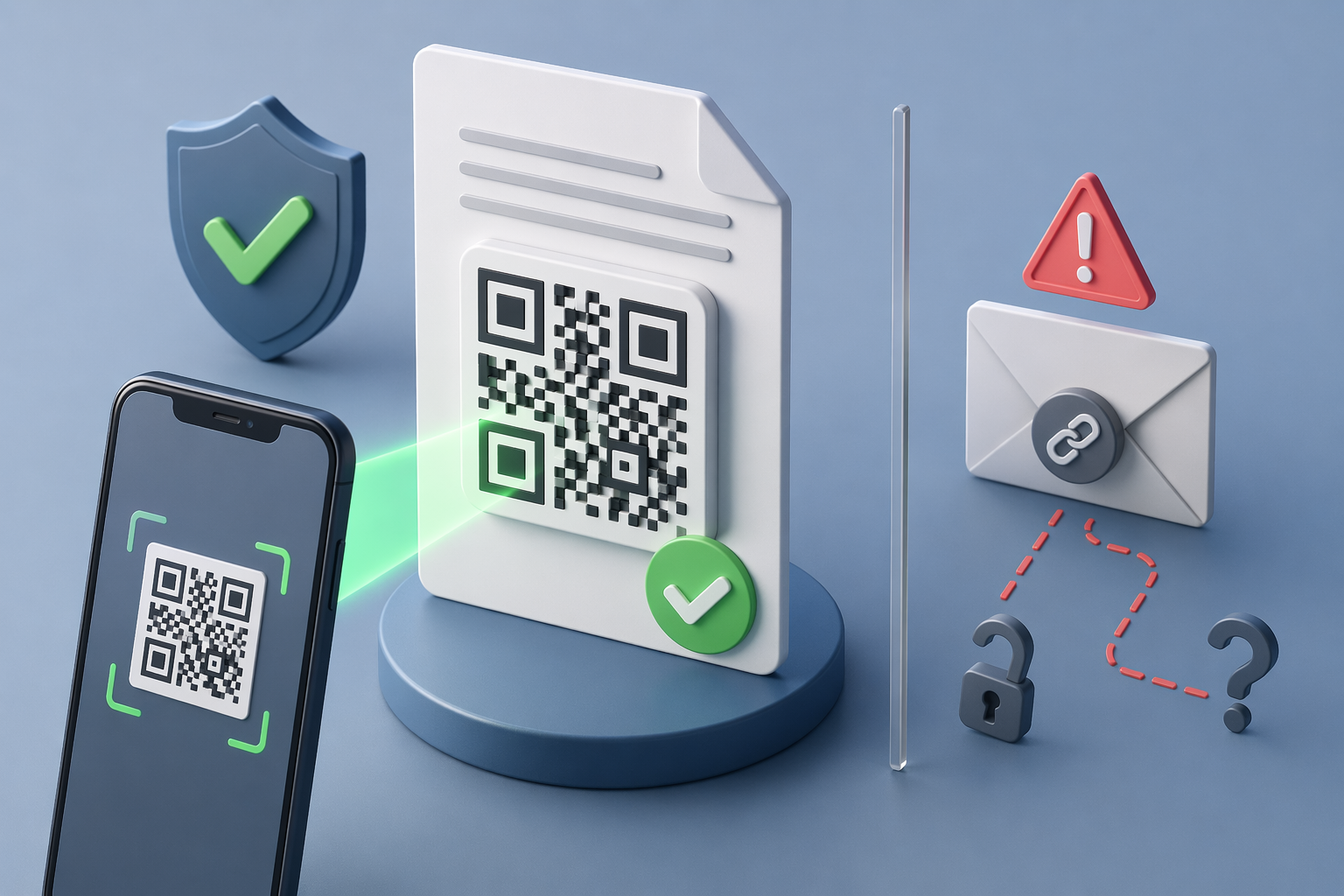
That is what VerifyDoc.ai provides: every document you issue carries a QR-backed Certificate of Authenticity and a hosted proof page, so any recipient can confirm in seconds that it is genuine, issued by you, and unaltered — no account, no phone call, no specialist tools. It does not replace KYC, NIBSS reporting, or NUC accreditation; it closes the specific gap that makes a document forgeable in the first place. As AI makes fakes cheaper, the organisations that can prove their documents are real will be the ones whose word still carries weight. See how it works.
Methodology and sources
The figures on this page are drawn from publicly reported data as of mid-2026 and are attributed to their originating bodies.
NIBSS, the Nigeria Inter-Bank Settlement System, publishes annual and quarterly industry fraud reports; the 2024 figures are used here. Smile ID's Digital Identity Fraud in Africa reports, in their 2025 and 2026 editions, are based on analysis of more than 110 million identity checks across Central, East, West, and Southern Africa. The Federal Ministry of Education and the NUC provided the ministerial briefings and directives on degree-certificate milling in 2024.
Figures cover different periods and scopes — Nigeria-specific for NIBSS and the Ministry of Education, and Africa-wide with Nigerian relevance for Smile ID — and are presented as reported. We update this page as new reports are published.
Make your documents impossible to fake
The data is clear: as AI makes forgery cheap, the documents you issue are a target. VerifyDoc.ai lets you issue documents with a QR-backed Certificate of Authenticity that anyone can verify in seconds — turning your credibility into something you can prove. Start free or see how it works.
Related reading: How to verify a CAC Certificate of Incorporation, How to spot a fake WAEC or NECO result, and Nigeria Data Protection Act 2023: a guide for document issuers.
This page compiles publicly reported third-party data for general information. Figures are attributed to their sources and periods; consult the original reports for full methodology.