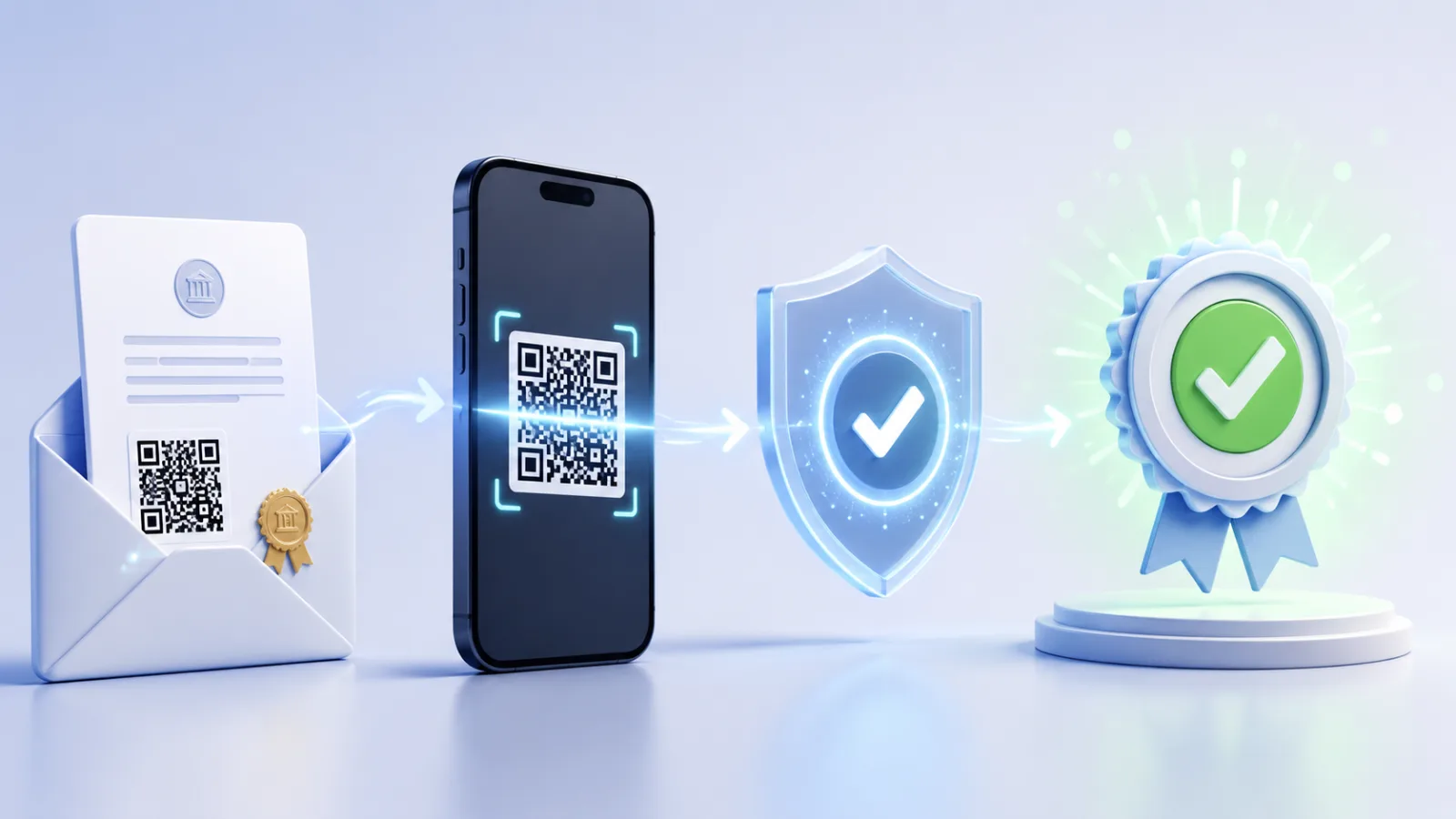
Yes — with issuer-side verification, the person checking a document needs no account, no login, no app, and no payment. They scan a QR code or open a proof-page link and instantly see whether the document is genuine, who issued it, and whether it has been altered. The issuer has an account; the verifier does not.
That sounds like a small convenience, but it is actually the difference between a document that is verifiable in theory and one that actually gets verified in practice.
The short answer
In a well-designed issuer-side system, verification effort sits with the issuer, once, not with every recipient, every time. The issuer signs up and issues documents that carry a verification mechanism. From then on, anyone who receives one of those documents can confirm it with nothing more than a phone camera or a web browser: no account to create, no login or password, no app to download, no fee to pay, and no special hardware — any smartphone or computer.
They scan the QR code, or click the proof link, the proof page loads, and in a couple of seconds they have their answer.
Why friction is the real enemy of verification
Most documents that could be verified never are — not because verification is impossible, but because it is inconvenient. Every extra step between a recipient and a confirmation causes drop-off: create an account to continue loses people; download our app loses more; log in to the portal loses more still; email us and wait two days loses almost everyone.
This is the gap that matters. A document can be technically verifiable and still fail in the real world if confirming it is painful enough that people shrug and accept it at face value — which, as our piece on what actually proves authenticity explains, is exactly how forged documents get through. Frictionless verification closes that gap by making the easy path and the safe path the same path.
Why no-account verification matters
Five things follow from removing the friction.
First, it actually gets done. Remove the account, the login, and the wait, and verification goes from something people mean to do to something people just do. Adoption is the whole game.
Second, it works for anyone, anywhere. Recipients are not always in your system or even your country — a landlord, an overseas employer, an embassy officer, an admissions office, someone on a basic phone with patchy data. Requiring accounts excludes exactly the people who most need to check. This matters especially across borders, where a transcript issued in one country may be verified by an institution in another.
Third, openness is a trust signal. A public proof page that anyone can reach says there is nothing to hide. A gated portal that demands registration before it will confirm anything invites the opposite suspicion. Open verifiability is, in itself, more credible.
Fourth, it is fast. Verification in seconds, not days, matters when a job offer, a tenancy, an admission, or a deal is waiting on it.
Fifth, it scales the right way. The issuer does the work once; an unlimited number of recipients verify with zero setup. The cost and effort do not grow with the number of people who need to check.
"No account" doesn't mean "no privacy"
Frictionless for the verifier should not mean careless with data. A well-built system confirms a document's authenticity without necessarily exposing all of its sensitive contents, and lets issuers apply access controls for confidential documents where appropriate. The goal is to make the proof open and effortless, while keeping control over what is shown — not to publish everyone's private information. Verifiability and privacy are designed to coexist.
Where account- or fee-based verification still makes sense
To be fair, not all verification should be account-free. Official registries and recipient-side verification services — checking a third party's degree through a national service, for example — legitimately use accounts and fees, because they are providing controlled, large-scale checking of documents they did not issue. That is a different job. The no-account advantage applies specifically to issuer-side verification: letting any recipient confirm a document you issued, at source, without obstacles. The two approaches complement each other.
How it works in practice
VerifyDoc.ai is built around frictionless verification. You issue documents with a QR-backed Certificate of Authenticity and a hosted proof page. Your recipients — wherever they are, on whatever device — scan or click and instantly confirm the document is genuine, issued by you, and unaltered. No account, no app, no login, no fee on their side. It stays verifiable whether the document is printed, emailed, forwarded, or archived.
A note on scope: this is issuer-side verification — confirming documents you issue. Checking a document someone else sends you is the recipient-side problem, and for identity specifically you would use KYC or identity-verification tools. No-account verification is about removing friction for the people confirming your documents, not a detector for inbound fakes.
Let anyone verify your documents in seconds
The best verification is the one people actually use. VerifyDoc.ai gives every document you issue a QR-backed Certificate of Authenticity and a proof page your recipients can check instantly — no account, no app, no login, no fee on their side. Start free or see how it works.
Related reading: How QR document verification works, What actually proves a document is authentic?, and Document verification FAQ.
This article is for general information.