A document is proven authentic when three things can be confirmed: who issued it (attribution), that it has not been changed since (integrity), and that anyone can check both independently, at source (verifiability). Notice what is not on that list — a logo, a letterhead, a signature, a watermark, an official-looking layout. Those are things you can see, and in 2026 anything you can see can be fabricated.
Authenticity is not a quality a document displays; it is a claim a recipient can verify. This piece explains the difference, and why it now matters more than ever.
The things we mistake for proof
Most proof of authenticity is really just familiarity. We trust a document because it looks the way we expect. But each of these signals fails under pressure.
| What we treat as proof | What it actually shows | Why it isn't proof |
|---|
| Company letterhead or logo | The document is styled like the issuer's | Logos and templates are trivially copied — and AI can reproduce them perfectly |
|---|
| A signature on the page | Someone, at some point, made a mark | A signature image can be lifted, scanned, or pasted; it isn't bound to the content |
|---|
| A watermark | A visual overlay was added | Watermarks are copyable and don't confirm origin or integrity |
|---|
| A stamp or embossed seal | A physical mark was applied | Stamps and seals are replicable; on a scan they're just an image |
|---|
| Security paper or holograms | The physical copy had features | Irrelevant once a document is a PDF — and even physical features get counterfeited |
|---|
| An official-looking PDF | Someone formatted it well | Appearance is free to fabricate; a perfect-looking PDF proves nothing |
|---|
| An email from a plausible address | A message arrived | Addresses are spoofable; business email compromise relies on exactly this |
|---|
Each of these answers the question: does this look right? None answers: is this real, and has it changed?
Why appearance stopped being proof
For most of history, forgery was expensive. Producing a convincing fake certificate or statement took skill, equipment, and time, so a document that looked right probably was right. Appearance was a reasonable proxy for authenticity.
AI ended that. As our document fraud statistics show, digital document forgery has overtaken physical counterfeiting for the first time, and the cost of producing a flawless fake has collapsed from specialist skill to a prompt. When anyone can generate a perfect-looking document in seconds, looking perfect is no longer evidence of anything. The entire model of recognise-by-appearance is obsolete.
What actually proves authenticity: three things, together
Real proof of authenticity rests on three properties — and you need all three. The next three sections take each in turn. Supporting them are provenance (the document's documented history), a trusted timestamp (when it was issued), and non-repudiation (the issuer cannot later deny it). But attribution, integrity, and at-source verifiability are the core.
Attribution — who really issued it
Not this looks like it is from the university, but a confirmable link back to the actual issuer. Attribution answers who stands behind this document, in a way that can be checked against the issuer's own record, not inferred from a logo.
Integrity — that nothing has changed
A genuine document that has been altered — a changed grade, an edited figure, a moved date — is no longer authentic. Integrity means any change since issuance is detectable. This is the role of tamper-evidence: you may not be able to stop someone editing a copy, but you can make the edit show.
Verifiability at source — anyone can check, independently
This is the decisive one. A recipient must be able to confirm attribution and integrity themselves, directly against the issuer, without trusting the document's appearance or the word of whoever sent it. This is the difference between claiming authenticity and proving it.
A simple test
Here is a way to judge any authenticity measure. Ask: could a complete stranger, who does not trust me and cannot inspect the original, confirm this document is genuine and unchanged — on their own, in seconds?
A letterhead fails that test. A pasted signature fails it. A watermark fails it. A QR code that links to the issuer's live proof page passes it — because the stranger is not trusting the document's looks or your say-so; they are checking it at source.
What this means in practice
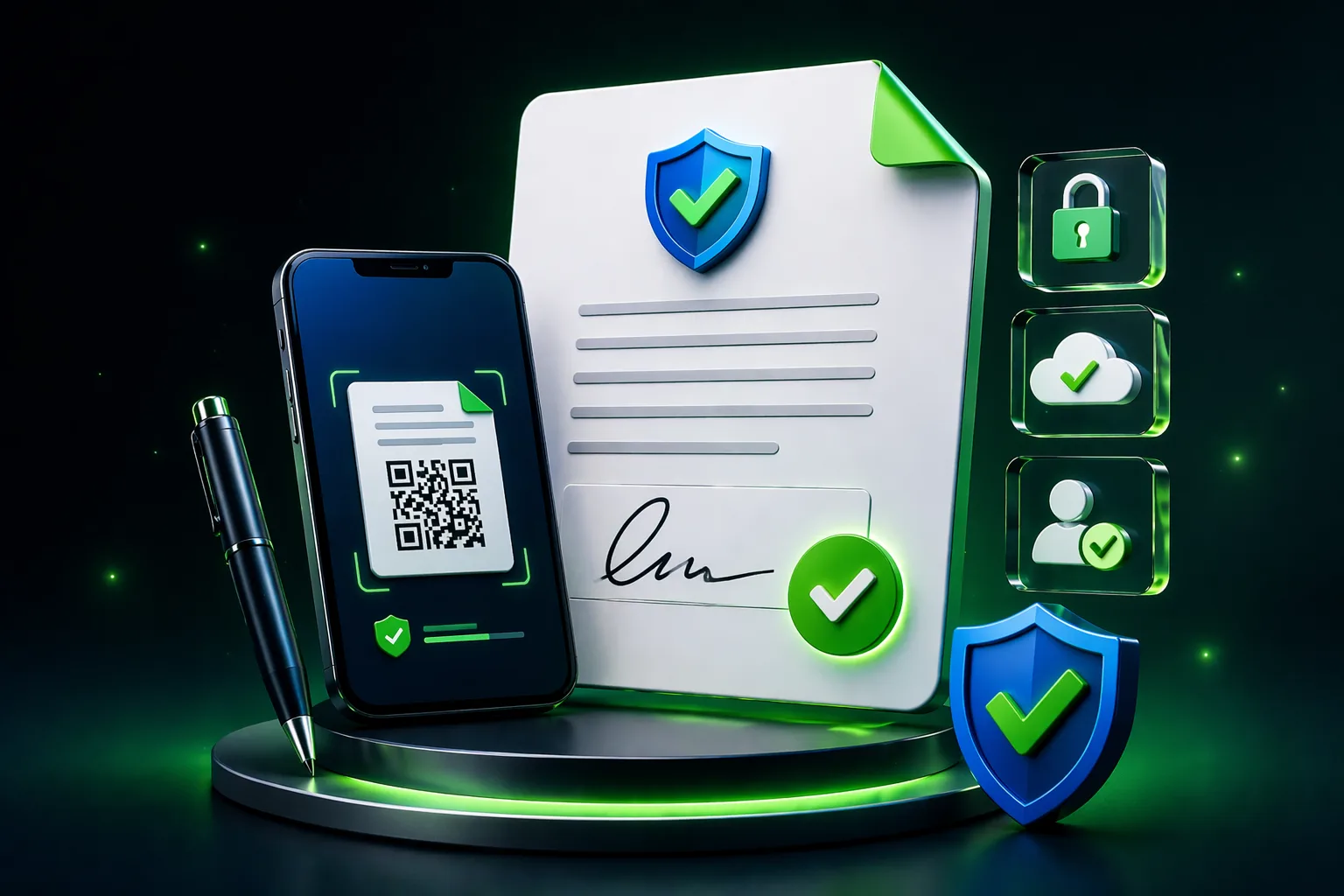
The practical answer is issuer-side verification: the organisation issuing a document builds the proof in, so every recipient can verify it at source. That is precisely what VerifyDoc.ai does — each document carries a Certificate of Authenticity (attribution), is tamper-evident (integrity), and links to a QR-backed proof page anyone can check (verifiability). The three properties that actually prove authenticity, built into the document at the moment it is issued.
A note on scope: this is about the documents you issue. Confirming a document someone else sends you is the recipient-side problem — for which you would verify at the issuer's source, use official registries, or, for identity, use KYC and identity-verification tools. Verifiable issuance closes the gap that makes your own documents forgeable; it is not a detector for inbound fakes.
Where traditional methods still fit
None of this makes signatures, notarisation, or Apostilles worthless — they prove different things and still matter. A signature evidences intent to agree. Notarisation attests that a named person signed at a given time. An Apostille lets a public document be recognised across borders. What none of them does, by itself, is let any future recipient independently confirm a document is genuine and unaltered at source. Verifiable issuance adds that missing layer; it complements these formalities rather than replacing them, and where the law requires them, they are still required.
Build the proof into your documents
If appearance no longer proves anything, the answer is to make your documents checkable. VerifyDoc.ai issues documents with a QR-backed Certificate of Authenticity and a proof page — so anyone, anywhere, can confirm who issued it, when, and that nothing has changed. Start free or see how it works.
Related reading: Document fraud statistics 2026, Verifiable documents glossary, and How to issue a Certificate of Authenticity.
This article is for general information and does not constitute legal advice.