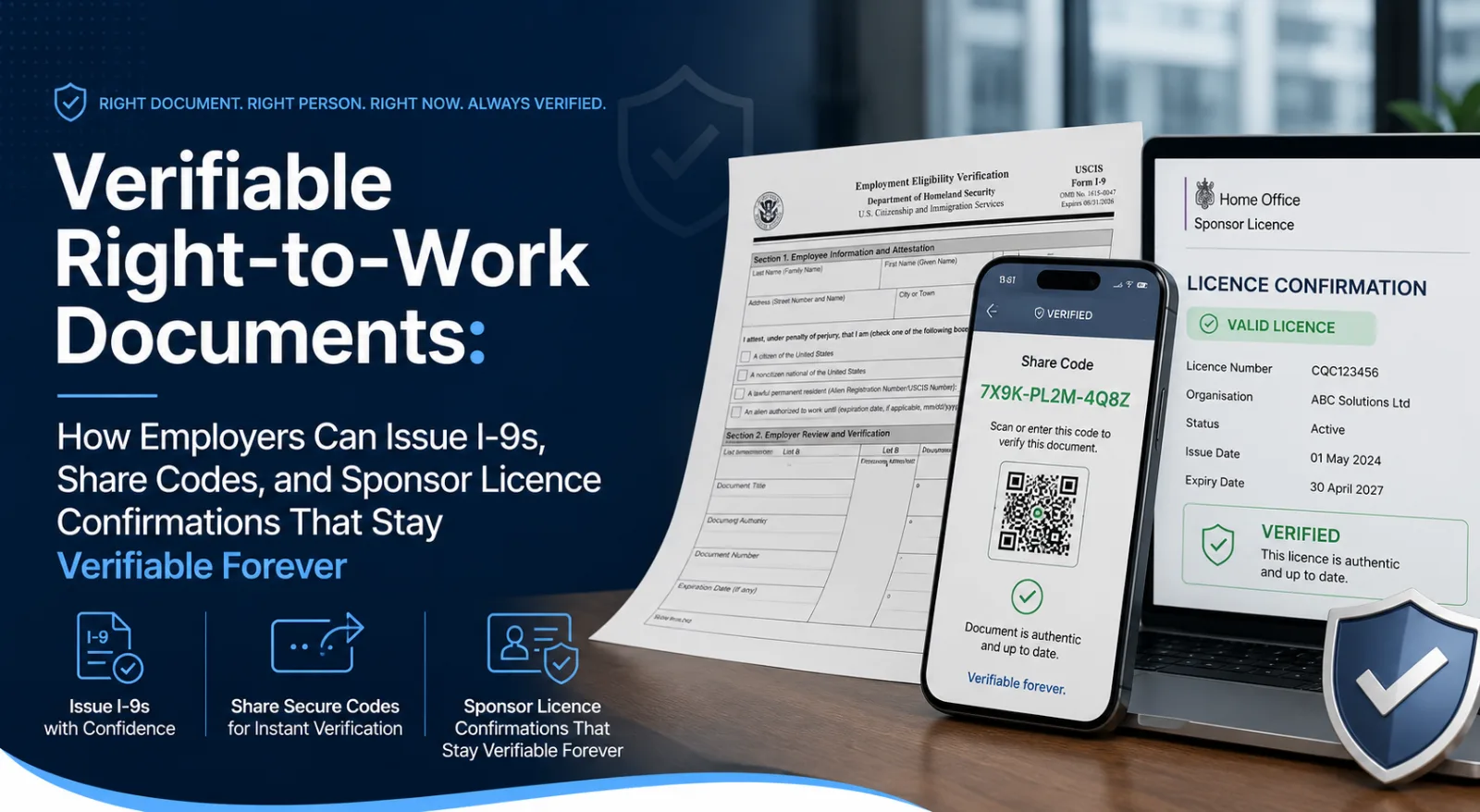
Insurers and brokers can issue policies, certificates of insurance, and proof-of-coverage letters that any recipient can verify at source — confirming the document genuinely came from the insurer or broker and hasn't been altered. That makes forged and altered certificates fail, lets the lenders, landlords, clients, and regulators who rely on these documents self-verify in seconds, and speeds acceptance for the policyholder. One honest caveat up front, which we return to: a verifiable document confirms its authenticity, not that the underlying policy is still in force. This guide explains the issuer side of insurance-document verification.
The issuer's opportunity: fake and altered certificates of insurance are a leading insurance-document fraud pattern. Verifiable issuance fixes it at the source — your genuine documents become confirmable, and forgeries in your name stop working. This is general information, not insurance or legal advice.
The problem: insurance documents are easy to fake, hard to trust
Certificates of insurance and proof-of-coverage letters are relied on by people making real decisions — a general contractor approving a subcontractor, a landlord approving a tenant, a lender releasing funds, a regulator checking compliance. Yet these documents are routinely forged or altered: a convincing fake certificate can be produced in minutes, and as we cover in the guide to verifying a certificate of insurance, a vendor-submitted or doctored COI is the most common pattern, sometimes turning an uninsured incident into a six-figure claim. The recipient usually has no quick way to tell — so they either take it on trust or call your office to verify.
What verifiable issuance does
Issue the document with verification built in. A policy, certificate, or proof-of-coverage letter carries a QR-backed verification layer and a proof page; the recipient scans it with their phone — no app, no account — and instantly confirms that it genuinely came from the insurer or broker and hasn't been altered. Any change to limits, dates, named insured, or additional-insured wording breaks verification.
What insurers and brokers gain
Forgeries and alterations fail: a fake document in your name has nothing that verifies, and tamper-evidence catches a genuine document that's been edited — changed limits, extended dates, an added additional-insured line.
You field fewer verification requests. When recipients can confirm a certificate at source themselves, they stop calling your team to verify, which removes a real, recurring administrative load from brokers and insurers who currently field verification requests by phone and email.
Acceptance is faster for policyholders: a certificate the recipient can confirm instantly is accepted faster — which helps your policyholder win the contract, lease, or loan that depended on it. That's a better client experience, attributable to you.
It builds brand trust and differentiation, since issuing verifiable documents signals security and professionalism, and distinguishes a broker or carrier in a market where document fraud is a known problem. And it gives you an issuance record — a clear record of what was issued and when, supporting audit and dispute resolution.
The honest limit: authenticity is not in-force status
This is the most important point, and it's the same one that governs the verifier side. A verifiable insurance document proves it was genuinely issued and is unaltered — its authenticity and integrity. It does not prove the underlying policy is still in force, because a policy can be cancelled, lapse, or be non-renewed after the document was issued, and that change won't appear on a document issued earlier.
So verifiable issuance removes the forgery-and-alteration problem, but a recipient who needs to know coverage is current should still confirm in-force status against the insurer's live records. Verifiable issuance proves the document; it doesn't replace coverage confirmation — and being clear about that is part of doing it honestly.
Where it fits
Verifiable issuance is the document layer. It sits alongside your policy-administration, claims, and any certificate-tracking systems, making the documents those systems produce confirmable at source. It complements them; it doesn't replace policy administration, claims processing, or coverage verification.
How VerifyDoc.ai fits
VerifyDoc.ai lets insurers and brokers issue verifiable insurance documents — policies, certificates of insurance, proof-of-coverage letters, and endorsements — each carrying a QR-backed Certificate of Authenticity and a proof page, so any recipient can confirm at source, on any phone, that the document is genuine and unaltered.
To be clear on scope: VerifyDoc.ai provides the verifiable-document layer. It confirms a document's authenticity and integrity — that it genuinely came from you and is unchanged — but it does not confirm a policy is in force, and it is not a policy-administration, claims, coverage-verification, or COI-tracking system. For the recipient's side of this, see how to verify a certificate of insurance. See how it works.
Issue insurance documents that verify themselves
VerifyDoc.ai lets your agency or carrier issue policies, certificates, and proof-of-coverage letters with a QR-backed Certificate of Authenticity — so recipients confirm at source that they're genuine and unaltered, forgeries in your name fail, and verification calls drop. Start free or see how it works.
Related reading: How to verify a certificate of insurance (proof of coverage), How to issue a Certificate of Authenticity, and Can you verify a document without an account?.
This article is for general information and does not constitute insurance or legal advice. A verifiable document confirms authenticity, not that a policy is in force; confirm current coverage with the insurer.