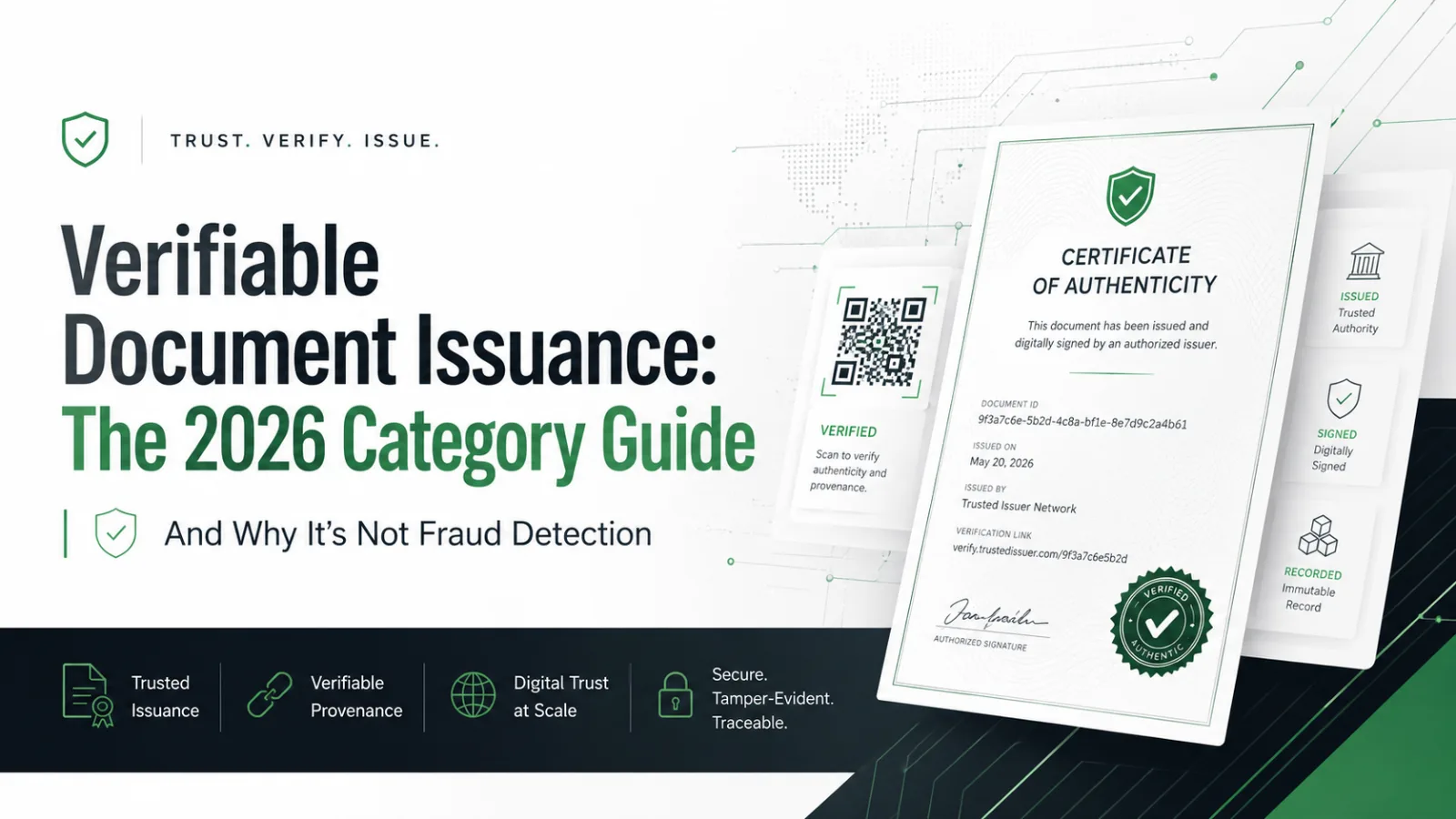
For most of the last decade, "document verification" was a single phrase that hid two completely different products inside it. One looks at documents that have already been produced and tries to work out whether they're real. The other rebuilds documents from the moment of issuance so that "is this real?" can be answered in seconds by anyone with a phone camera, without trusting anyone's analysis.
These are not two flavours of the same product. They are two different categories of software, sold to two different teams, solving two different sides of the same underlying problem.
The category that gets discussed less — partly because it's newer, partly because the language for it hasn't settled — is verifiable document issuance. It's the category VerifyDoc.ai sits in. It's the category every major regulator, from the EU through the FDA through HIPAA's HHS, is now actively pushing institutions toward. And it's the one that, by the end of this decade, will quietly replace most of what we currently call "document verification" — because verification becomes trivial when the document was built to be verified in the first place.
This guide is the definitive 2026 reference for the verifiable issuance category. It covers what verifiable issuance actually is, the four architectural components that make a document verifiable, the standards underneath (PAdES, W3C Verifiable Credentials, OpenID4VP), the regulations driving adoption, who the issuers are, and — crucially — what verifiable issuance is not, including why it's structurally different from fraud detection.
If you've landed here trying to understand whether your organisation needs to issue verifiable documents or detect fake ones, the answer is usually "both," but for different document flows. This article explains why.
The 90-second definition
A verifiable document is one that carries, embedded in itself, cryptographic proof of three things: who issued it, what its contents were at the moment of issuance, and whether it is currently valid. Anyone receiving it can confirm all three in seconds, without contacting the issuer, without installing software, and without trusting any third-party analysis.
Verifiable document issuance is the act of producing such a document. The work happens at the source — the HR team, the registrar, the regulator, the lender, the carrier, the brand owner — at the moment the document is created. Once issued, the document carries its own proof for the rest of its life.
Concretely, a verifiably-issued document in 2026 typically combines:
A cryptographic signature using a standard like PAdES (PDF Advanced Electronic Signatures, ETSI EN 319 142) or W3C Verifiable Credentials, binding the document's content to the issuer's identity.
A QR code printed or embedded in the document, linking to a verification page on the issuer's own domain.
A hosted proof page — a public, issuer-controlled web endpoint that any recipient can load to see authenticity, integrity, and current status.
A revocation channel that lets the issuer mark the document invalid if circumstances change (for example, if a credential is rescinded or a permit expires early).
Long-term verifiability (PAdES-LTV) so verification continues to work decades after issuance, even if the issuer's signing certificate has since expired.
This combination is what allows verification to happen in two seconds, on any phone, anywhere in the world, without anyone calling the issuer or running an analysis. The verifier scans, sees the issuer's branded confirmation page, and moves on.
The architectural shift: from "detect after receipt" to "prove at source"
The traditional approach to document trust assumed that documents would be produced in roughly the same way they had always been produced — letterhead, signature, stamp, PDF export — and that the recipient would need to figure out whether what arrived was real. This produced an entire industry of verification: registrars phoning back to confirm transcripts, banks faxing employment-verification responses, HR teams answering "does this person work here?" calls all day, and an emerging crop of AI-based fraud detection tools designed to score documents for forgery indicators.
That assumption broke in 2024 and 2025. Generative AI made high-quality document fabrication available to anyone with a $20 monthly subscription, and the volume of forged pay stubs, bank statements, transcripts, W-2s, invoices, and permits rose by an order of magnitude. Inscribe's 2026 Document Fraud Report found that AI-generated document fraud rose roughly fivefold across 2025, and 85.56% of surveyed fraud and risk leaders now cite bank statements and income documents as their single most vulnerable category. Point Predictive's 2026 Auto Lending Fraud Trends Report put auto lending fraud exposure at $10.4 billion, much of it driven by fabricated income and employment documentation.
Two responses emerged. The first was to scale up detection — more sophisticated AI models analysing incoming documents for forgery indicators, font inconsistencies, mathematical errors, and AI-generation markers. This is a legitimate and useful capability, and it's the category that companies like verifydoc.com and Inscribe operate in. The second response — the one this guide is about — was to rebuild documents at the moment of issuance so they carry their own proof of authenticity. No detection required.
Both responses solve the same underlying problem. They just attack it from opposite ends. Detection works on documents that were never designed to be verifiable; issuance works by ensuring documents are verifiable to begin with. In any given organisation in 2026, both are usually needed for different document flows — and we'll come back to that.
The four components of a verifiable document
A verifiable document isn't just a PDF with a QR code on it. The QR code is the user-facing part, but underneath sit four architectural components that together make verification cryptographically meaningful rather than cosmetic.
Component 1: A cryptographic signature tied to the issuer's identity
The document is signed at issuance using a private key controlled by the issuer. The signature binds the exact bytes of the document at the moment of signing to the issuer's public identity. Two standards dominate:
PAdES (PDF Advanced Electronic Signatures), defined in ETSI EN 319 142, is the standard for cryptographically-signed PDFs. PAdES has multiple profiles — B-B (basic), B-T (with trusted timestamp), B-LT (with revocation data), and B-LTA (with archival validation) — each adding additional verifiability over longer time horizons. For documents that need to be verifiable decades after issuance — diplomas, deeds, certificates of authenticity, regulatory permits — PAdES-LTA is the appropriate profile.
W3C Verifiable Credentials, defined in the Verifiable Credentials Data Model 2.0 (W3C Recommendation), are a JSON or JWT format for credentials that can be cryptographically signed by an issuer, held by a subject, and presented to a verifier. Verifiable Credentials are the credential format underneath the EU Digital Identity Wallet (EUDI Wallet) and most modern verifiable credential infrastructure.
The two formats coexist: PAdES is appropriate when the document needs to remain in PDF form (legal contracts, healthcare records, regulatory filings), and Verifiable Credentials are appropriate when the credential will be held in a digital wallet and presented selectively (driver's licences, academic credentials, professional qualifications).
Component 2: A QR code linking to a hosted proof page
Cryptographic signatures are mathematically rigorous and operationally invisible to humans. A bank loan officer doesn't open a PDF in Acrobat and inspect the certificate chain. They scan a QR code and read a sentence.
The QR code on a verifiable document encodes a URL to a hosted proof page — typically on a subdomain of the issuer's own site (verify.[issuer].com or similar). The verifier scans, the page loads, and within two seconds shows: who issued the document, when, what the document is, whether it has been tampered with since issuance, and whether it is currently valid.
The hosted proof page is the human-facing surface of verifiable issuance. It's what makes the entire architecture usable by ordinary people in ordinary contexts: a landlord on their phone, a regulator on a tablet, an admissions officer at their desk. We've covered the hosted proof page in depth in What Is a Hosted Proof Page?.
Component 3: A revocation channel
Documents don't stay valid forever. Credentials get rescinded. Permits get cancelled. Employees leave companies and their employment verification letters should no longer be relied upon as current. A verifiable document architecture without a revocation channel is one where the issuer permanently loses control over the document the moment it's issued — which is unacceptable in most regulated contexts.
A proper revocation channel lets the issuer update the document's status at any time. When the recipient scans the QR code, the verification page reflects the current status: valid, revoked, or expired. The cryptographic signature remains intact (the document is still cryptographically the document the issuer produced), but the status indicates whether it should be relied upon now.
Revocation is what distinguishes verifiable issuance from one-shot cryptographic signing. PGP-signed PDFs have existed for decades; what they lack is the operational layer that lets an issuer say "this credential is no longer valid" without requiring the verifier to chase down the issuer.
Component 4: Long-term verifiability
A document issued in 2026 may need to be verified in 2046. The signing certificate that produced the cryptographic signature will, by then, have long expired. The certificate authority that issued the signing certificate may no longer exist. Naive cryptographic verification will fail.
PAdES-LTA (Long-Term Archival) solves this by embedding, at signing time, all the validation material the verifier will need in the future: the full certificate chain, revocation status at the time of signing, and trusted timestamps. The document carries its own future-proofing. Twenty years later, the verifier can confirm not only that the signature is mathematically valid but that the certificate chain was valid at the moment of signing — which is the claim that actually matters.
For Verifiable Credentials, equivalent long-term verifiability is achieved through anchoring to verifiable data registries (often public blockchains or decentralised identifier networks) that preserve issuer key state independently of the issuer's own infrastructure.
This component matters disproportionately for high-stakes documents: property deeds, university transcripts, professional licences, lifetime achievement certificates, regulatory approvals. Documents that need to be verifiable across decades, not just months.
Issuer-side vs recipient-side: the category split
The four components above describe what makes a document verifiable from the issuer's perspective. They presuppose an issuer who wants their documents to be verifiable.
But in 2026, only a small minority of all the documents circulating in the economy are issued this way. The vast majority of pay stubs, bank statements, transcripts, invoices, and certificates are still produced as ordinary unsigned PDFs by issuers who haven't yet adopted verifiable issuance. For documents in that majority, the verifier has no built-in proof to work with — they have to assess authenticity after the fact, by analysing the document for forgery indicators.
This is the recipient-side category: fraud detection. It takes documents that arrived without verifiable issuance and tries to determine, through analysis, whether they're real. Mature detection tools look at hundreds of signals — font kerning, mathematical relationships between fields, AI-generation artefacts, metadata anomalies, comparison against known-good templates — and produce an authenticity score within seconds.
The two categories — issuer-side verifiable issuance and recipient-side detection — are structurally different products solving different sides of the same underlying problem:
Verifiable issuance is for organisations that produce documents and want recipients to verify them in one scan, with no analysis required. The buyer is the issuer: HR, registrar, regulator, lender (for outbound statements), carrier (for COIs), brand owner (for certificates of authenticity).
Fraud detection is for organisations that receive documents from external parties and need to confirm authenticity without cooperation from the issuer. The buyer is the recipient: lenders evaluating loan applications, landlords screening tenants, HR teams running background checks, underwriters processing claims.
Most organisations need both. A bank that issues customer statements (issuance) also receives pay stubs from loan applicants (detection). A property management company that issues lease agreements (issuance) also receives applicant bank statements (detection). An HR team that issues offer letters (issuance) also receives candidate diplomas (detection).
The categories are complementary, not competitive. They sit on opposite ends of the same workflow. We've covered this distinction in more depth at VerifyDoc.ai vs verifydoc.com: What's the Difference? and QR Code Document Verification: How It Works and Why It Beats Email Links.
Who issues verifiable documents
Verifiable issuance applies anywhere an organisation produces a document that downstream parties will need to verify. In practice, that's a broader set of organisations than most people initially think.
HR and payroll teams issue offer letters, employment verification letters, pay stubs, experience certificates, and pension statements — documents that get routinely re-verified by lenders, landlords, immigration officers, and background-check companies. Verifiable issuance lets these teams stop fielding verification calls. Covered in detail at Verifiable Pay Stubs and Verifiable Employment Verification Letters.
Banks and financial institutions issue account statements, loan agreements, bank guarantees, KYC reference letters, and proof of funds — documents that other banks, landlords, mortgage lenders, and visa officers regularly need to verify. Issuance reduces the inbound verification workload that banks currently absorb at significant operational cost.
Universities, colleges, and training providers issue diplomas, transcripts, course-completion certificates, professional credentials, and continuing-education records. These are some of the highest-stakes verifiable issuance use cases: a forged diploma can cost an employer or licensing body real money, and a verifiable diploma resolves the question in two seconds. Covered at How to Verify a Degree Certificate or Transcript with QR Codes.
Government bodies and regulators issue permits, licences, identity documents, immigration approvals, tax clearances, and food-safety certificates — documents that field inspectors, customs officers, and partner agencies routinely need to verify. Covered at Government Permits and Licences.
Healthcare providers issue discharge summaries, lab reports, referrals, prescriptions, and insurance authorisations — documents that travel between providers, insurers, and patients, and that are now routinely fabricated for insurance fraud and prescription abuse. Covered at Healthcare Records on the Move.
Insurance carriers and brokers issue policies, certificates of insurance (COIs), proof-of-coverage letters, and claim settlement notices. COIs in particular are an industry-wide pain point: general contractors, property managers, and procurement teams all spend significant time validating COIs by phone because forged COIs are common.
Consumer brands and CPG companies issue certificates of authenticity, distributor authorisation letters, warranty cards, and product registration confirmations. Verifiable issuance protects against grey-market goods, counterfeit channel documentation, and warranty fraud.
Legal firms and notaries issue engagement letters, notarised affidavits, powers of attorney, and settlement documents — documents whose authenticity is the entire point of the transaction.
Real estate agencies and land registries issue property deeds, lease agreements, tenancy references, valuation reports, and title confirmations.
The common thread: any organisation whose documents travel to downstream parties who need to verify them is, structurally, a candidate for verifiable issuance. The decision is no longer whether to verify documents — it's whether the issuer takes responsibility for verifiability at source, or whether every recipient has to perform their own detection.
The regulations driving adoption
Verifiable issuance is being pulled into the mainstream by a parallel set of regulatory shifts. None of them mention "verifiable issuance" by name, but each one effectively requires it for the document flows it covers.
eIDAS 2.0 (Regulation EU 2024/1183) mandates that every EU Member State make at least one European Digital Identity Wallet (EUDI Wallet) available to its citizens by 24 December 2026, and that designated relying parties accept wallet-presented credentials by 6 December 2027. The EUDI Wallet is a Verifiable Credentials infrastructure. Any organisation issuing credentials to EU residents — universities, regulators, professional bodies, employers — will need to issue them in wallet-compatible form. Covered in depth at eIDAS 2.0 and the EUDI Wallet.
HIPAA (45 CFR Parts 160, 162, and 164) requires healthcare entities to maintain integrity and authenticity of electronic protected health information (ePHI). HIPAA doesn't mandate verifiable issuance specifically, but its integrity requirements are most efficiently satisfied by cryptographic signing at issuance — the alternative is auditing and detection workflows that scale poorly. Covered at HIPAA and E-Signatures: A 2026 Compliance Guide.
21 CFR Part 11 governs electronic records and signatures in FDA-regulated industries — pharmaceuticals, medical devices, clinical trials. The regulation's requirements around record integrity, signature non-repudiation, and audit trails align directly with the architectural components of verifiable issuance.
FCA and PRA rules in UK financial services impose record-integrity and customer-protection requirements that, increasingly, are most efficiently satisfied by verifiable issuance for outbound customer documents.
GDPR Article 5(1)(f) requires personal data to be processed with appropriate security including protection against unauthorised or unlawful processing. For documents containing personal data, cryptographic signing at issuance is a structurally cleaner answer than ongoing detection of tampered copies.
SOX Section 404 and equivalent corporate reporting frameworks require integrity controls over financial documents. Verifiably-issued financial statements satisfy integrity-control requirements more cleanly than unsigned PDFs supplemented by audit trails.
The shorter version: there is no major regulatory framework in 2026 that pushes organisations away from verifiable issuance, and several that effectively require it.
What verifiable issuance is not
A pillar guide is only useful if it draws the boundary as carefully as it defines the interior. Several adjacent capabilities get confused with verifiable issuance and shouldn't be.
Verifiable issuance is not fraud detection. Detection examines documents that have already been produced, looking for indicators of forgery. Issuance produces documents that are already verifiable. They sit on opposite ends of the same workflow. An organisation that does only detection is on the back foot for every document; an organisation that does only issuance still needs detection for incoming documents from issuers who haven't yet adopted verifiability.
Verifiable issuance is not the same as e-signature. A standard e-signature (under ESIGN, UETA, or eIDAS) is legally binding but not necessarily verifiable by recipients without specialist tools. A verifiable e-signature, by contrast, is one a recipient can confirm in seconds on their phone. Most major e-signature platforms produce legally binding signatures that fall short of practical verifiability. Covered at What Is a Verifiable E-Signature?.
Verifiable issuance is not identity verification. Identity verification (Onfido, Jumio, Persona) confirms that a person is who they claim to be — typically through document scanning, biometric matching, and liveness checks. Verifiable issuance confirms that a document is what its issuer says it is. The two are complementary: a verifiably-issued credential plus identity verification gives the strongest possible answer to "is this the right person presenting a real credential?"
Verifiable issuance is not blockchain anchoring alone. Several early verifiable-credentials projects assumed that anchoring document hashes to a public blockchain was, by itself, sufficient for verifiable issuance. It isn't. The hash anchoring proves a document existed at a certain time, but doesn't connect it to a verifiable issuer identity, doesn't support revocation, and doesn't produce the human-facing proof page that makes verification practical. Blockchain anchoring is sometimes a useful component of verifiable issuance infrastructure (particularly for long-term anchoring), but it is not the architecture.
Verifiable issuance is not document automation. Document automation tools (PandaDoc, DocuSign Gen, Conga) help organisations produce documents faster, with templates and merge fields. Verifiable issuance is about the integrity and authenticity properties of the resulting documents, regardless of how they were produced. The two are orthogonal — you can automate the production of verifiable documents, or you can manually produce them; either way, the verifiability properties are independent of the production workflow.
Verifiable issuance is not notarisation. Traditional notarisation involves an in-person notary witnessing a signature and applying a seal. Remote online notarisation (RON) digitises this with video and ID checks. Both are about confirming that a particular person signed a particular document at a particular time, in the presence of a witness with regulatory authority. Verifiable issuance, by contrast, is about making any document — notarised or not — cryptographically verifiable by recipients. They serve different purposes and frequently co-occur. Covered at QR Code Verification vs Legal Notarisation.
How VerifyDoc.ai fits into the category
VerifyDoc.ai is a verifiable document issuance platform. Organisations use it to issue documents — pay stubs, employment letters, certificates, contracts, healthcare records, regulatory permits, professional credentials, COIs, deeds — that carry the four architectural components described above: a cryptographic signature, a QR code linked to a hosted proof page on the issuer's own domain, a revocation channel, and long-term verifiability.
The platform is built around three deployment patterns:
Direct issuance from a workspace, where small and mid-sized teams produce verifiable documents directly in the VerifyDoc.ai workspace or through native Google Docs and Microsoft Word integrations. Suitable for HR teams, small banks, universities, and government bodies issuing tens to thousands of documents per month.
API-based issuance, where larger organisations embed verifiable issuance directly into their existing document workflows — payroll systems, HRIS platforms, loan origination systems, registrar software. The document is produced where it was always produced; the API adds the verifiability layer.
Bulk issuance, where organisations migrate historical document portfolios into verifiable form — universities issuing wallet-bound credentials for past graduates, regulators issuing verifiable versions of previously-issued permits, brands issuing verifiable certificates of authenticity for products already in market.
In all three patterns, the deliverable is the same: a document the recipient can verify in two seconds by scanning a QR code, with no account, no app, no email link, and no analysis required.
What VerifyDoc.ai does not do is fraud detection. We don't analyse incoming documents for signs of forgery; we don't score uploaded PDFs for AI-generation markers; we don't generate authenticity reports on documents we didn't issue. If that's the capability you need, you need a recipient-side detection tool — and verifydoc.com (the separate company at the .com TLD) operates in that category, along with Inscribe and several others. The two categories are complementary; many organisations use both.
- Frequently asked questions
Is verifiable issuance the same as a digital signature?
No. A digital signature (in the cryptographic sense) is one component of a verifiably-issued document, but verifiable issuance is the full architectural pattern: signature plus QR code plus hosted proof page plus revocation channel plus long-term verifiability. A document with only a cryptographic signature is signed but not verifiable in a practical sense — a recipient still has to open it in specialist software to confirm the signature. A verifiably-issued document collapses that into a two-second phone scan.
Does verifiable issuance work for paper documents?
Yes. The QR code prints. A document issued verifiably can be printed, photocopied, scanned, faxed, and re-printed, and the QR code still resolves to the verification page. Verification works on paper documents in 2026 the same way it works on PDFs — point a phone camera, see the result. This is one of the most overlooked properties of QR-based verifiable issuance: it bridges the digital and paper worlds in a way no other approach does.
Will verifiable issuance replace fraud detection?
Not entirely, and not soon. For documents that organisations issue themselves, verifiable issuance is structurally the right answer and will increasingly become the default. For documents received from external issuers who haven't yet adopted verifiable issuance, detection remains necessary. The mix shifts over time as more issuers move to verifiable issuance — detection's role narrows from "default approach for every document" to "fallback for documents from non-verifying issuers" — but the detection category doesn't disappear.
How long does verifiable issuance take to implement?
For a small or mid-sized organisation using a managed platform, hours to days. The signing infrastructure, QR code generation, hosted proof page, and revocation channel are provided by the platform; the organisation configures branding, document templates, and any required integrations. For larger organisations integrating with existing HRIS, payroll, registrar, or loan origination systems through an API, weeks to a few months depending on the complexity of the integration. Either way, dramatically faster than the multi-year programmes typically associated with credentialing infrastructure.
Does verifiable issuance require blockchain?
No. The cryptographic primitives that make verifiable issuance work — public-key signatures, hashing, trusted timestamps, certificate authorities — predate blockchain by decades and work without it. Some verifiable issuance architectures use blockchain or distributed ledger anchoring as one component (typically for long-term verifiability or registry decentralisation), but blockchain is not a required ingredient. A purely PAdES-based verifiable issuance system uses no blockchain at all.
Is verifiable issuance legally recognised?
Yes, in essentially every major jurisdiction. eIDAS 2.0 explicitly recognises both Advanced and Qualified Electronic Signatures (which underpin PAdES) and Verifiable Credentials (which underpin the EUDI Wallet). The US ESIGN Act and UETA recognise cryptographically-signed electronic documents as legally equivalent to paper. UK eIDAS continues to provide equivalent recognition post-Brexit. The legal infrastructure for verifiable issuance is mature; the operational adoption is what's catching up.
What's the difference between verifiable issuance and verifiable credentials?
Verifiable credentials are a specific format (defined by the W3C) for cryptographically-signed credentials held in digital wallets. Verifiable issuance is the broader category of producing documents that recipients can verify — which includes verifiable credentials but also includes PAdES-signed PDFs, QR-coded contracts, and any other format that combines the four architectural components. Verifiable credentials are one valid output of verifiable issuance; PDFs are another.
Is VerifyDoc.ai the same as verifydoc.com?
No. VerifyDoc.ai is an issuer-side verifiable document platform — the category this guide describes. verifydoc.com is a separate company operating in the recipient-side fraud detection category. The two are independent commercial entities working on opposite ends of the same underlying problem. We cover the distinction in detail at VerifyDoc.ai vs verifydoc.com: What's the Difference?.
Where to go from here
If you're evaluating verifiable issuance for your organisation, the practical next steps depend on which side of the problem you have.
If you produce documents that downstream parties need to verify — pay stubs, employment letters, transcripts, permits, COIs, certificates — start with our Scan-to-Verify Documents pillar guide, which walks through the architecture in more depth. Then move to the sector-specific guide closest to your use case: HR teams to Verifiable Pay Stubs, universities to Degree Certificate Verification, regulators to Government Permits and Licences, healthcare to Healthcare Records on the Move.
If you receive documents from external parties and need to assess authenticity, you're on the detection side of the problem. We don't operate in that category, but our companion content on Detecting AI-Generated Bank Statements, AI-Forged W-2s and Tax Documents, and The 7 Red Flags of an AI-Generated Fake Document covers the methodology.
If you do both — most organisations do, for different document flows — both categories of tooling belong in the stack. The two are complementary, not substitutes. You issue the documents your team produces. You detect on the documents your team receives. Done well, the two together eliminate the entire document-trust problem for your organisation, at both ends of every workflow.
This article was prepared by the VerifyDoc.ai editorial team as the category guide to verifiable document issuance. For our analysis of the adjacent fraud-detection category and the distinction from verifydoc.com, see VerifyDoc.ai vs verifydoc.com: What's the Difference?.