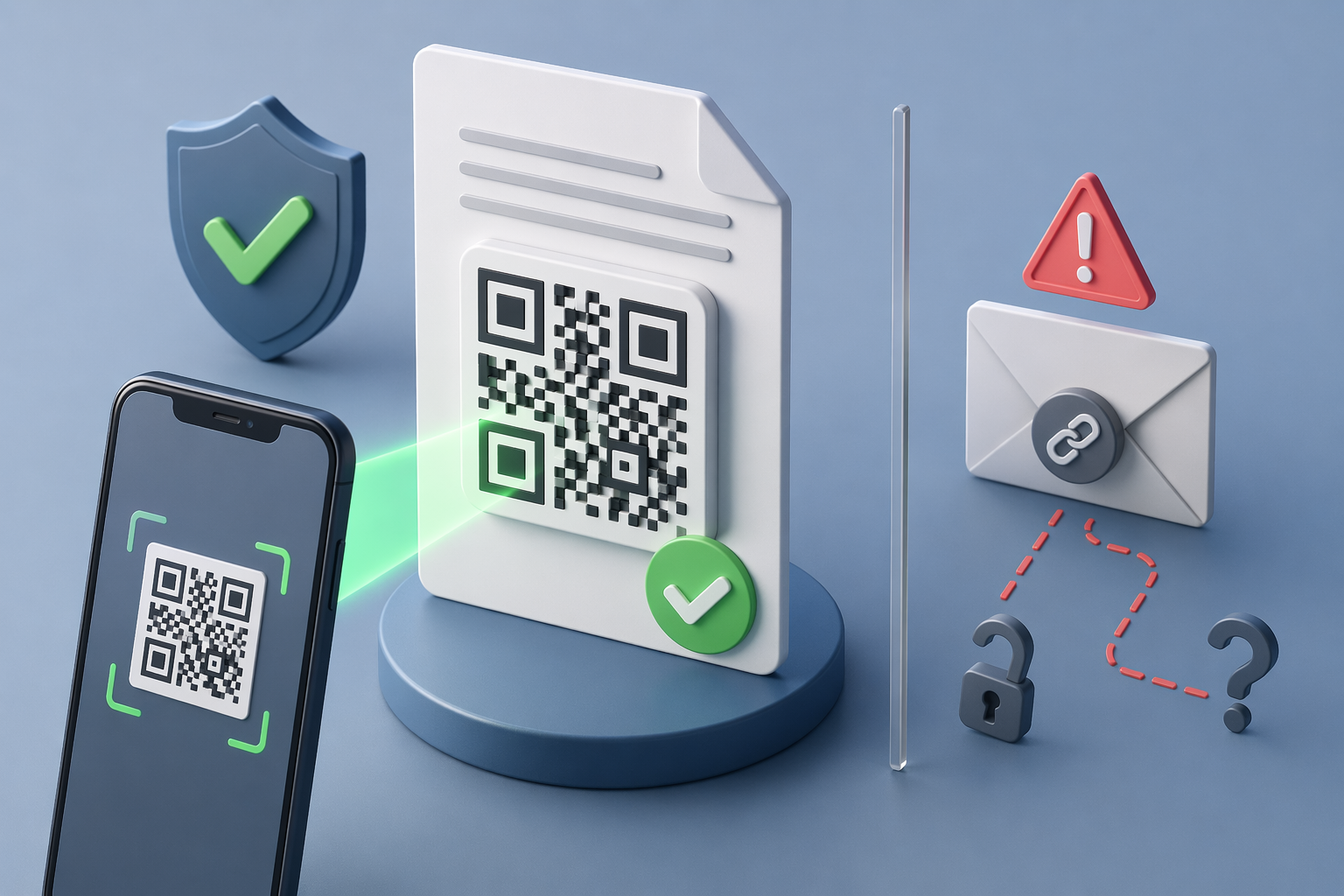
The fastest way to verify a Nigerian Tax Clearance Certificate is to scan the QR code on the e-TCC and confirm the result matches the physical certificate — or to validate the certificate number directly on the issuing authority's portal: FIRS TaxPro-Max for federal and company TCCs, or the relevant State Internal Revenue Service for individuals. Nigeria has moved to electronic TCCs (e-TCC) carrying a unique certificate number and QR code specifically to defeat forgery, so a genuine TCC can always be confirmed at source. If the QR does not resolve, the certificate number will not validate, or the TIN does not match the taxpayer, treat it as fake.
The fastest way to verify a Nigerian TCC
Scan the QR code on the e-TCC with any phone QR scanner, follow the link, and confirm the verified details match the physical certificate. If you cannot scan, validate the certificate number on the issuing authority's portal — FIRS, through TaxPro-Max, for company and federal TCCs, or the relevant State IRS for individuals.
Check that the TIN matches the taxpayer name via TIN verification, and confirm the basics: taxpayer name, the three covered tax years, the issue date, and validity. Any mismatch means stop. A genuine e-TCC always confirms against the tax authority's own system.
What a Tax Clearance Certificate is — and who issues it
A Tax Clearance Certificate (TCC) is an official document from a Nigerian tax authority confirming that a taxpayer has settled all tax obligations — or that no tax is due — for the three years immediately preceding the current year of assessment. It typically shows the taxpayer's name, Tax Identification Number (TIN), the employer for individuals or nature of business for companies, the income and tax paid, a unique certificate number, and a QR code. A TCC is generally valid for one year from issue.
Two types of authority issue TCCs, and it matters which one you are verifying against.
| Issuer | Covers | Verify on |
|---|
| FIRS (Federal Inland Revenue Service) | Companies and federal taxes | FIRS TaxPro-Max (Validate TCC) or FIRS e-services |
|---|
| State Internal Revenue Service (e.g. LIRS in Lagos, FCT-IRS in Abuja) | Individuals' personal income tax (PAYE) in that state | That state's e-Tax or eTCC portal |
|---|
So a company's TCC is validated with FIRS; an individual's is validated with the State IRS where they are tax-resident.
The shift to e-TCC: QR codes and certificate numbers
This is the most important development for anyone verifying TCCs. Both FIRS and the state revenue services now issue electronic TCCs (e-TCC) carrying a unique certificate number and a QR code, along with a digital signature, as anti-forgery features. The Lagos State Internal Revenue Service, for example, explicitly encourages government MDAs and commercial banks to request and validate the e-TCC's security features before transacting, in line with Section 85(2) of the Personal Income Tax Act.
The practical upshot: a modern, genuine TCC is verifiable at source. A document presented as a TCC with no QR code or no validatable certificate number should be treated with suspicion.
How to verify a TCC, step by step
Method 1, scanning the QR code, is the fastest. Open any QR scanner on your phone, scan the code on the e-TCC, and follow the link. You will usually be asked to enter your email and organisation name, after which the authority's system displays the verified certificate. Compare it to the physical document — they must match exactly.
Method 2 is to validate the certificate number on the portal. For a company or federal TCC, use the Validate TCC function on FIRS TaxPro-Max (taxpromax.firs.gov.ng) with the certificate number and taxpayer details. For an individual's TCC, validate it on the issuing State IRS portal, for example the LIRS eTax platform. The portal confirms whether the certificate is genuine and current.
Method 3 is to verify the TIN. Confirm the Tax Identification Number on the certificate is real and belongs to the named taxpayer, using TIN verification through the Joint Tax Board or FIRS TIN verification services. A TCC whose TIN does not resolve, or resolves to a different name, is a red flag.
Method 4, for high-value transactions where doubts remain, is to confirm with the issuing authority directly — contact FIRS or the relevant State IRS to confirm the certificate number, taxpayer, and validity.
Red flags: how to spot a fake TCC
Watch for any of these. No QR code, or a QR code that does not resolve or leads to a non-official site. A certificate number that will not validate on the FIRS or state portal. A TIN that does not verify or does not match the taxpayer's name. Wrong or missing tax years — a TCC should cover the three years preceding the current assessment year. An expired certificate presented as current, since TCCs are generally valid for one year. An old-style paper certificate offered where an e-TCC with security features is now standard. Or formatting inconsistencies and a missing digital signature.
Any one of these is reason to validate at source before relying on the certificate.
Who must verify TCCs — and why
Verification is not optional for several groups. Government MDAs and procurement teams need it because a valid TCC is a precondition for many contracts, tenders, and official transactions; accepting a forged one undermines the award and carries legal risk. Banks and financial institutions rely on TCCs to support business lending, account opening, and KYC. Employers, regulators, and agencies require proof of tax compliance, and businesses doing vendor or partner due diligence need to confirm a counterparty's tax standing.
Tax authorities process this data under Nigeria's data-protection regime — see our NDPA guide for document issuers — so handle any taxpayer details you collect during verification accordingly.
What the e-TCC teaches every document issuer
It is worth noticing why a TCC is now straightforward to verify: FIRS and the state revenue services deliberately rebuilt it as an e-TCC with a QR code and a validatable certificate number, so anyone can confirm it at source. That is issuer-side verification — the same model behind the CAC public search and WAEC and NECO result verification. Government has shown the way: make the document confirmable the moment it is issued, and forgery stops working.
The gap is everywhere else. The contracts, invoices, certificates, engagement letters, and reports that businesses and professional firms issue every day have no such mechanism — so they remain easy to fake, exactly as paper TCCs once were. VerifyDoc.ai closes that gap for your own documents: each one is issued with a QR-backed Certificate of Authenticity and a hosted proof page, so any recipient — a government agency, a bank, a partner — can scan and confirm it is genuine and unaltered in seconds, just like a modern e-TCC.
One important point: VerifyDoc.ai does not issue or verify Tax Clearance Certificates — those come only from FIRS and the State Internal Revenue Services and are validated on their portals. VerifyDoc.ai is an issuer-side tool for making your own documents verifiable. See how it works.
Give your own documents e-TCC-grade trust
Nigeria's tax authorities made the TCC verifiable at source with a QR code and a certificate anyone can validate. VerifyDoc.ai brings that same property to every document your business or firm issues — a QR-backed Certificate of Authenticity any agency, bank or partner can scan to confirm it is genuine and unaltered. Start free or see how it works.
Related reading: How to verify a CAC Certificate of Incorporation and Document fraud in Nigeria: the 2026 data and landscape.
This guide is for general information. Tax authorities' portals, processes and validity rules change; always confirm current verification steps through the official FIRS (firs.gov.ng) or relevant State IRS websites.