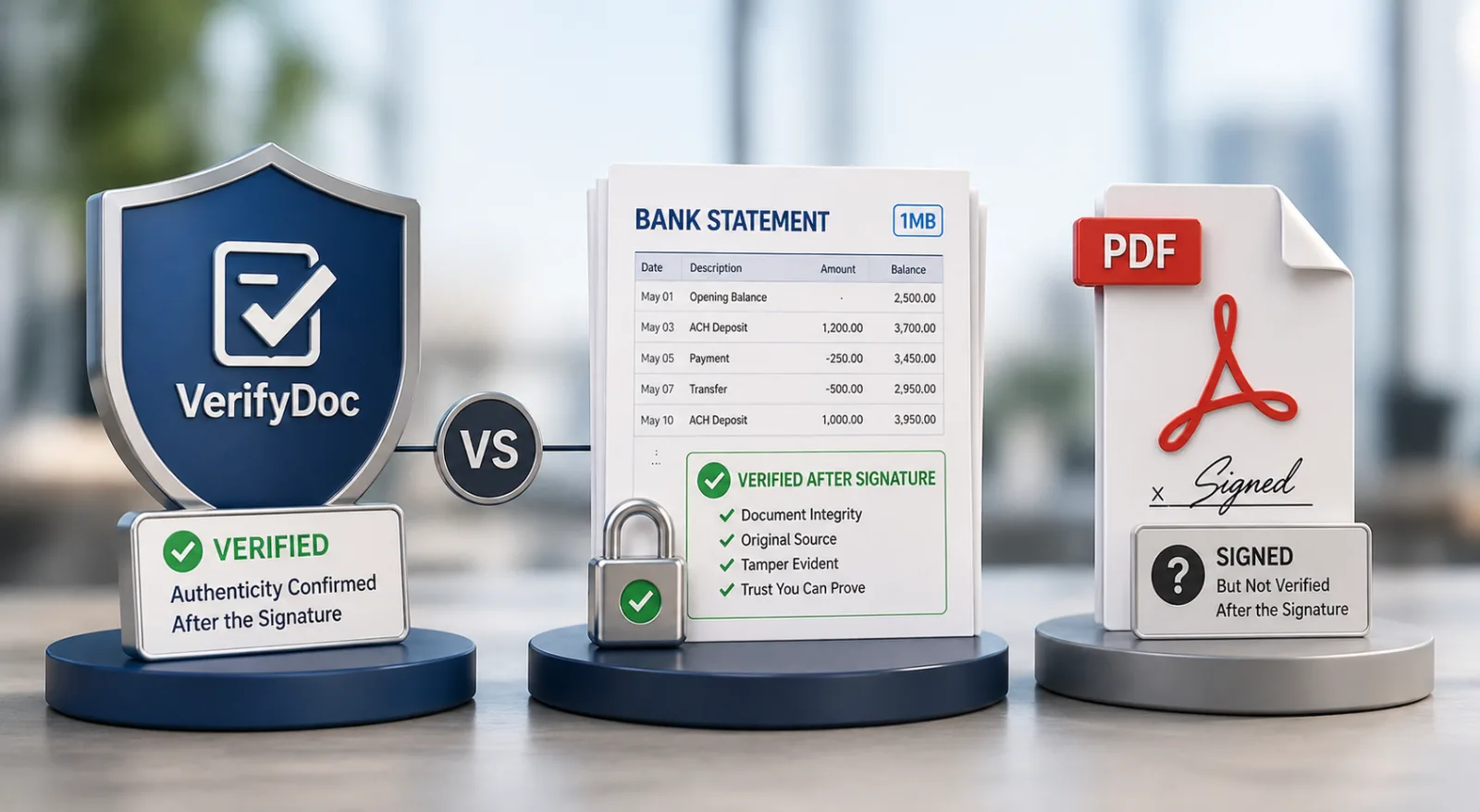
Banks and financial institutions can issue account statements, proof-of-funds letters, and guarantee documentation that recipients verify at source — confirming the document genuinely came from the bank and hasn't been altered. For statements and letters, this directly attacks one of the most common financial-document frauds. For formal bank guarantees and standby letters of credit, it's a complementary layer only: the authoritative channel for those instruments remains authenticated bank-to-bank confirmation over SWIFT. This guide explains the issuer side for financial institutions — and where the honest boundaries are.
The split that matters: verifiable issuance is a strong, clean fit for statements and letters. For formal bank guarantees and SBLCs, it complements — and never replaces — SWIFT MT760 interbank authentication and the ICC rules that govern them. This is general information, not financial, legal, or regulatory advice.
Account statements: among the most-forged documents
A bank statement is among the most-forged documents in existence, because it gates loans, mortgages, visas, tenancies, and KYC. Forged and AI-generated statements are now cheap to produce, and the recipients who rely on them — lenders, landlords, embassies — often have no quick way to confirm a statement genuinely came from the bank, as covered in our guides to verifying a bank statement and spotting fakes.
Bank guarantees and SBLCs: a long-running fraud target
A bank guarantee, or BG, or a standby letter of credit, an SBLC, is a regulated bank's written promise to pay if its customer fails to perform or settle, used in trade, tenders, and construction. They are also the subject of a long-running fraud industry: advance-fee leased SBLC scams, fake instruments sent as PDFs or email screenshots, and offers to monetise guarantees. Authentic instruments travel over SWIFT as MT760 messages and follow ICC rulebooks such as URDG 758 for demand guarantees or ISP98 for standbys — and crucially, a real guarantee comes through SWIFT, not Gmail or WhatsApp.
What verifiable issuance does
A bank can issue a document with verification built in: a QR-backed verification layer and a proof page, so any recipient can scan it — no app, no account — and confirm at source that the document genuinely came from the bank and hasn't been altered. Any change to a balance, amount, or date breaks verification.
Where it's a strong fit: statements and letters
For account statements, proof-of-funds letters, balance confirmations, and bank reference letters, verifiable issuance is a clean, powerful fit. The lender, landlord, embassy, or counterparty can confirm at source, in seconds, that the document is genuinely from the bank and unaltered — defeating forgery, speeding acceptance for the customer, and reducing the verification requests the bank's staff currently field by phone and email.
Bank guarantees: a complementary layer, not a replacement for SWIFT
Here's the essential honesty for the guarantee side. For a formal bank guarantee or SBLC, the authoritative way to confirm authenticity is authenticated bank-to-bank confirmation over SWIFT, the MT760 message, direct confirmation with the issuing bank, and checking that the bank is genuinely licensed and its BIC is in the SWIFT directory — all within the ICC rules framework of URDG 758 or ISP98. A PDF, even a polished one, is not a guarantee; as the trade-finance world repeats, an instrument arriving by email or messaging app is a red flag.
A verifiable-issuance layer can confirm that a bank's guarantee documentation genuinely came from the bank and is unaltered — a useful additional check against forged paper. But it does not replace SWIFT MT760 authentication, and a beneficiary of a formal instrument should rely on the authenticated interbank channel, never treat a verifiable PDF as a substitute for a SWIFT-transmitted guarantee. Used this way — as a complement — it adds value without creating false confidence.
What financial institutions gain
Forgery of the bank's documents fails: fakes in the bank's name don't verify, and alterations are caught. Recipients verify at source, bringing faster acceptance, less fraud, and fewer verification calls to the bank. Tamper-evidence means changed balances, amounts, or dates are detectable.
There's a better customer experience, since customers' statements and proof-of-funds are accepted faster where they're instantly confirmable. And it builds brand trust and reduces fraud, because issuing verifiable documents signals security and protects the bank's name from being used in fraud.
How VerifyDoc.ai fits
VerifyDoc.ai lets financial institutions issue verifiable account statements, proof-of-funds and reference letters, and guarantee documentation — each carrying a QR-backed Certificate of Authenticity and a proof page, so any recipient can confirm at source that the document is genuine and unaltered.
To be clear on scope: VerifyDoc.ai provides the verifiable-document layer. For formal bank guarantees and SBLCs it complements, and does not replace, SWIFT MT760 interbank authentication and the ICC rules that govern those instruments. It confirms a document's authenticity and integrity — not that an account balance or coverage is currently accurate, which depends on the bank's live records, KYC, and open-banking data — and it is not a core-banking, SWIFT, trade-finance, or payments system. See how it works.
Issue bank documents that verify themselves
VerifyDoc.ai lets your institution issue account statements, proof-of-funds letters, and guarantee documentation with a QR-backed Certificate of Authenticity — so recipients confirm at source that they're genuine and unaltered, and forgeries in your bank's name fail. Start free or see how it works.
Related reading: How to verify a bank statement, Verifiable documents for Nigerian fintechs & microfinance banks, and Document fraud statistics 2026.
This article is for general information and does not constitute financial, legal, or regulatory advice. Formal bank guarantees and SBLCs are authenticated through SWIFT and governed by ICC rules; confirm such instruments through authenticated interbank channels.