Admissions fraud — altered transcripts, transcripts from institutions that don't exist, and fabricated recommendation letters — is a growing problem, sharpened by AI tools and application mills. The strongest defence is primary-source verification: confirm transcripts directly with the issuing institution or a clearinghouse, check that the institution is accredited, and verify referees independently. When institutions and referees issue verifiable transcripts and recommendations — confirmable at source — admissions offices can do all of this in seconds rather than weeks. This guide covers both the methods that work and where verifiable issuance fits.
The principle: the fix for fake transcripts and recommendations is verification at the source. Verifiable issuance makes at the source instant — but it confirms a document is genuine, not that the institution is accredited or the referee is real. This is general information, not admissions or legal advice.
The admissions-fraud problem
Application fraud takes several forms, and they compound. Transcripts are altered to inflate grades, or fabricated entirely — sometimes from institutions that don't exist — and AI now makes convincing fakes cheap to produce. Recommendation letters are widely fabricated or purchased, to the point that some international-admissions specialists treat unverified reference letters as nearly worthless. Test scores and personal statements are falsified too, and third-party agents and application mills package all of it, especially in international admissions. Real cases are not hypothetical: in one prosecuted scheme, an admissions official submitted inflated-grade transcripts and phony recommendation letters for unqualified applicants in exchange for payment, and admissions teams regularly report batches of near-identical transcripts from a single source.
A related but different problem is identity fraud — ghost student rings exploiting financial aid, which surged in 2025 to the point that some institutions flagged up to a third of applicants as suspicious. That's an identity-verification problem, not a document-authenticity one, and it's worth keeping the two distinct.
How admissions offices verify transcripts today
The gold standard is primary-source verification: an official transcript sent directly from the issuing institution, or confirmation through a clearinghouse such as the National Student Clearinghouse, via DegreeVerify and DiplomaVerify. For international applicants, credential evaluation services assess and authenticate foreign records. Throughout, accreditation checks matter — a transcript from an unaccredited diploma mill is worthless even if it's real, as covered in our guide to spotting a fake degree. Reviewers also scan for internal discrepancies and tell-tale duplicate submissions.
How admissions offices verify recommendations
Because the threat is usually a fake or fabricated referee rather than a doctored letter, the key is to verify the referee independently — using contact details obtained from the institution, not the details printed on the letter — and to favour systems where the recommender submits directly. This is the same logic set out in our guide to verifying a reference letter.
How verifiable transcripts and recommendations help
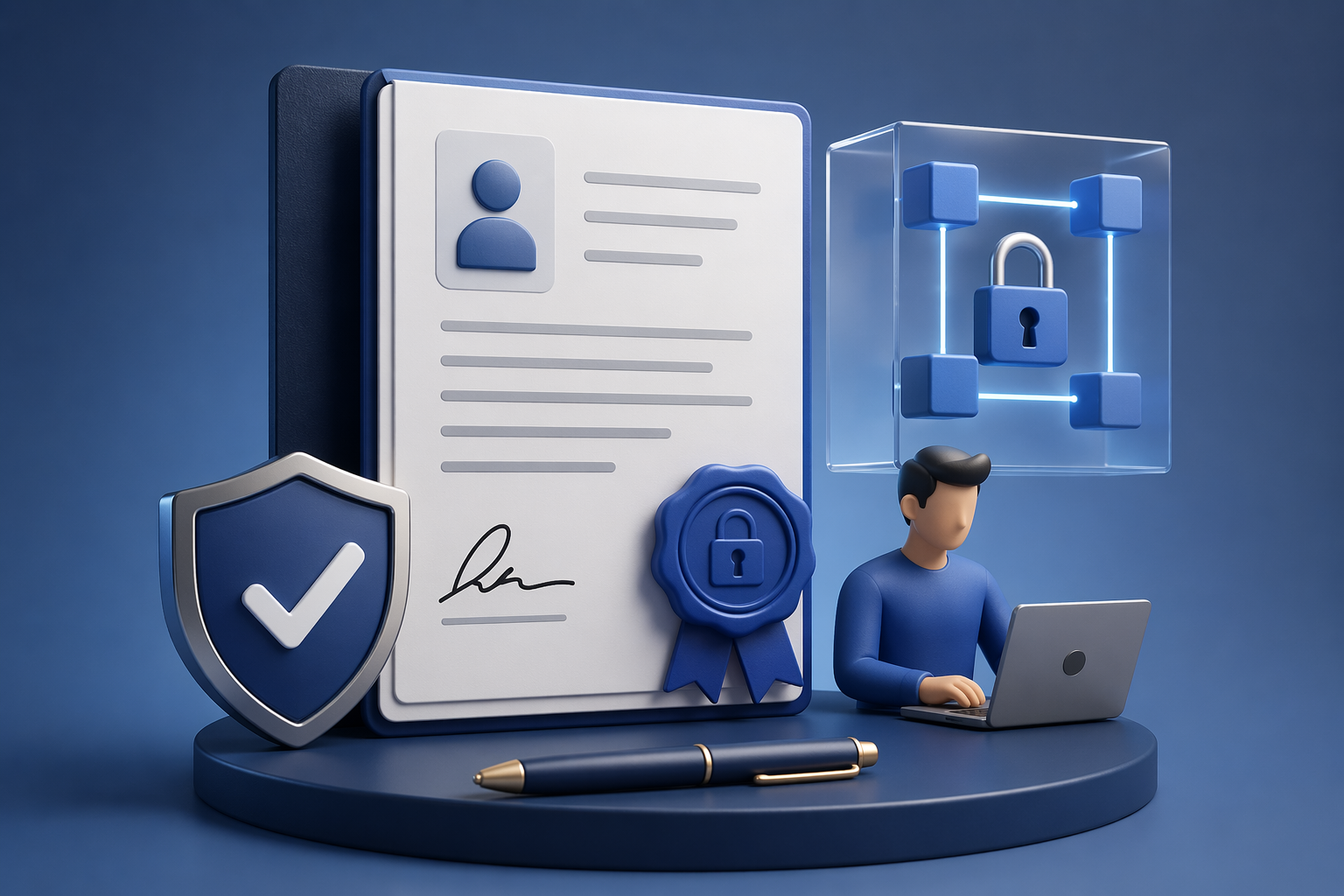
The slow part of all this is the back-and-forth: requesting official transcripts, waiting on registrars, chasing referees. When the issuing institution issues verifiable transcripts and referees issue verifiable recommendations — each carrying a QR-backed verification layer and proof page — an admissions officer can confirm at source, in seconds, that a transcript genuinely came from the institution and a recommendation genuinely came from the referee, and that neither has been altered. It turns primary-source verification from a multi-week process into an instant one, and it directly counters grade alteration and letter fabrication.
The honest limits
Verifiable issuance is powerful, but it confirms one specific thing — that a document was genuinely issued by a given account and is unaltered. It does not, on its own, do several things.
It doesn't confer accreditation: a bogus institution could issue its own verifiable transcript, so whether the issuer is a real, accredited institution is a separate check. It doesn't prove a referee is genuine and appropriate, because confirming a recommendation came from an account is not the same as confirming the referee is a real person in the role they claim — verify that independently. It doesn't detect fakes in documents that weren't issued verifiably: for an arbitrary PDF transcript, you still need the clearinghouse, the registrar, or credential evaluation, since a verifiable-issuance system isn't a forensic fake-detector. And it doesn't verify applicant identity — ghost-student and aid fraud are identity problems, addressed by identity verification, not document authenticity.
The strongest admissions defence layers verifiable issuance with accreditation checks, independent referee verification, and identity checks.
How VerifyDoc.ai fits
VerifyDoc.ai is for the issuing side: schools and universities can issue verifiable transcripts and result documents, and referees or institutions can issue verifiable recommendation letters, each carrying a QR-backed Certificate of Authenticity and proof page — so an admissions office can confirm at source, on any device, that the document is genuine and unaltered, with no app or account.
To be clear on scope: VerifyDoc.ai is the issuer-side verifiable-document layer. It does not verify arbitrary inbound third-party documents or act as a fake-detection service, does not confer accreditation or prove a referee's legitimacy, and does not verify applicant identity. It complements — rather than replaces — clearinghouse verification, credential evaluation, accreditation checks, and identity verification. See how it works.
Help admissions offices trust your transcripts instantly
VerifyDoc.ai lets schools, universities, and referees issue verifiable transcripts and recommendation letters with a QR-backed Certificate of Authenticity — so admissions offices confirm at source that they're genuine and unaltered, in seconds. Start free or see how it works.
Related reading: How to spot a fake university degree certificate, QR-verifiable degrees & transcripts for universities, and How to verify a reference letter.
This article is for general information and does not constitute admissions, education, or legal advice. Institutions set their own verification policies; combine document verification with accreditation and identity checks.