To verify a utility bill as proof of address, confirm it is a recent bill — usually issued within the last three months — of an accepted type, showing the person's name and a matching address from a real provider, then corroborate it electronically or at source rather than trusting the paper alone. Utility bills are the default proof-of-address document for KYC, AML, tenancy, and onboarding, but they are also among the easiest documents to forge or edit, which is why proof of address is widely considered one of the weakest links in KYC controls.
This guide covers what makes a bill acceptable, how to verify it properly, and the red flags that reveal a fake. It is general information, not legal or financial advice; address verification for KYC and AML is regulated, so get consent and follow applicable rules.
Why utility bills are used — and why they're risky
Proof of address (PoA) is a standard KYC and AML requirement for regulated firms — banks, fintechs, payment and e-money institutions — used to confirm a customer genuinely resides where they claim, flag high-risk jurisdictions, and deter identity fraud and money laundering. Utility bills are the most familiar PoA document.
But they are a soft target. A bill is easy to fabricate with an online generator or template, and digital e-bills are easier still to alter than paper. As our document fraud statistics show, editing a name or address onto a believable-looking bill is now trivial — so the document alone proves very little.
What makes a utility bill acceptable as proof of address
Before verifying authenticity, check the bill even qualifies. Most regulated firms require recency — typically issued within the last three months. They require an accepted type: gas, electricity, water, landline, or broadband bills, and council tax bills, are usually accepted, while mobile phone bills are often not accepted, or only post-paid ones meeting strict conditions, so check your policy and jurisdiction. They require a name match — the bill must be in the name of the person being verified, and in shared households, someone whose name is not on the bill usually needs an alternative, such as a bank statement or government letter in their own name. And they require a full, matching address, including a valid postcode or ZIP, from a recognisable, real provider that actually operates in that area.
Requirements vary widely by country — what is accepted in Germany differs from India or Nigeria — so apply your local rules.
The verification methods, best to worst
There are four broad routes, from electronic database verification down to inspecting the bill itself. The next sections take each in turn, strongest first.
Method 1 — Electronic address verification (modern best practice)
Rather than judging a PDF, cross-reference the person's name and address against trusted data sources — credit reference agencies, the electoral roll, and government databases. Automated eKYC tools extract the bill's data by OCR, run tamper-detection, and cross-check it against those databases, often in seconds. This reduces reliance on the easily-forged document and is now the preferred approach for scale.
Method 2 — Confirm at source with the provider
Where feasible, contact the issuing utility directly — using independently sourced details, never those printed on the bill — to confirm an account exists in that name at that address. It is reliable, but slow, consent-dependent, and many utilities will not confirm to third parties.
Method 3 — Corroborate with a second source
Best practice is one identity proof plus one separate address proof, never relying on a single bill. Cross-check the name and address against the applicant's ID and other documents, and validate that the address itself exists and is residential.
Method 4 — Forensic inspection (catches sloppy fakes)
When you are scrutinising the document itself, check the date and recency — within the required window, not suspiciously old or future-dated. Confirm provider legitimacy — a real company, with correct current branding, operating in that region. Look for account and meter details — account or customer numbers and supply identifiers, such as a UK electricity MPAN or gas MPRN, present and plausibly formatted. Check the numbers — charges add up, consumption and tariff or standing charges are realistic, and any VAT or tax is correct.
Examine the formatting — consistent fonts and alignment, no leftover template or placeholder text, no spelling errors, a valid address format. Confirm an exact name and address match to the applicant, watching for a mismatched name, a care of, or an address that only just meets a requirement. And inspect the metadata — the producing software, a real billing system versus Word, Canva, or a generator, and any edit dates after the stated issue date.
Quick red-flag checklist
A fast side-by-side of genuine versus suspicious.
| Check | Genuine | Suspicious |
|---|
| Date | Within about 3 months | Old, future-dated, or missing |
|---|
| Bill type | Accepted (energy, water, landline, broadband, council tax) | Mobile bill or non-standard, where excluded |
|---|
| Name and address | Exactly match the applicant | Mismatch, care of, or shared-household name |
|---|
| Provider | Real, operates in the area, current branding | Unknown, wrong region, outdated logo |
|---|
| Identifiers | Account and meter numbers present and plausible | Missing or malformed |
|---|
| Numbers | Charges and consumption reconcile | Don't add up; implausible usage |
|---|
| Metadata | Billing-system software, consistent dates | Generator, Word, or Canva; post-dated edits |
|---|
The bottom line: paper proof of address is weak
Forensic checks catch lazy fakes, but a competent forgery — or an AI-generated bill — can pass visual inspection. Because what actually proves a document genuine is confirmation at source, the durable approach to proof of address is electronic and database verification plus corroboration, treating the bill as one signal among several rather than the decision itself.
For organisations that issue proof-of-address documents
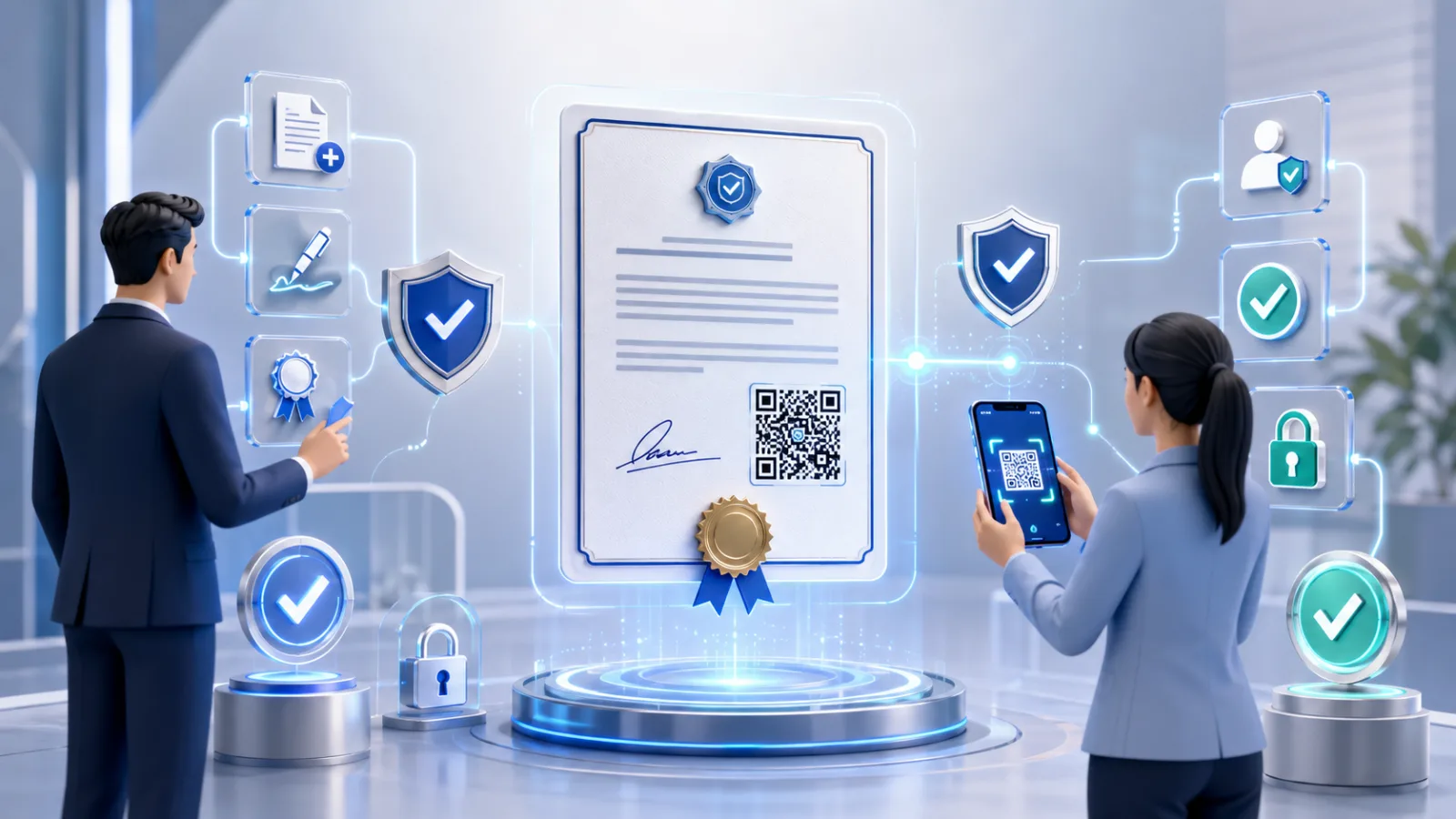
There is a flip side worth noting. If your organisation issues documents that people use as proof — a utility or council issuing bills, a housing association or letting agent issuing tenancy or address-confirmation letters, a bank or employer issuing address letters — you can make those documents verifiable at source, so recipients do not have to guess. VerifyDoc.ai lets you issue documents with a QR-backed Certificate of Authenticity and proof page, so a verifier can confirm in seconds that the document is genuine and unaltered.
To be clear on scope: VerifyDoc.ai is issuer-side. It is not an address-verification, eKYC, or KYC/AML service, and it does not check or score utility bills that others send you. If you are the one verifying an applicant's proof of address, use electronic address verification and source confirmation as above. See how it works.
Issue proof documents that verify themselves
If your organisation issues bills, statements, or address-confirmation letters, VerifyDoc.ai lets each one carry a QR-backed Certificate of Authenticity — so any recipient can confirm it is genuine at source, with no account on their side. Start free or see how it works.
Related reading: How to verify a pay stub is real, What actually proves a document is authentic?, and Document fraud statistics 2026.
This article is for general information and does not constitute legal or financial advice. Proof-of-address and KYC/AML requirements vary by jurisdiction; obtain consent and comply with applicable rules.