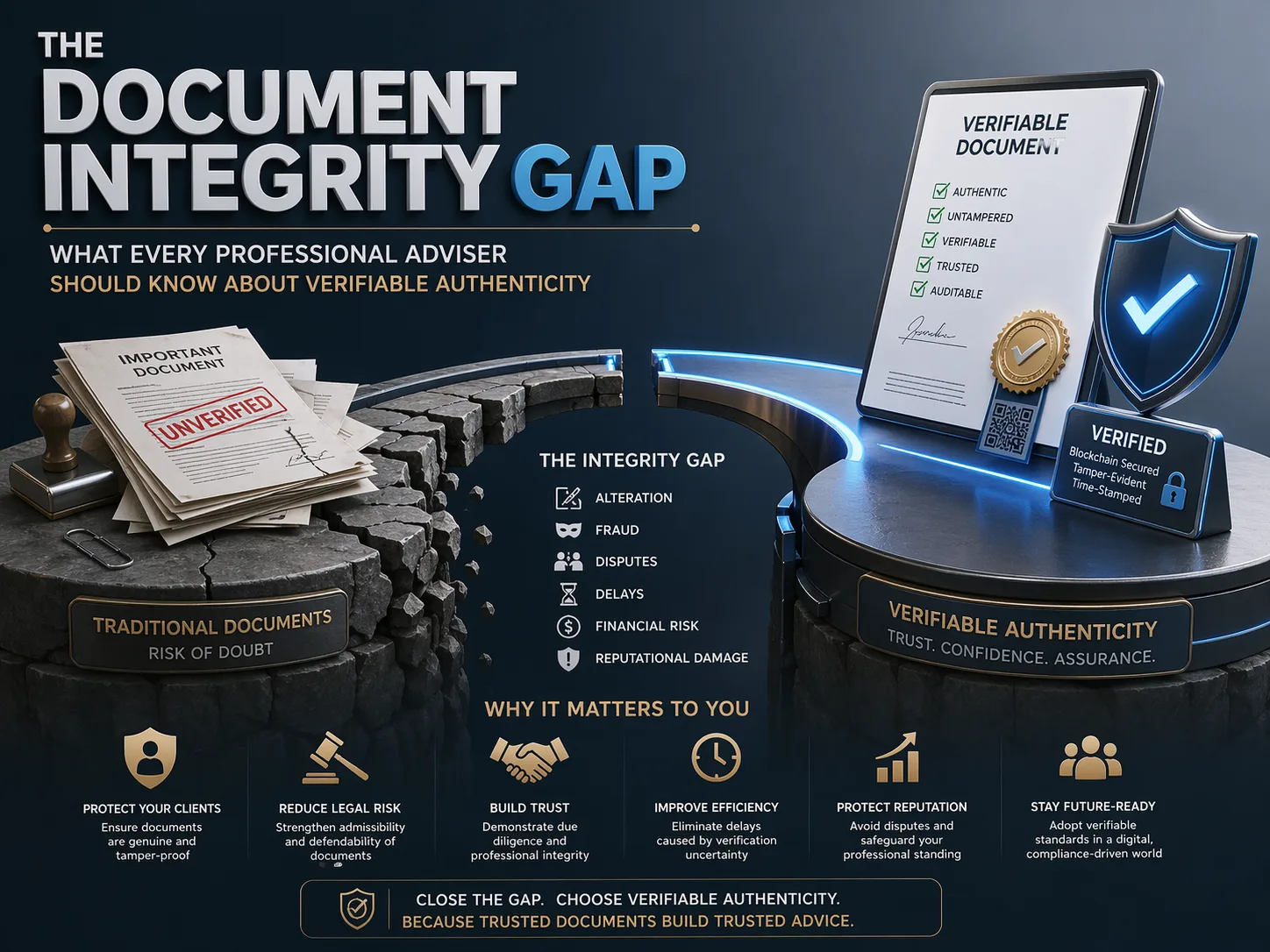
Professional advisers run on documents they did not create: bank statements from a client, a counterparty's signed contract, a counterpart firm's letter of engagement. Each is accepted largely because it looks right. That is the document integrity gap — the distance between looking authentic and being provably authentic — and it has quietly become one of the profession's sharpest risks.
This guide defines the document integrity gap, explains why it threatens advisers specifically, and shows how verifiable authenticity closes it.
What is the document integrity gap?
The document integrity gap is the trust void between a document appearing authentic and being provably authentic and unaltered. Most professional workflows close that gap with judgment — a partner glances at a statement, decides it looks legitimate, and relies on it. That worked when forging a convincing document was hard. It no longer is. The gap is dangerous precisely because it is invisible: a forged or altered file gives off no signal, and the adviser who relies on it inherits the consequences. Closing the gap means moving from "this looks real" to "this is verified against the issuer's record." That is what verifiable authenticity provides — a check, anchored to the issuer, that any adviser can run in seconds rather than a visual impression they have to trust.
Why are professional advisers especially exposed?
Professional advisers are exposed because they make consequential decisions on documents they did not issue and often cannot independently verify. A lawyer relies on a counterparty's signed agreement; an accountant relies on client bank statements and invoices; both carry professional and sometimes legal liability if a document turns out to be fake. The threat environment has sharpened fast: digital document forgeries rose 244% year over year in 2024 and overtook physical counterfeits to become 57% of all document fraud (Entrust 2025 Identity Fraud Report). Globally, deepfake incidents grew tenfold from 2022 to 2023 and a further fourfold into 2024, with forged or altered ID documents still about half of all fraud (Sumsub Identity Fraud Report). Advisers sit exactly where these forged documents are presented and acted upon.
What does the integrity gap cost when it goes wrong?
When the integrity gap is exploited, the losses are large and concentrated in exactly the transactions advisers handle. U.S. cybercrime losses reached a record $16.6 billion in 2024, up 33% year over year (FBI IC3 2024 Internet Crime Report). Business Email Compromise alone — typically a forged invoice, payment instruction, or letter slipped into a legitimate thread — drove $2.77 billion in losses across 21,442 complaints in 2024, and roughly $8.5 billion over 2022–2024 (FBI IC3 2024 Report). For an advising firm, a single accepted forgery can mean misdirected client funds, a void transaction, regulatory exposure, and reputational damage. The cost of closing the gap up front is trivial against the cost of one document the firm trusted that it should not have.
How does verifiable authenticity close the gap?
Verifiable authenticity closes the gap by replacing visual judgment with a check anchored to the document's issuer. Instead of deciding whether a statement looks real, the adviser scans a QR code or opens a link that resolves to the issuer's hosted proof page, which confirms whether the copy in hand matches the issued original. The proof is anchored upstream, at issuance, so it does not depend on the file looking suspicious — this is the verifiable document issuance model rather than after-the-fact fraud detection. For documents an adviser issues themselves — engagement letters, opinions, certifications — the same mechanism lets clients and counterparties verify back. See the pillar on how to verify document authenticity for the full picture.
How do trust methods compare for advisers?
An adviser's options for trusting a third-party document differ sharply in speed, reliability, and whether tampering is actually caught.
| Method | Speed | Catches a skilled forgery? | Recipient effort |
|---|
| Visual judgment ("looks right") | Instant | No | None |
|---|
| Call/email the issuer | Hours to days | Yes, if reachable | High |
|---|
| AI forgery detection | Seconds | Sometimes, probabilistic | Low |
|---|
| Issuer-controlled proof page | Seconds | Yes, provable | Low |
|---|
Visual judgment, still the default in most firms, is the one method that catches nothing. An issuer-controlled proof page is the only option that is both fast and provable.
Where does VerifyDoc.ai fit for advisory firms?
VerifyDoc.ai gives advisory firms both sides of the integrity gap. For documents the firm issues — engagement letters, opinions, certifications, signed agreements — it attaches QR-backed verification, an issuer-controlled proof page, a certificate of authenticity, cryptographic hashing, and a tamper-evident audit trail, so clients and counterparties can confirm them with no login or app. It complements e-signature tools by proving the finished document, not just capturing a signature, which matters for legal services where the executed document must hold up later. For inbound documents that already carry a proof page, the firm's team verifies in seconds. The result is a workflow where authenticity is checked, not assumed.