Editorial19 April 2026VerifyDocs Editorial

Tamper-Proof Offer Letters

The 2026 HR Playbook for Issuing Documents Your Employees Can Actually Prove Are Real

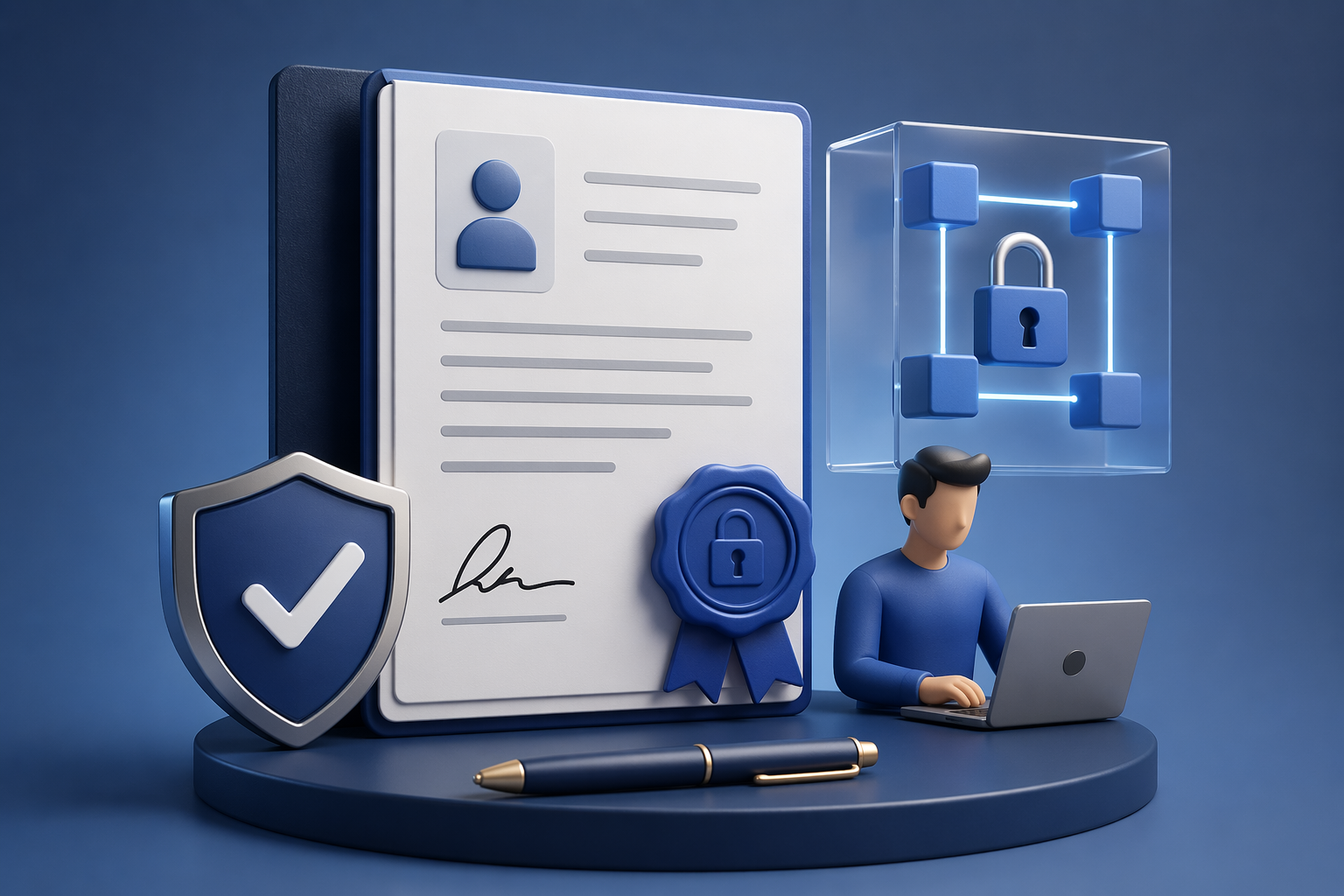
Tamper-Proof Offer Letters: The 2026 HR Playbook for Issuing Documents Your Employees Can Actually Prove Are Real illustration

Your HR team probably fields two types of document-verification calls every week. The first: a bank, landlord, or immigration office calling to confirm that an offer letter your company issued is real. The second: a hiring manager asking whether a diploma, reference, or past-employment letter submitted by a candidate is real.

Both calls are symptoms of the same problem. In 2026, most HR documents are issued as static PDFs that nobody can independently verify — which creates endless verification phone tag on the inbound side and gives AI-generated fakes a wide opening on the outbound side.

This playbook fixes both directions. By the end, you'll have a concrete plan for issuing offer letters (and all HR documents) that employees can prove to third parties in one scan, plus a candidate-verification process that closes the door on forged credentials.

The two problems HR is quietly absorbing in 2026

On the outbound side: your employees need to verify their employment for banks, landlords, credit applications, immigration, and visa applications. Every verification request lands on someone's desk in HR or finance. The average mid-market HR team now spends between 2 and 5 hours per week just confirming documents they themselves issued, often years earlier.

On the inbound side: every candidate submission is now suspect. Synthetic identity document fraud rose 311% in a year. AI-generated diplomas and transcripts pass visual inspection by hiring managers who haven't been trained to detect them. According to industry surveys in late 2025, 97.8% of fraud and risk leaders expressed concern about AI-enabled document fraud — and HR is in the blast radius.

Both problems have the same root cause: no cryptographic link between the document and its issuer. And both problems have the same solution: a verification-first document workflow on both sides.

The outbound fix: issue every HR document with a certificate of authenticity

Every formal HR document your team issues — offer letters, employment verification letters, promotion letters, bonus confirmations, reference letters, separation agreements — should be issued with a QR-linked certificate of authenticity. The operational shift is smaller than it sounds. Most modern e-signature platforms can attach a COA automatically; you flip a setting once and every future document gets one.

Why offer letters specifically matter

An offer letter is one of the highest-leverage documents in any employee's life. It is used for:

  • Mortgage applications, often months after the hire date
  • Apartment and rental applications
  • Credit card applications
  • Visa applications and immigration filings
  • Verification of income for car loans
  • Professional licensing applications
  • Proof-of-employment for insurance underwriting

Background checks in future hiring cycles

Each one of these verifications currently routes through your HR team, because the third party has no independent way to confirm the offer letter is real. A verification letter is drafted, signed, emailed. Multiply by every current and former employee, and the cost is significant.

A tamper-proof offer letter with a COA eliminates every one of those verifications. The employee hands the third party the original offer letter (or a printed copy). The third party scans the QR code and sees, on your verification domain, exactly when it was issued, to whom, for what role, and that it has not been altered since issuance.

  • The 10 fields every tamper-proof offer letter COA should include

From the general COA template, these are the specific fields for an offer letter:

  1. Document ID — a unique identifier
  2. Issuer — your company's verified legal name
  3. Recipient — the employee's legal name, identity-verified at signing
  4. Document type — Offer Letter
  5. Role and department — the position and team offered
  6. Issue date — when the offer was formally extended

Start date — the anticipated or agreed first day

Compensation summary — as stated in the letter; this is what banks actually want to see

  1. Cryptographic hash — SHA-256 of the final offer letter PDF

Revocation status — active, revoked, or superseded

Everything above is included automatically by any modern COA-issuing platform. You don't fill in fields manually; you upload the signed offer letter and the platform extracts what it needs.

The revocation layer that most HR teams miss

This is the single most important detail — and the one most HR teams overlook.

When an employee departs your company, their offer letter becomes historically interesting but operationally stale. It should not be usable to verify current employment. Without a revocation mechanism, a former employee can still present an original offer letter to a bank years after separation, and the bank — relying on the letter — treats them as a current employee of your company.

With a revocation mechanism, the moment an employee is marked as separated in your HRIS, the COA for their offer letter is marked as "superseded" or "revoked - former employee." A third party scanning the QR code now sees a clear status message: "This document was issued by [Company] on [date]. The recipient is no longer a current employee as of [separation date]. For current employment verification, contact HR."

This single feature dramatically improves the accuracy of downstream verifications and reduces your inbound workload. The third party gets the answer they need without calling you.

  • Beyond offer letters: every HR document deserves a COA

Once the offer-letter workflow is running, extend it to every formal HR document:

Employment verification letters. Issued on demand, with the same COA structure. Include current role, tenure, and compensation if authorized. Revoke on separation.

Promotion and bonus letters. Use COAs with references to the original offer letter's document ID, so the full history is traceable.

Reference letters. If your policy allows written references, issue them with COAs so the recipient company can verify authenticity without calling you.

Separation agreements and severance documents. Mission-critical for future disputes. The COA provides the cryptographic backstop.

Visa and immigration support letters. Often scrutinized by government officers who have no way to verify documents independently. A COA is the fastest path to trust.

Policy acknowledgements. Internal documents where employees acknowledge handbook, code of conduct, IP assignment, etc. COA creates an audit trail that satisfies compliance.

The operational rule: any formal HR document that exits your HRIS and could be shown to a third party gets a COA. Default on, never off.

The inbound fix: eliminate forged candidate credentials

The other side of the HR verification problem is inbound: diplomas, transcripts, references, and past-employment letters submitted by candidates. AI-generated document fraud has made hiring managers' eyeball inspection effectively worthless for these documents. You need a process.

The three-tier candidate verification model

Tier 1 — Issuer-verified credentials (preferred). The candidate submits a credential that comes with a verification URL or QR code from the original issuer. The hiring manager scans or clicks, and the issuer (the university, the prior employer, the certifying body) confirms authenticity in seconds.

This is increasingly the norm. Most major universities now issue digital diplomas with issuer-hosted verification. Most reputable professional certifying bodies do the same. If a candidate can't produce issuer-verified credentials for claims that matter, that's itself signal.

Tier 2 — Direct confirmation from the issuer. Where issuer-verified credentials aren't available, verify directly. Contact the registrar's office for diploma confirmation. Call the prior employer's HR team for past-employment confirmation. This is what historically happened for every credential; you're now doing it only for the ones Tier 1 doesn't cover.

Tier 3 — Third-party verification services. Background-check services, academic verification services, and credential verification platforms provide systematic verification for high-volume hiring. They're more expensive than Tier 1 or 2 but scale.

The cheapest-by-far model is to push as much of your hiring pipeline into Tier 1 as possible, use Tier 2 for the rest, and reserve Tier 3 for scale-sensitive situations.

Red flags on candidate-submitted documents

Train whoever reviews candidate documents on these signals (drawn from our 7 red flags guide):

Metadata mismatch. The PDF's creation software, author, or date contradicts the document's claimed origin.

Font or kerning drift. AI-generated documents often have subtle font inconsistencies visible at 300% zoom.

Missing audit trail. A claimed e-signed document without a signature panel, certificate, or audit log.

Unusual channel. A credential submitted via personal Gmail attachment when the issuer has a verification portal.

"Urgent" framing. Pressure to skip verification because the candidate has "another offer expiring soon."

One or two red flags may be noise; three or more is almost always signal. For a full walkthrough, see our guide on how to verify a signed PDF.

The employee-enablement piece

A tamper-proof offer letter is more valuable when your employees know how to use it. Two small training items eliminate most of the downstream friction:

At onboarding: teach new hires that their offer letter is QR-verifiable. Show them the verification page. Explain that they can share their offer letter with banks, landlords, and agencies without needing you to confirm it separately. Give them a one-line script they can use: "This offer letter has a QR code for verification — scan it, and you'll see the details on my employer's verification domain."

On separation: remind departing employees that their offer letter's verification status will change to "former employee" on their last day. This avoids the awkward situation of a former employee trying to use their original offer letter for a mortgage application six months later and discovering the status has changed without warning.

These two touches dramatically improve employee experience, reduce HR's inbound verification load, and position your company as doing HR right — which matters more in a tight labor market than most HR leaders think.

The compliance dimension

A tamper-proof offer letter workflow also satisfies several compliance checkboxes that most HR teams address separately:

ESIGN/UETA compliance is automatic if the offer letter is e-signed with full audit trail, consent, and retention — which every modern platform provides. See our guide on ESIGN vs. UETA for specifics.

eIDAS compliance (for any EU-based hires or EU operations) is handled if you use a platform that supports AdES or QES. Most EU-based employees implicitly expect eIDAS-tier signatures on formal HR documents.

Data retention for employment records — typically 7+ years, sometimes indefinitely — is handled automatically if your signing platform preserves audit trails and COA records for the required period.

Record integrity for auditors — HR audits increasingly expect tamper-evident records for offer letters, promotions, and separation agreements. A COA provides cryptographic evidence that satisfies any reasonable auditor.

GDPR (for EU employees) is addressed by ensuring your COA verification page doesn't expose unnecessary personal data to unauthenticated viewers — typically the verification page shows only enough to confirm authenticity, not the full document.

You're not layering five separate compliance processes. You're doing one thing — issuing COAs with every HR document — that satisfies all of them.

  • Implementation checklist

A pragmatic 30-day plan for mid-market HR teams:

Week 1 — Scope and pick a platform. Inventory the HR documents your team currently issues (offer letters, employment verification letters, promotion letters, separation agreements, etc.). Pick a platform that supports COA issuance with revocation (VerifyDoc.ai is purpose-built for this; other platforms partially support it). Confirm the platform integrates with your HRIS.

Week 2 — Build templates. Migrate your offer letter, employment verification letter, and 2-3 highest-volume HR documents to the new platform. Configure the COA fields to match the 10-field structure. Set up the verification page copy so recipients see clear, branded messaging.

Week 3 — Pilot. Issue the next 5-10 offer letters and employment verification letters through the new workflow. Walk through the employee-facing verification experience with the new hires. Fix any friction points.

Week 4 — Full rollout. Switch all HR document issuance to the new workflow. Update onboarding materials to include the verification walkthrough. Send a one-time email to active employees explaining the new verification-first model. Communicate the change to your finance and legal teams.

Ongoing — Revocation hygiene. Ensure your HRIS separation workflow triggers COA revocation automatically. If it doesn't, build a manual Friday checklist for the separations of the prior week.

Total implementation time for most mid-market HR teams: under a month, with most of the work in week 2.

  • What this does for your company

Three shifts, each of which compounds:

First, HR's inbound verification workload drops meaningfully. Depending on your company size, expect 40-80% reduction in ad-hoc verification requests within 90 days of full rollout. That time returns to actual HR work.

Second, employees trust you more. Small signal, big effect. An employee who can prove their employment to a bank in 10 seconds has a better experience of your company than one who has to email HR and wait.

Third, the category of offer-letter-based fraud targeting your employees closes. Fraudsters sometimes forge offer letters from real companies to scam banks or new employers. A QR-verified offer letter is not forgeable — the fraudster can create a lookalike PDF, but it won't pass a hash check on your verification domain.

  • Frequently asked questions

Does tamper-proofing offer letters require changing our HRIS?

Usually no. Most modern HRIS systems integrate with e-signature and COA platforms via API or prebuilt connectors. The change is in your signing platform, not your HRIS.

What about offer letters we've already issued?

Don't retroactively convert them. Issue new COA-backed letters going forward. For employees who need verification of an older offer letter, issue an employment verification letter with a COA — this achieves the same goal without the complexity of retrofitting old documents.

Can we revoke a COA if we made a mistake in the original letter?

Yes — revoke the original and issue a corrected version with a fresh COA. The revocation history is itself part of the audit trail, which demonstrates process integrity.

Are QR codes on offer letters intrusive?

Not if placed thoughtfully. A small QR code in the footer with a one-line verification note is visible but unobtrusive. Many HR teams find that branded verification actually looks more professional, not less.

How do we handle offers made verbally or via email that we later formalize?

Standard practice: the verbal/email offer is a pre-contractual communication; the formal offer letter with the COA is the legally operative document. The COA is attached to the formal letter.

What about highly sensitive documents like executive offer letters?

Same process, with access controls on the verification page if needed. The verification page can be configured to show only minimal public information (issuer, recipient, date, status) while keeping compensation and role details gated behind a login or PIN.

Do we need to tell employees about this at hiring?

Yes — briefly. Include one line in the onboarding materials: "Your offer letter is QR-verifiable. To verify your employment for a third party, you can share the offer letter directly; they can scan the QR code to confirm authenticity."

Where to go from here

Tamper-proof offer letters are the single highest-leverage change HR teams can make in 2026. The technology is mature. The implementation time is measured in weeks. The inbound workload drop is immediate. The fraud surface closure is permanent.

The broader playbook — how offer letters fit into a full document verification stack for your business — is covered in our pillar guide: How to Verify Document Authenticity in 2026. To understand the signature layer underneath, read Electronic Signature vs. Digital Signature.

Ready to issue your first tamper-proof offer letter? Try VerifyDoc.ai free and onboard your next hire with a document they can independently prove is real — in under five minutes.

Back to blog