The most common question we get from new prospects, on first call or first demo, is some version of: "So when I upload a document, you tell me if it's fake?" The answer is no. We don't analyse uploaded documents. We don't return authenticity scores. We don't run forensic checks on PDFs. We don't detect AI-generated forgeries. None of that is what VerifyDoc.ai does, and none of it is what we plan to add.
This article exists because that answer is counter-intuitive enough to need its own piece. In a market where "document verification" has historically meant "tell me if this document is real," it sounds odd for a document verification company to say it doesn't detect fakes. The shorter version is that we operate in a different category — verifiable issuance, not fraud detection — and the two categories solve opposite sides of the same underlying problem. The longer version is that we've made a deliberate architectural choice not to expand into detection, and we think the choice is correct on the merits. This article is the explanation of why.
For readers who landed here looking for fraud detection, we'll tell you upfront: you probably need a recipient-side detection tool, and we'll point you toward the category at the end. For readers who landed here trying to understand the architecture of document trust in 2026, this is the piece that explains why we think putting proof at the issuance step is structurally the right answer, and why bolting detection onto an issuance platform would weaken both halves.
The two categories, one more time
We've covered this distinction in two prior pieces — Verifiable Document Issuance: The 2026 Category Guide and Issuer-Side vs Recipient-Side Document Trust — and we'll be brief here because this article is more about the architectural argument than the category definition. But the distinction has to be on the table to make the argument coherent.
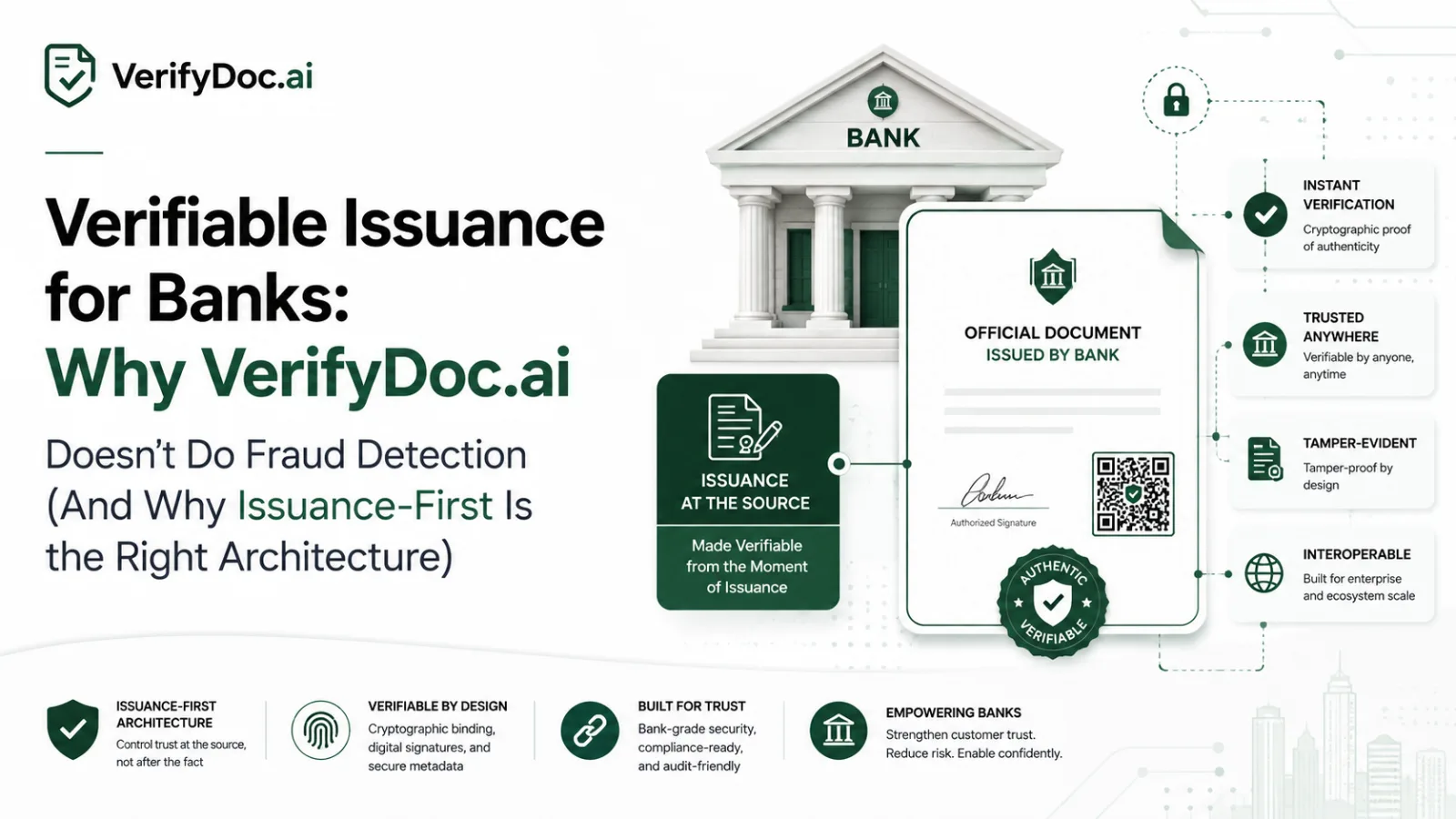
Verifiable issuance is the practice of producing documents that carry, embedded in themselves, cryptographic proof of who issued them, what their contents were at issuance, and whether they're currently valid. The proof is built into the document at the moment of creation. Anyone receiving the document can verify in two seconds by scanning a QR code that resolves to a hosted proof page on the issuer's own domain. No analysis is involved. The cryptographic signature either checks out or it doesn't.
Fraud detection is the practice of analysing documents that arrive without verifiable issuance, looking for forgery indicators: font inconsistencies, mathematical errors, AI-generation markers, metadata anomalies, template-based fabrication. The output is a probability-weighted authenticity score and a list of specific flags. Detection works on documents that were never designed to be verifiable; it doesn't require cooperation from the issuer.
VerifyDoc.ai operates exclusively in the first category. verifydoc.com (a separate company at the .com TLD, which we've disambiguated at VerifyDoc.ai vs verifydoc.com: What's the Difference?) operates in the second. Other names in the detection category include Inscribe, Ocrolus, MiTek, Socure, and several others. The categories are complementary, not competitive — most organisations past a certain size need both, for different document flows. But for any given vendor, the architectural choice between the two is meaningful, and bolting one onto the other dilutes both.
The rest of this article is the case for why.
The first reason: detection is fundamentally probabilistic; issuance is fundamentally cryptographic
This is the most important architectural difference, and the one that determines almost everything downstream about how the two categories are built, sold, and used.
A fraud detection tool, however sophisticated, produces a probability-weighted judgement about a document's authenticity. It examines a document, scores it across dozens of signals, weights the signals against training data, and outputs something like "92% likely authentic" or "highly likely forged based on these flags." The judgement is reasoned, defensible, and grounded in observable features of the document — but it's not certain. There's always a residual probability that a well-crafted forgery passes detection (false negative) or that a legitimate document gets flagged because it happens to share features with known forgeries (false positive). The tool's value is in reducing the false-positive and false-negative rates relative to human inspection, not in eliminating them.
A verifiable issuance system, by contrast, produces a cryptographic answer. The signature on a verifiably-issued document either verifies against the issuer's published identity or it doesn't. There's no probability weighting. There's no "92% likely authentic." There's "the signature matches" or "the signature doesn't match." If a forger tries to produce a verifiably-issued document without access to the issuer's private signing key, the signature won't verify — full stop, with mathematical certainty.
These are fundamentally different kinds of answer. They're produced by different kinds of system. They serve different operational decision-making patterns. And the engineering that produces each is fundamentally different.
A detection system is, at its core, a machine-learning pipeline. The hard engineering problems are: building large, well-labelled training datasets of known-good and known-forged documents; designing model architectures that capture forgery signals across diverse document formats; managing the false-positive and false-negative trade-off as adversarial techniques evolve; explaining model outputs in ways operations teams can act on; and updating models continuously as new forgery techniques emerge. The bar for "good enough" is set by competitive detection accuracy, and the work to maintain it never stops.
A verifiable issuance system is, at its core, a cryptographic infrastructure. The hard engineering problems are: holding private signing keys securely (HSM and KMS architecture); integrating with certificate authorities and trust service providers (a commercial process that takes months); producing signatures that verify against the standard trust stores recipients use (Adobe Approved Trust List, EU Trusted Lists, browser CA stores); implementing PAdES profiles correctly across the four levels (B-B, B-T, B-LT, B-LTA); designing hosted proof pages that load fast globally and verify signatures server-side reliably; managing certificate rotation and key lifecycle without breaking verification of historical documents. The bar for "good enough" is set by cryptographic correctness and standards compliance, and the work concentrates around standards alignment rather than continuous adversarial pressure.
A team that builds verifiable issuance well is, almost by necessity, deeply specialised in cryptography, PKI, and trust infrastructure. A team that builds detection well is, almost by necessity, deeply specialised in machine learning, computer vision, and adversarial robustness. These are different competencies, with different talent pools, different research literatures, different vendor ecosystems, and different operational rhythms.
A vendor trying to do both at high quality has to staff and maintain both competencies in parallel — and most vendors who attempt this end up doing one of them seriously and the other shallowly. The shallow side tends to drag the deep side, because the customer interpreting the vendor's pitch can't easily tell which is which and ends up either disappointed by the weak side or skeptical of the strong side. Specialisation is the architecturally honest answer.
The second reason: the incentives are different, and combining them creates bad incentives
A fraud detection vendor's commercial incentive is to find fakes. Their value to the customer is measured in how many forgeries they catch that would otherwise get through. The more fakes they detect, the better their product looks. The more fakes they fail to detect that turn out to be forgeries, the worse their product looks.
A verifiable issuance vendor's commercial incentive is to make verification trivially easy. Their value to the customer is measured in how reliably issued documents verify in downstream workflows, and how completely they eliminate the inbound verification workload the issuer currently absorbs. The cleaner the verification works, the better the product looks. The more verification failures occur (because of technical issues, certificate problems, or proof page outages), the worse the product looks.
These incentives are not antagonistic, but they're not the same. The detection vendor wants to find more flags; the issuance vendor wants to make verification quieter. If you combine them in one product, the incentives pull subtly against each other in ways that distort both halves.
The clearest distortion: a vendor offering both issuance and detection has a structural temptation to recommend detection-side workflows even for documents that could be issued verifiably. If the customer's documents are verifiably issued, the recipient verifies in two seconds and the detection product is unnecessary. If the customer's documents are not verifiably issued, the recipient runs detection and the detection product is necessary. The combined vendor's revenue is higher when documents are unverified at issuance, because both halves of the product are needed. A pure issuance vendor has no such incentive — their interest is unambiguously aligned with making the customer's documents verifiable so verification is structurally trivial downstream.
A second, subtler distortion: a vendor doing both has a temptation to position issuance as a higher-tier feature than detection, gating verifiable issuance behind more expensive plans and selling detection as the entry-level product. This skews adoption: organisations that should be issuing verifiably end up on detection-only plans because the pricing structure pushes them there, and the issuance category as a whole takes longer to reach the maturity that would benefit the entire ecosystem.
A third, more strategic distortion: a vendor doing both has a temptation to dampen the structural critique of detection that issuance-first architecture implies. The honest case for verifiable issuance is partly that it makes detection structurally less necessary over time, as more issuers adopt verifiable issuance and the share of unverified documents shrinks. A combined vendor can't make that case publicly — it would undercut their own detection product. A pure issuance vendor can, and should, because it's true.
We think the incentive alignment of a pure issuance vendor is materially better for the customer, for the category, and for the broader trajectory of document trust in the economy. We chose specialisation deliberately, and the choice is part of the value proposition.
The third reason: bolting detection onto issuance pulls product focus in the wrong direction
There's a product-discipline argument here that's almost more important than the architectural one. Vendors that do too many things end up doing all of them shallowly. The companies in the broader software industry that have produced the deepest, most operationally trusted products are, with rare exceptions, the ones that picked one job and did it relentlessly well for years.
In verifiable issuance specifically, the deep work that produces a category-leading product is in:
The signing infrastructure: implementing PAdES across all four profiles, integrating with multiple certificate authorities for different jurisdictional and regulatory requirements, maintaining HSM and KMS architecture at scale, supporting qualified signature tiers under eIDAS 2.0 for customers that need them, and W3C Verifiable Credentials format for wallet-bound credentials suitable for the EUDI Wallet ecosystem.
The hosted proof page: loading fast globally on every browser and phone, re-verifying signatures server-side on every load (you can't trust client-side verification), supporting issuer-controlled branding and domain configuration, handling certificate rotation and key lifecycle transparently, working reliably under load spikes that come with viral or high-volume issuance events, and meeting accessibility standards for recipients who interact with the page through assistive technology.
The integration surface: API design that's clean enough for engineering teams to integrate in days rather than months, SDKs in the languages customers actually use, webhook patterns that handle the events that matter in production, idempotency and retry semantics that work under realistic operational conditions, and documentation that lets developers self-serve without sales involvement.
The lifecycle management: revocation channels that propagate globally in seconds, status updates that reflect underlying business events correctly, long-term verifiability (PAdES-LTA) that keeps documents verifiable across decades, audit trails that satisfy compliance and discovery requirements, and the operational tooling for issuers managing portfolios of issued documents at scale.
The compliance and standards alignment: eIDAS 2.0 (Regulation EU 2024/1183, including the EUDI Wallet relying-party deadline of 6 December 2027), HIPAA, 21 CFR Part 11, ESIGN, UETA, SOC 2, ISO 27001, GDPR — each requires its own engineering, its own evidence, its own ongoing maintenance. Detailed regulatory background at eIDAS 2.0 and the EUDI Wallet.
This is, individually, enough engineering and product work to occupy a category-leading team continuously for years. There's no spare capacity in a focused vendor's roadmap for adding detection capabilities at competitive depth without diluting the issuance work. The vendors that have tried have, in our reading, either built detection at shallow depth (giving away the deep-engineering position they hold on issuance) or built detection at competitive depth (which usually requires a separate team and product, in which case the products end up loosely coupled at best and largely independent at worst).
We've chosen to do the issuance work properly, deeply, and exclusively. The pricing and product implications are that VerifyDoc.ai is purchased alongside (not instead of) a recipient-side detection tool when the customer needs detection. Most customers past a certain size do need both, and the two products coexist cleanly in the operations stack — issuance handles outbound documents, detection handles inbound documents, neither product needs to know about the other.
The fourth reason: the trajectory of the category favours issuance over time
There's a longer-term argument that runs underneath the architectural one. The trajectory of document trust over the next decade is toward verifiable issuance as the dominant pattern, with detection serving as the bridge for documents from non-verifying issuers.
The drivers of this trajectory are concrete:
eIDAS 2.0, as mentioned, mandates that EU Member States make European Digital Identity Wallets available to citizens by 24 December 2026 and that designated relying parties accept wallet-presented Verifiable Credentials by 6 December 2027. This creates a structural pull toward verifiable issuance for any document that touches an EU resident — which, for any organisation with European customers, employees, partners, or operations, is a substantial share of its document workflow.
Sector-by-sector regulatory pressure in the US, UK, and other jurisdictions is moving toward stronger integrity requirements on documents in regulated workflows. HIPAA's integrity requirements for ePHI, 21 CFR Part 11's electronic records requirements in FDA-regulated industries, FCA and PRA expectations for UK financial services, SOX integrity requirements for US corporate reporting, GDPR's Article 5(1)(f) integrity requirement for personal data — none of these explicitly mandates verifiable issuance, but each one moves the regulatory environment toward higher document-integrity expectations that verifiable issuance satisfies more cleanly than detection-plus-audit.
Receiver-side adoption pressure is the more powerful driver. As more major recipients (banks, regulators, large employers, large procurement organisations) start preferring documents from issuers that issue verifiably, the rest of the market follows. A bank that funds quickly on verifiable pay stubs wins business from competitors that wait for phone verification. A landlord that signs leases on verifiable proof-of-funds letters processes applications faster. A regulator that licenses firms on verifiable KYC letters reduces its own verification workload. The competitive logic compounds: one large recipient's preference for verifiable issuance becomes a vendor-selection criterion for the issuers that work with that recipient.
AI-driven fraud growth is the most direct pressure. Inscribe's 2026 Document Fraud Report found AI-generated document fraud rose roughly fivefold across 2025, and the rate continues to accelerate. Detection remains useful and necessary, but it's a continuously-fought adversarial battle. Verifiable issuance, by contrast, is a structural defence: a document that carries a cryptographic signature backed by the issuer's verifiable identity is not vulnerable to AI fabrication in the same way an unsigned document is. The fabricator's only attack vector against a verifiably-issued document is to compromise the issuer's signing infrastructure (a substantially harder problem) or to deceive recipients about which verification page is authentic (also harder, and detectable). The structural defence is stronger than the continuous detection battle.
Over the long run, the share of documents that are verifiably issued grows, and the share that requires detection shrinks. Detection doesn't disappear — there will always be documents from issuers who haven't yet adopted verifiable issuance, and detection is the right answer for those — but its role narrows from "default approach for every inbound document" to "fallback for documents from non-verifying issuers."
This is the trajectory we're building toward. We think it's the right trajectory for the broader document trust ecosystem, and we think specialised verifiable-issuance vendors are the right shape of company to push it forward. A vendor with one foot in detection has a structural reason to slow this trajectory; a pure issuance vendor doesn't.
What this means for customers evaluating us
Knowing the architectural argument is useful for customers evaluating VerifyDoc.ai because it tells you what to expect from us, what not to expect, and how we fit into your broader document-trust stack.
What to expect from us: the deepest possible verifiable issuance platform we can build, with continuously improving signing infrastructure, hosted proof pages, integration surfaces, lifecycle management, and standards alignment. We'll keep adding to the issuance product across every dimension that matters — supported document formats, signing identity hierarchies, proof page customisation, integration patterns for specific industries, compliance certifications, and the long tail of capabilities that make issuance work cleanly at scale across more customer scenarios.
What not to expect from us: a detection product. We won't analyse uploaded documents for forgery indicators. We won't return authenticity scores on documents we didn't issue. We won't add a tab to the workspace that says "analyse incoming document." If you ask for these things, we'll point you to the right tools in the recipient-side category.
How we fit into your stack: alongside a recipient-side detection tool, if you need detection. For your outbound documents (the ones your team produces), use VerifyDoc.ai to make them verifiable. For your inbound documents (the ones from external parties whose issuers haven't yet adopted verifiable issuance), use a detection tool — verifydoc.com, Inscribe, Ocrolus, or whichever fits your workflow. The two products don't need to integrate directly; they live at opposite ends of the document workflow and serve different teams in your organisation. We've covered this stack pattern in detail at Issuer-Side vs Recipient-Side Document Trust.
If you only need detection, not issuance: we're the wrong vendor. The recipient-side category exists, the vendors in it are competent, and they'll serve you better than a half-built detection feature attached to an issuance platform would. Go to them directly. We'd rather lose the sale than sell you a product that's not the right fit.
- Frequently asked questions
Will VerifyDoc.ai ever add fraud detection?
No, not as a native capability. We may, over time, integrate with detection vendors in ways that make it easier for customers to use both products in a coordinated workflow — for example, single-sign-on, unified billing for customers using both, or workflow integrations that route inbound and outbound documents to the right product automatically. But we won't build native detection. The architectural argument in this article is why.
What if I want to verify a document someone sent me?
If the document was issued verifiably by an issuer using VerifyDoc.ai (or any compatible verifiable issuance platform), you scan the QR code with your phone camera and the proof page on the issuer's domain tells you whether it's authentic. No account required, no software required, no analysis required.
If the document was not issued verifiably — which is still the case for most documents from most issuers in 2026 — you'll need a detection tool to analyse it. verifydoc.com, Inscribe, Ocrolus, and others operate in that category. We don't, and we'll tell you that openly.
Doesn't this mean you can't help me if my documents are fakes?
If your outbound documents are being forged by someone trying to impersonate you (your customers receive fake versions of your statements, your employees receive fake versions of your offer letters, your counterparties receive fake versions of your bank guarantees), verifiable issuance is exactly the right structural answer. We make your real documents verifiable, which means the forged versions either lack the QR code and stand out, or carry fake QR codes that resolve to obviously-wrong proof pages. The forgeries get caught by the structural difference, not by detection.
If your inbound documents are being forged by external parties (loan applicants are sending you forged pay stubs, vendors are sending you forged certificates of insurance, applicants are sending you forged transcripts), we don't help directly. A recipient-side detection tool does. The architectural answer is to use both products — issuance for your outbound flows, detection for your inbound flows — and not to expect either product to do both jobs.
How does this work with the EUDI Wallet and W3C Verifiable Credentials?
VerifyDoc.ai issues both PAdES-signed PDFs and W3C Verifiable Credentials, depending on the customer's preference and the document type. For documents intended for wallet-based presentation through the EUDI Wallet or any compatible Verifiable Credentials wallet ecosystem, we issue in Verifiable Credentials format. For documents intended for traditional PDF workflows (most current use cases), we issue PAdES-signed PDFs. The verifiable issuance architecture supports both natively. Detailed background at eIDAS 2.0 and the EUDI Wallet.
What about agentic AI workflows where the recipient is an AI agent rather than a human?
Verifiable issuance is the right architecture for agentic workflows specifically because the cryptographic verification is machine-readable. An AI agent receiving a verifiably-issued document can parse the signature, resolve the proof page programmatically, and confirm authenticity without any human in the loop. The hosted proof page returns structured data that agents can consume natively. As agent-to-agent commerce scales over the next several years, verifiable issuance becomes increasingly the default for documents that need to travel between AI systems, because it removes the ambiguity that detection-side authenticity scoring introduces. We'll cover this pattern in more depth in a forthcoming article on verifiable issuance for AI agents.
Are you saying detection vendors are wrong to do detection?
No. Detection is necessary, valuable, and well-suited to the documents it operates on. The detection category exists because most documents in circulation today aren't verifiably issued, and the recipients of those documents need a way to assess authenticity. Detection vendors do important work and the category is going to remain operationally important for the foreseeable future.
We're saying that VerifyDoc.ai shouldn't do detection, because it's a different architectural category and trying to do both well dilutes both. The detection vendors should keep building detection at category-leading depth; we keep building issuance at category-leading depth; customers use both where they need both.
Is the verifydoc.com brand confusion part of why you're emphasising this?
Partly, yes. The brand name similarity creates real user friction — people looking for one of us land on the other and waste time figuring out which is which. We've addressed this directly in VerifyDoc.ai vs verifydoc.com: What's the Difference?, and the structural answer is that the brand similarity is incidental but the category difference is real and important. This article is part of making the category difference unmistakable in our own positioning: we don't do detection, the .com does, and the architectural reasons for our choice are substantive rather than circumstantial.
What happens if a verifiably-issued document gets forged anyway?
A cryptographically-signed document cannot be forged without access to the signing key (which lives in HSM-backed infrastructure and never leaves it) or compromise of the certificate authority (which is an industry-wide trust event, not a forgery technique). What a forger can do is produce a visually similar document without a valid signature — but that document either lacks the QR code (and stands out as non-verifiable in a context where the issuer's real documents are verifiable) or carries a fake QR code that resolves to a domain the forger controls (which careful recipients spot by checking that the proof page domain matches the issuer they expect). The forgery surface is substantially smaller than for unsigned documents, and the attack escalation required to forge a verifiable document is meaningful enough that opportunistic fabricators almost always move to easier targets.
If you're concerned about adversarial forgery against verifiably-issued documents specifically, the recommended pattern is to combine verifiable issuance with recipient education about checking the proof page domain. Most recipients who scan a QR code on a verifiably-issued document and see a proof page on the issuer's branded subdomain treat that as sufficient authentication; sophisticated recipients also check that the domain is actually the issuer's. The combination of cryptographic signature plus correct domain plus current status is a substantially stronger authentication chain than any detection score on an unsigned document.
Why didn't you just call yourselves something other than "VerifyDoc" to avoid the confusion entirely?
The verification language ("verify," "doc," "authentic") describes the entire document-trust space, and multiple companies have built brands around variants of these words. The structural answer to category confusion isn't naming — it's clear category positioning, which is what this article and the broader content series are doing. We'd rather invest in making the category distinction unmistakable than chase a less-collision-prone name that abandons the descriptive value of "VerifyDoc" in our category.
Where to go from here
If you're evaluating VerifyDoc.ai for verifiable issuance use cases, the natural next reading is the category guide at Verifiable Document Issuance: The 2026 Category Guide and the buyer's diagnostic at Issuer-Side vs Recipient-Side Document Trust. The sector-specific guides closest to your use case are linked from there.
If you're looking for fraud detection rather than verifiable issuance, the vendors operating in that category include verifydoc.com (distinct company at the .com TLD), Inscribe, Ocrolus, MiTek, Socure, and several others. Our companion content on detection methodology — written for educational purposes, not as recommendations between specific detection vendors — covers the field at The 7 Red Flags of an AI-Generated Fake Document, Detecting AI-Generated Bank Statements, AI-Forged W-2s and Tax Documents, and How to Spot an AI-Generated Pay Stub.
If you need both — issuance for your outbound document flows, detection for your inbound document flows — both categories of tooling belong in your operations stack. The two are complementary, sit in different parts of the workflow, and don't need to integrate directly. The architectural distinction this article is making isn't a recommendation to use only one; it's a recommendation that each category be done by specialists, with VerifyDoc.ai filling the issuance role and an appropriate detection vendor filling the detection role.
The structural argument underneath all of this is that document trust in 2026 — and increasingly through the rest of this decade — is converging on verifiable issuance as the primary architecture, with detection as the bridge that handles documents from issuers who haven't yet adopted verifiable issuance. We're building for the convergence. We think it's the right shape of the future, and we think building a focused issuance platform without detection is the right way to push the convergence forward. The choice to specialise is part of the product, not a limitation of it.
This is the seventh article in our series on verifiable document issuance. For the foundational category context, see Verifiable Document Issuance: The 2026 Category Guide; for the buyer's diagnostic, see Issuer-Side vs Recipient-Side Document Trust; for the developer guide, see The VerifyDoc.ai API; for use cases, see Verifiable Certificates of Insurance, Verifiable Right-to-Work Documents, and Verifiable Issuance for Banks. The distinction between VerifyDoc.ai (issuer-side) and verifydoc.com (recipient-side) is covered in detail at VerifyDoc.ai vs verifydoc.com: What's the Difference?.