A small business owner in Manchester walks into a high street bank branch on a Wednesday afternoon. She needs a bank reference letter for a commercial property lease the landlord requires by Friday. The branch staff confirm her account standing, populate a templated letter on bank letterhead, and email her a signed PDF within thirty minutes. She forwards the PDF to the landlord. The landlord's lettings agent receives the PDF, looks at it for about ten seconds, and emails the bank's general inquiries line to confirm the letter is real. The inquiries line takes four working days to respond. The lease deadline passes. The deal stalls.
The same week, a mortgage broker in Birmingham receives three months of bank statements from a self-employed applicant. The statements are PDFs exported from the applicant's online banking portal, password-protected, with the bank's logo and the applicant's name and address on each page. The broker opens them, scans the deposits, and notices several large round-number incoming transfers that he wants to verify before submitting the application to the underwriter. He emails the bank's mortgage team requesting confirmation. He receives an automated acknowledgement and, eight working days later, a polite reply saying the bank doesn't confirm individual transactions on customer statements to third parties.
A US commercial loan officer at a mid-sized regional bank in Chicago receives a payoff letter from a borrower's previous lender. The payoff letter — typed on the previous lender's letterhead, signed by an authorised signatory, dated three days ago — confirms the outstanding balance, the per diem interest, and the wire instructions for the payoff. The loan officer dials the previous lender's verification line, gets routed through three departments, and finally reaches someone who can confirm the letter — twenty-five minutes after the original call started. The verification was a single sentence ("yes, that letter is ours, and the figures are current"). The twenty-five minutes was the cost.
Across the global banking industry, the cost of inbound document verification calls — the cost of confirming, to outside parties, that documents the bank issued are real and current — is one of the largest unmeasured operational line items in the customer operations function. It absorbs CSR capacity, mortgage team capacity, branch staff capacity, and commercial banking team capacity. It runs at significant volume around the clock at any bank with non-trivial customer counts. And it produces, in aggregate, no value for anyone: the verifying party gets a verbal confirmation of what the document already said; the bank confirms what the document already said; the customer waits while the verification cycle resolves.
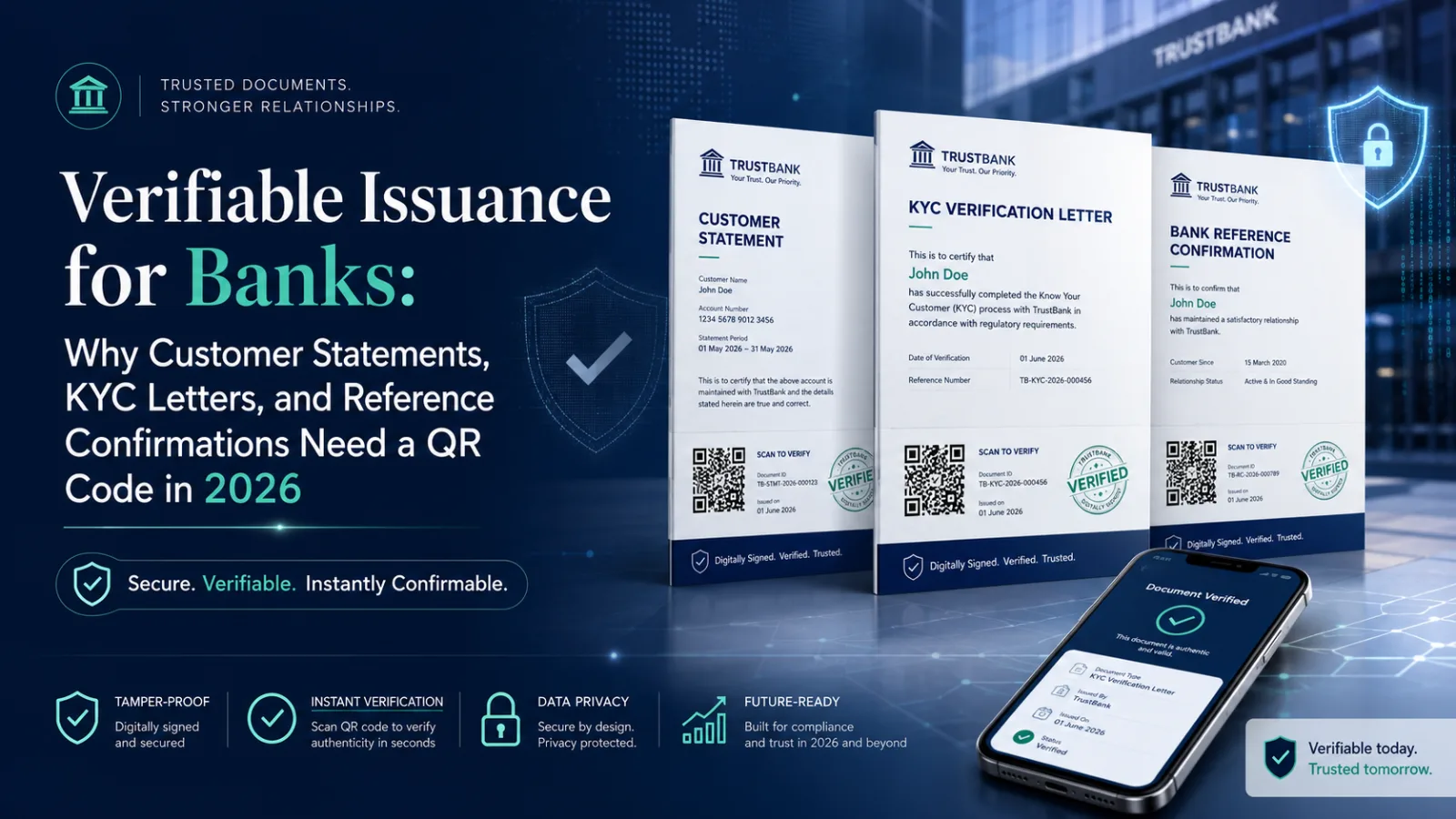
This article is about the structural shift that resolves the entire pattern. Banks that issue customer documents verifiably — statements, KYC reference letters, payoff letters, bank guarantees, account confirmation letters, proof of funds letters, audit confirmations — eliminate inbound verification workload as a category. The recipients verify in two seconds with a phone scan; the bank's operations team no longer fields the calls; the customer no longer waits for the deal to close. The same shift applies to investment banks issuing trade confirmations, to private banks issuing wealth-management statements, to corporate banks issuing letters of credit and bank guarantees, and to retail banks issuing the everyday customer documents that flow outward by the millions every year.
For banking technology leaders thinking about whether verifiable issuance belongs in the 2026 roadmap, this guide covers the structural case, the document categories where it applies most cleanly, the regulatory environment (FCA, PRA, GDPR, eIDAS 2.0, SOC 2 alignment), the implementation pattern for core banking and document generation systems, and the strategic positioning for banks that adopt before their competitors.
What banks issue, and what happens to it after
The most useful starting point for thinking about verifiable issuance in banking is to look at the full set of outbound documents a typical bank produces and trace what happens to each after it leaves the bank's systems.
Account statements are produced monthly or quarterly for every customer with an active deposit, savings, or credit account. The statement leaves the bank as a PDF or paper document and travels to wherever the customer needs it: a mortgage lender's underwriting team, a landlord's screening process, a visa officer at a consulate, a tax preparer's filing workflow, an immigration solicitor's evidence package, a small business loan application. Each downstream recipient needs to confirm the statement is real before relying on it. Most don't, because phone verification of bank statements is expensive on both ends and banks generally don't confirm individual statement contents to third parties without specific customer authorisation.
KYC reference letters are produced on customer request for customers who need a bank to confirm their account standing to another institution — another bank during account opening, a regulator during licensing, a foreign exchange counterparty during onboarding, a correspondent banking relationship. The letter typically confirms identity, address, account history, and (in some cases) standing. The recipient of the letter — almost always a regulated entity itself, often in another jurisdiction — needs to confirm the letter is genuine before relying on it for their own compliance obligations.
Account verification letters are produced for customers who need to confirm to a third party (a vendor, a counterparty, a landlord, an immigration officer) that they hold an account with the bank, often with specific account standing or transaction history. The recipient needs to confirm the letter is real before treating the underlying account confirmation as evidence.
Proof of funds letters are produced for customers in transaction contexts — property purchases, large acquisitions, immigration applications, visa requirements — where the customer needs to demonstrate available funds. The letter confirms account balance as of a specific date. The recipient needs to confirm the letter is real before treating the balance as evidence.
Bank guarantees and letters of credit are produced in commercial banking contexts — international trade, construction projects, government contracts, large procurement arrangements — where the bank guarantees performance or payment on behalf of a customer. The beneficiary of the guarantee or letter of credit needs to confirm the document is real and the bank's commitment is current before relying on it as security. Phone verification of bank guarantees is the standard workflow today, and it absorbs substantial commercial banking team capacity globally.
Payoff letters and loan documentation are produced when customers pay off loans, refinance with other lenders, or close out credit facilities. The receiving lender or escrow agent needs to confirm the payoff letter is current and accurate before completing the transaction. Phone verification of payoff letters is universal in US mortgage refinancing and absorbs meaningful capacity at every mortgage servicer.
Audit confirmations are produced for the customer's auditor (typically annually for corporate customers) confirming the customer's account balances, loan facilities, and credit lines as of the audit date. The bank's commercial banking team and audit confirmation function (where one exists) processes these confirmation requests in volume during the audit season. Phone verification, fax confirmation, and the paid-confirmation services (Confirmation.com, now part of Thomson Reuters) all exist because the underlying document — the audit confirmation letter — doesn't carry its own proof.
Trade confirmations are produced by investment banks and broker-dealers after each securities transaction, confirming the trade details to the counterparty and the customer. The recipient needs to confirm the trade confirmation is real before treating it as evidence of the transaction having occurred. Phone confirmation of trade details is a standard workflow in institutional trading, despite the volume of confirmations involved.
Customer statements for high-net-worth and private banking clients include more detailed wealth-management reporting: positions, performance, asset allocations, fee disclosures. The clients (or their family offices, lawyers, accountants, tax advisors) need to share these statements with various third parties throughout the year. The recipients face the same verification problem at a higher friction cost because the documents are more detailed and the stakes are higher.
In every one of these document categories, the structural problem is the same: the document leaves the bank's systems and immediately becomes unverifiable except by phoning the bank back. The bank absorbs verification workload it didn't ask for and isn't paid for. The customer waits while the verification cycle resolves. The recipient either accepts unverified or accepts the cost of phone verification.
Verifiable issuance changes the structure of every one of these document flows.
What a verifiable bank document actually is
A verifiable bank document is one that carries, embedded in itself, cryptographic proof of three things: that the bank issued it, that its contents haven't been altered since issuance, and that the document is currently authoritative (active, superseded, or revoked).
The architecture is the one we've covered in Verifiable Document Issuance: The 2026 Category Guide — a cryptographic signature using PAdES (PDF Advanced Electronic Signatures, ETSI EN 319 142) or W3C Verifiable Credentials format for credential-style documents, a QR code linking to a hosted proof page on the bank's own domain (typically verify.[bank].com or verify.[bank].co.uk), a revocation channel that lets the bank update document status when underlying circumstances change, and long-term verifiability so the document remains verifiable across the regulatory retention period of seven to fifteen years and beyond.
The recipient — the landlord's lettings agent, the mortgage underwriter, the corporate auditor, the trade counterparty — scans the QR code with a phone camera. The verification page loads on the bank's branded subdomain within two seconds and shows:
The document is authentic; the cryptographic signature verifies against the bank's published identity.
The document was issued on the date claimed; the timestamp is anchored to a trusted timestamping authority.
The document's contents match what the bank signed; the bytes haven't been altered.
The document's current status: active, superseded by a newer version, or revoked.
For statement-type documents, the proof page shows the statement's authenticity and the bank's identity as issuer; the underlying account details remain visible to the recipient only on the original document, preserving the customer's privacy (the bank doesn't share statement contents with anyone scanning the QR code — it confirms the document the recipient is already holding is authentic).
For reference-style documents (KYC letters, account verification letters, proof of funds letters), the proof page can show authenticity plus the asserted facts (account holder confirmed, account in good standing as of date, etc.), depending on the bank's preferences for what to publish on the proof page versus what to leave only on the original document.
For commercial documents (bank guarantees, letters of credit, payoff letters), the proof page typically shows authenticity, the document's current status, and any subsequent amendments that have superseded the original.
The verification happens without anyone calling the bank. The bank's operations team isn't pulled from current work to confirm what the document already said. The customer doesn't wait for the verification cycle. The recipient doesn't carry residual risk on the document's authenticity. Everyone's workflow improves simultaneously.
The architecture is straightforward; the practical question is how to integrate it into the bank's existing document production systems.
Integration patterns by banking system
The natural integration point for verifiable issuance in banking depends on which system produces each document type. In a typical mid-to-large bank, document production is distributed across several systems, and the integration pattern varies accordingly.
Core banking systems
The core banking system (Temenos T24/Transact, FIS Profile or Horizon, Fiserv DNA or Premier, Finacle, TCS BaNCS, or a bank-built core) is the system of record for account-level data and the source of monthly statement runs. Statements are typically generated in batch, either by the core banking system directly or by an output management system (Quadient Inspire, OpenText Exstream, HP Exstream's successor products, or specialist customer-communications platforms) that pulls data from the core and renders the statements.
The verifiable issuance integration sits at the rendering output of the statement generation pipeline. The statement PDF is generated by the existing pipeline; the verifiable issuance layer signs the rendered PDF and overlays a QR code in a non-conflicting location (typically the upper-right corner, bottom of each page, or a dedicated verification footer on the final page); the signed PDF is what gets delivered to the customer (via online banking download, secure email, or print-and-mail).
For banks running modern core banking systems with API access, this is a clean integration at the output step. For banks running legacy cores where direct integration is difficult, the integration can sit one layer downstream — at the customer communications platform, the output management layer, or the customer portal where the customer downloads the statement.
The integration capacity required is modest. Statement generation already happens in batch; the verifiable issuance layer adds a signing step per document, processed in parallel with the existing pipeline. Volume considerations apply at the largest banks — a UK retail bank with twenty-five million current accounts generates twenty-five million statement PDFs per month and the verifiable issuance volume needs to match — but the architectural pattern is the same regardless of volume.
Document generation and customer communications platforms
For the broader category of customer documents — KYC letters, account verification letters, proof of funds letters, audit confirmations, payoff letters — most banks generate these through a combination of templated document systems (built into the core or implemented as a separate document management layer) and ad-hoc document production by customer-facing staff.
The verifiable issuance integration for templated documents sits at the template rendering output, similar to the statement pattern: the document is rendered by the existing pipeline, the verifiable issuance layer signs and QR-stamps the output, the signed document is what gets delivered. For ad-hoc documents produced by branch or operations staff, the integration sits at the document export step — either through a browser plugin that signs documents at the point of generation (when staff use online tools), through a print-driver integration (when staff print from desktop applications), or through a watch folder pattern (where documents are placed in a designated folder, signed, and re-stored).
Commercial banking and trade finance systems
For bank guarantees, letters of credit, and other trade finance documents, the relevant system is the bank's trade finance platform — Finastra Trade Innovation, Surecomp, CGI Trade360, or bank-built platforms. These platforms typically produce trade finance documents in highly templated form, with specific regulatory and ICC (International Chamber of Commerce) format requirements.
The verifiable issuance integration follows the same pattern: rendered document → cryptographic signing → QR overlay → signed output. The specific consideration for trade finance documents is the international audience — recipients of a bank guarantee or letter of credit issued in one jurisdiction need to verify it in another jurisdiction, often without familiarity with the issuing bank's domain or branding. The hosted proof page configuration should account for international recipients: clear domain branding tying the verification to the issuing bank, multilingual support where appropriate, and (for banks operating in EU jurisdictions or with EU counterparties) compatibility with the eIDAS 2.0 framework for cross-border verification.
Investment banking and capital markets systems
For trade confirmations, prospectuses, term sheets, and other capital markets documents, the relevant system is the bank's trade processing platform — Murex, Calypso, FIS Front Arena, Misys (now Finastra) Sophis, or bank-built systems for the largest investment banks. The integration pattern is similar in shape but operates at higher document volumes and tighter latency requirements (trade confirmations need to be issued promptly after trade execution, often within hours and sometimes within minutes).
The verifiable issuance pattern handles this volume and latency cleanly — cryptographic signing is a sub-second operation per document, and the QR generation is essentially free — but the integration architecture needs to handle the parallelism appropriately.
Private banking and wealth management systems
For private banking client statements and wealth management reporting, the integration sits at the wealth management platform — typically Avaloq, Temenos Wealth, FIS Wealth Suite, BlackRock Aladdin, SS&C, or specialist wealth management platforms. Private banking clients have particularly high-value use cases for verifiable issuance because their downstream recipients (family offices, tax advisors, foreign banks for cross-border wealth structures, immigration solicitors for golden visa applications) verify documents at higher rates than retail recipients and have lower tolerance for verification friction.
- The pattern across the categories
In all of these integration patterns, the structural elements are consistent:
The document is produced where it's always been produced. The bank's existing systems, processes, and staff workflows don't change.
The verifiable issuance layer sits at the document output step, applying signing and QR overlay between rendering and delivery.
The signed document is what gets stored as the record of issuance and what gets delivered to the customer or counterparty.
The proof page is hosted on a bank-controlled subdomain, branded with the bank's identity, and configured to show the appropriate level of detail for each document type.
The revocation and status-update workflow ties to the bank's lifecycle events for each document type: statements supersede each other monthly, KYC letters can be marked superseded when newer ones are issued, payoff letters become historical once the payoff completes, bank guarantees follow their lifecycle through draw-down, amendment, and expiry.
The deeper architectural pattern, covering API surface, authentication, signing identity management, and SDK coverage, is described in The VerifyDoc.ai API: Embedding Verifiable Issuance Into Your Product.
The strategic positioning argument
For banks, the case for verifiable issuance is not purely operational — although the operational case (eliminating inbound verification workload) is substantial on its own. The strategic case is about the bank's positioning relative to two emerging shifts in the regulatory and competitive environment.
The first shift: regulatory expectations on customer document integrity are increasing. The FCA's Consumer Duty rules (effective from 31 July 2023 for new and existing products, with the closed-products extension having taken effect 31 July 2024) require firms to deliver "good outcomes for retail customers" across the full lifecycle of products and services. The PRA's operational resilience framework (effective from 31 March 2022, with the final March 2025 deadline for full mapping and testing) requires firms to ensure important business services remain operational under stress, including the customer-facing services that produce and deliver customer documents. eIDAS 2.0 (Regulation EU 2024/1183) creates the EU framework for verifiable credentials presented via the European Digital Identity Wallet, with the mandate for Member States to make EUDI Wallets available to citizens by 24 December 2026 and for designated relying parties to accept wallet-presented credentials by 6 December 2027. Detailed background at eIDAS 2.0 and the EUDI Wallet.
None of these explicitly mandates verifiable issuance for bank documents, but each one moves the regulatory environment toward higher expectations on document integrity, customer-facing service quality, and cross-border verifiability. Banks adopting verifiable issuance today are positioned correctly for the trajectory; banks waiting will face higher transition costs when explicit requirements arrive.
The second shift: customer expectations on document portability are increasing. Customers — particularly small business customers, high-net-worth individuals, and international customers — increasingly expect to be able to use bank documents in downstream contexts (lending applications, immigration applications, business transactions, regulatory filings) without per-document phone verification cycles. The mortgage lender that funds quickly on verifiable bank statements wins business from the mortgage lender that waits eight days for phone confirmation. The bank whose customers can move documents through downstream workflows without verification friction becomes the customer's preferred bank for the next high-stakes life event.
The competitive logic is one-way. Once a meaningful share of any given customer segment (small business, HNW, expatriate, immigrant entrepreneur) starts preferring banks that issue verifiable documents, the rest of the segment follows. The banks that adopt early become the obvious choice for customers with downstream document needs; the banks that don't become the ones whose customers complain about verification friction at every transaction.
For banking technology leaders, the question is not whether verifiable issuance will become standard — the regulatory and competitive trajectory is clear — but whether the bank wants to be among the early adopters who establish the position, or among the later adopters who follow when the position is already established by competitors.
The fraud and AI threat dimension
Beyond the operational and strategic cases, there's a fraud-prevention case that's becoming harder to ignore.
AI-generated bank statements, KYC letters, and account confirmation letters are, in 2026, trivially easy to produce at convincing quality. The forger uses a real statement (their own, or one obtained from a friend or from a leaked dataset) as a template, populates the fields with whatever the recipient needs to see, and produces a PDF that visually matches the bank's statement format. The forgery passes inspection by most recipients because the recipients don't have the bank's actual statement on hand for visual comparison.
The downstream consequences of forged bank documents fall on the recipients but reflect on the banks. A mortgage lender that funds a loan based on a forged statement loses money on the resulting default. A regulator that licences a firm based on a forged KYC letter accepts a counterparty that shouldn't have been admitted. A landlord that signs a lease based on a forged proof of funds takes a tenant who can't pay. In each case, the bank named on the forged document — whose customer the forger claimed to be, or whose letterhead the forger reproduced — gets a reputation hit, sometimes a regulatory inquiry, often a customer call asking why the document the recipient relied on turned out to be fake.
The detection-side response to this — recipients running incoming documents through fraud detection tools — is real, growing, and the subject of substantial vendor activity. We've covered the detection side in detail at Detecting AI-Generated Bank Statements: A Forensic Checklist for Lenders and the broader category context at The 7 Red Flags of an AI-Generated Fake Document. The detection category serves a real need for recipients of documents from issuers who haven't yet adopted verifiable issuance.
The issuance-side response — banks issuing documents that are structurally outside the fabrication problem because their authenticity is cryptographically verifiable — is the structural fix at the source. A bank whose statements are verifiably issued cannot have its statements convincingly forged. The forger's options are reduced to either omitting the QR code (which makes the document stand out as non-verifiable in a context where the bank's normal documents are verifiable) or constructing a parallel verification infrastructure on a fake domain (which is detectable by recipients who pay attention to the verification page's domain). Both options move the fraud surface to a substantially harder problem than the current "produce a convincing PDF" attack.
For banks, the asymmetry is straightforward. Verifiable issuance protects the bank's brand and its customers' interests against a specific category of attack that's growing rapidly. Detection on the recipient side is necessary for documents from non-verifying issuers but doesn't prevent the brand-damage risk on the bank named in a forgery. The two approaches are complementary in the broader ecosystem; for the bank specifically, verifiable issuance is the controllable lever.
The regulatory environment in more detail
For banking technology leaders evaluating verifiable issuance against the compliance environment, the relevant regulations across major jurisdictions:
EU and UK: eIDAS 2.0 (Regulation EU 2024/1183). Creates the framework for verifiable credentials presented via the EUDI Wallet. Member States must make wallets available by 24 December 2026; designated relying parties must accept wallet-presented credentials by 6 December 2027. For banks operating in the EU or with EU customers, the trajectory toward verifiable credentials for cross-border KYC and customer documentation is explicit. Detailed background at eIDAS 2.0 and the EUDI Wallet.
UK: FCA Consumer Duty and PRA Operational Resilience. The Consumer Duty (effective from 31 July 2023, with closed products extension from 31 July 2024) requires firms to deliver good outcomes across the customer lifecycle. Operational resilience requirements (final March 2025 deadline for full mapping and testing) include the customer-facing document services that produce and deliver customer documents. Verifiable issuance contributes to both: better customer outcomes (recipients verify in seconds rather than waiting through phone-verification cycles) and stronger operational resilience (the bank's documents remain verifiable even if specific verification staff or systems are temporarily unavailable).
EU: GDPR (Regulation EU 2016/679). Article 5(1)(f) requires personal data to be processed with appropriate security including protection against unauthorised or unlawful processing. Bank documents contain extensive personal data; cryptographic signing at issuance is a structurally stronger answer to the integrity requirement than ordinary PDF storage with audit trails.
US: SOX, GLBA, and federal banking regulation. SOX Section 404 requires integrity controls over financial documents and reporting. GLBA (Gramm-Leach-Bliley Act) requires safeguards on customer information including document-level integrity. Federal banking regulators (OCC, Federal Reserve, FDIC) impose record-keeping requirements on national banks and federally-insured institutions that are most cleanly satisfied by verifiable issuance.
US: ESIGN Act and UETA. Cryptographically-signed documents are legally equivalent to paper documents under both. Banks issuing verifiable documents satisfy the legal recognition requirements straightforwardly. Detailed background at ESIGN Act vs UETA.
International: Basel framework, FATF recommendations, IOSCO standards. Each touches the document-integrity space at different points: Basel's operational risk framework, FATF's recommendations on customer due diligence and beneficial ownership records, IOSCO's standards for securities markets participants. None mandates verifiable issuance specifically; all align with the higher document-integrity posture verifiable issuance provides.
Sector-specific frameworks: SOC 2, ISO 27001, PCI DSS. Banks subject to SOC 2 audits (typically for technology operations or for fintech partnerships), ISO 27001 certification, or PCI DSS compliance (for payment-card-handling operations) face integrity and authenticity requirements that verifiable issuance addresses cleanly. Detailed banking-CISO context at The CISO's Guide to Document Trust: SOC 2, ISO 27001 and Verifiable Authenticity.
The pattern across these regulatory regimes is consistent: none currently requires verifiable issuance, and most explicitly recognise verifiable issuance as satisfying or exceeding their requirements. The trajectory is toward stronger explicit requirements, and the banks adopting today position themselves correctly for the trajectory.
- Frequently asked questions
Does verifiable issuance work with our existing core banking system?
Yes. The integration pattern is at the document output step — wherever your core or your customer communications platform renders the document. The architectural pattern works with every major core banking system (Temenos, Fiserv, FIS, Finacle, TCS BaNCS, bank-built cores) because it doesn't require modifying the core itself — it sits at the output layer, after the core has done its work. For banks running modern cores with API access, integration is faster; for banks running legacy cores, the integration sits one layer downstream at the customer communications platform or output management layer.
Does this require changing the statement format?
No. The statement PDF renders exactly as before — same layout, same fields, same regulatory disclosures, same bank branding. Verifiable issuance adds a QR code in a non-conflicting location (typically the upper-right corner or the verification footer) and a cryptographic signature that doesn't affect the visible content. Customers see the statement they expect; recipients see a QR code they can choose to scan.
What about customer privacy on the proof page?
The proof page can be configured to show whatever level of detail the bank prefers. For statements, the default pattern shows authenticity and bank identity but not statement contents — the recipient is already holding the statement, so the proof page confirms authenticity rather than re-displaying the data. For reference letters where the bank wants to publish the asserted facts (account confirmed, in good standing, etc.), the proof page can show that. The pattern is configurable per document type, and banks can also gate the proof page with one-time tokens for documents where stronger access control is appropriate.
What happens to historical statements?
Verifiable issuance applies prospectively to newly-issued documents. Historical statements remain whatever they were — ordinary PDFs that recipients can verify only by phone. Banks can choose to bulk-reissue selected historical documents in verifiable form for high-value customer segments (private banking, HNW, business banking) or for specific use cases (immigration evidence, mortgage refinancing for existing customers), but most banks apply verifiable issuance forward and let the back-book remain in the legacy format.
Will customers actually use the QR code?
The customers don't use the QR code — the recipients of the customer's documents do. The customer's experience is improved indirectly: their statements, references, and proof-of-funds letters work more reliably in downstream workflows because recipients can verify in seconds rather than waiting for the bank's verification cycle. For high-stakes customer journeys (mortgage applications, property purchases, immigration applications, business loan applications), this is a meaningful customer experience improvement that customers notice even if they never scan the QR code themselves.
What about cross-border use cases?
Cross-border use cases are where verifiable issuance pays off most clearly. A UK bank's customer applying for a mortgage in Australia, an EU customer applying for a US visa, a Singapore customer demonstrating proof of funds for a UK property purchase — in each case the receiving institution faces the strongest version of the verification problem (cross-border phone verification across time zones, language barriers, and unfamiliar institutions). Verifiable issuance with QR-based verification works identically across borders because the verification is performed locally by the recipient with their phone, against the bank's verification page on the bank's own domain. eIDAS 2.0 explicitly supports cross-border verifiable credentials presented via the EUDI Wallet for EU jurisdictions; the same architectural pattern works for non-EU jurisdictions through standard PAdES-signed PDFs.
How does this work with audit confirmations?
Audit confirmations — the documents banks provide to corporate customers' auditors confirming account balances and credit facilities — are a high-value application of verifiable issuance. The auditor receives a verifiably-issued confirmation letter and verifies authenticity in seconds rather than going through the phone, fax, or paid-confirmation-service workflow. For banks that currently absorb the audit confirmation workload directly, verifiable issuance eliminates the inbound capacity demand; for banks that use Confirmation.com or similar services, verifiable issuance is complementary (the bank can continue offering documents through the service and through verifiable issuance, depending on the auditor's preference).
Is this the same as e-signatures?
Verifiable issuance includes cryptographic signing as one component, but the architectural pattern is broader. Most e-signature platforms (DocuSign, Adobe Sign, HelloSign) produce signatures that are legally binding under ESIGN, UETA, and eIDAS but require recipient-side tooling (opening the PDF in Acrobat, viewing the signature panel) to actually verify. Verifiable issuance produces signatures plus QR codes plus hosted proof pages plus revocation channels — recipients verify in two seconds on a phone, no tooling required. The distinction is covered in What Is a Verifiable E-Signature?.
Is VerifyDoc.ai the same as verifydoc.com for banking documents?
No. VerifyDoc.ai is the issuer-side platform — banks use it to issue verifiable customer documents. verifydoc.com is a separate company in the recipient-side fraud detection category — banks (and other lenders) use detection tools (verifydoc.com, Inscribe, Ocrolus, others) to analyse incoming documents from third parties whose issuers haven't yet adopted verifiable issuance. The two categories are complementary: a bank typically uses VerifyDoc.ai for its outbound customer document workflow and a detection tool for its inbound underwriting workflow. The architectural distinction is covered in Issuer-Side vs Recipient-Side Document Trust and the brand-specific clarification in VerifyDoc.ai vs verifydoc.com: What's the Difference?.
How long does implementation take at a typical bank?
For a mid-sized bank running modern core banking and customer communications systems, a pilot covering one document category (typically monthly statements or reference letters) can run in four to eight weeks. Full production rollout covering the main customer document categories typically takes three to six months, depending on the number of source systems and the bank's release cadence. For larger banks with multiple cores, legacy systems, or strict change-control processes, the timeline extends accordingly but the architectural pattern remains the same.
What does this cost?
Pricing for verifiable issuance is volume-based — based on the number of documents issued per month — rather than per-customer or per-seat. For most banks, the cost per document is meaningfully lower than the loaded cost of the inbound verification work that verifiable issuance eliminates, particularly for document categories where verification volume is high (statements, KYC letters, audit confirmations, payoff letters). Current pricing tiers at verifydoc.ai/pricing.
Where to go from here
If you're at a retail or commercial bank evaluating verifiable issuance for customer documents, the natural next reading is Verifiable Document Issuance: The 2026 Category Guide for the broader category context. The companion piece on Issuer-Side vs Recipient-Side Document Trust is useful for separating the bank's outbound document workflow (where verifiable issuance is the answer) from the bank's inbound underwriting workflow (where recipient-side detection is the answer).
If you're at an investment bank or capital markets institution, the same category guide applies, plus the developer-facing API guide covering integration patterns relevant for trade processing and capital markets systems.
If you're at a private bank or wealth management firm, the document categories — high-net-worth client statements, portfolio reports, performance summaries, wealth structuring documentation — apply the same architectural pattern at higher per-document stakes. The cross-border use cases are particularly strong here because private banking clients consistently use bank documents in downstream contexts across jurisdictions.
If you're at a fintech or neobank, verifiable issuance is the architectural pattern that lets your customer documents work in downstream contexts at parity with (or above) traditional banks. The integration is typically faster than at incumbent banks because your stack is more modern; the strategic positioning benefit is stronger because customer experience differentiation is core to the neobank model.
For the broader workflow context across other adjacent document categories, our category-specific guides cover: Verifiable Bank Statements, Verifiable Loan Agreements, The CISO's Guide to Document Trust, and the broader compliance background at HIPAA and E-Signatures for banks operating in healthcare-adjacent contexts.
The fundamental shift is the one this article opened with: customer documents that leave the bank's systems today become unverifiable to recipients except by phoning the bank back, which is a workflow that absorbs bank operations capacity and customer time without producing value. Verifiable issuance retires that workflow structurally. Recipients verify in seconds; banks recover the operations capacity they currently spend confirming what the documents already said; customers get downstream workflows that close on time. The regulatory and competitive trajectory in 2026 makes adoption a matter of when rather than whether. The banks that adopt early are the ones whose customers, regulators, and downstream counterparties prefer working with them — and the asymmetry compounds with every quarter of head start.
This is the sixth article in our series on verifiable document issuance. For the foundational category context, see Verifiable Document Issuance: The 2026 Category Guide; for the buyer's diagnostic, see Issuer-Side vs Recipient-Side Document Trust; for the developer guide, see The VerifyDoc.ai API; for adjacent use cases, see Verifiable Certificates of Insurance and Verifiable Right-to-Work Documents. The distinction between VerifyDoc.ai (issuer-side) and verifydoc.com (recipient-side) is covered in VerifyDoc.ai vs verifydoc.com: What's the Difference?.