A Nigerian doctor in Lagos wants to register her credentials to practise medicine in Germany. She needs her medical degree authenticated. The process, as it works in 2026, looks like this: she requests a notarised copy of the diploma from her university, takes it to the Federal Ministry of Foreign Affairs in Abuja for authentication, then to the German Embassy in Lagos for consular legalisation — Nigeria is not a party to the Hague Apostille Convention, so the apostille route isn't available. The full process takes eleven weeks, costs roughly €450 in fees plus travel between Lagos and Abuja, and produces three pieces of paper stapled together: the notarised copy, the ministry stamp, the embassy stamp. At any point in the next twenty years, when a German licensing body asks her to produce her credentials, she will need either the original physical package or to repeat the process from scratch.
A Brazilian engineer in São Paulo wants to register his professional qualifications in Portugal. Brazil and Portugal are both Hague Convention signatories, so he uses the apostille route. He takes the original engineering diploma to a cartório, gets a notarised copy, takes the notarised copy to the competent authority designated by Brazil (the Tribunal de Justiça in his state) for the apostille certificate, and ships the result by courier to Portugal. Process time: three to five weeks. Cost: roughly €120 plus courier. Result: a piece of paper with an apostille certificate attached, which the Portuguese receiving authority will examine, stamp, and file. If the engineer ever needs to use the credential in a third country — Spain, France, the United Arab Emirates — he repeats the process for that country.
A Sri Lankan accountant in Colombo wants to apply for a job in the United Kingdom that requires verification of her chartered accountancy credentials. Sri Lanka acceded to the Hague Convention on 5 January 2021, so the apostille route is now available. She takes her credentials to the Ministry of Foreign Affairs in Colombo for authentication, then to the registrar of her professional body for verification, and then to the apostille-issuing authority. The whole process is, this time, less painful than the embassy-legalisation route — but still requires her to be physically present at multiple offices in Colombo and produce a paper output that has to travel by courier to her prospective UK employer.
These are three variations of the same process, and the process is, in 2026, three to twelve weeks of work that produces paper credentials whose authenticity is asserted by accumulated stamps. The Hague Apostille Convention has worked, more or less, for over sixty years — it was signed at the Hague in 1961 and came into force in 1965, and it has been an undeniable improvement over the consular-legalisation alternative that preceded it. But the process it created is, by 2026 standards, slow, expensive, and structurally mismatched to the way documents actually move in modern workflows. Documents that need to cross borders for visa applications, professional licensing, academic admissions, business registrations, marriage and family law, immigration applications, and dozens of other categories spend weeks in a paper authentication pipeline because the underlying authenticity model assumes the document is a physical object that needs to acquire physical stamps.
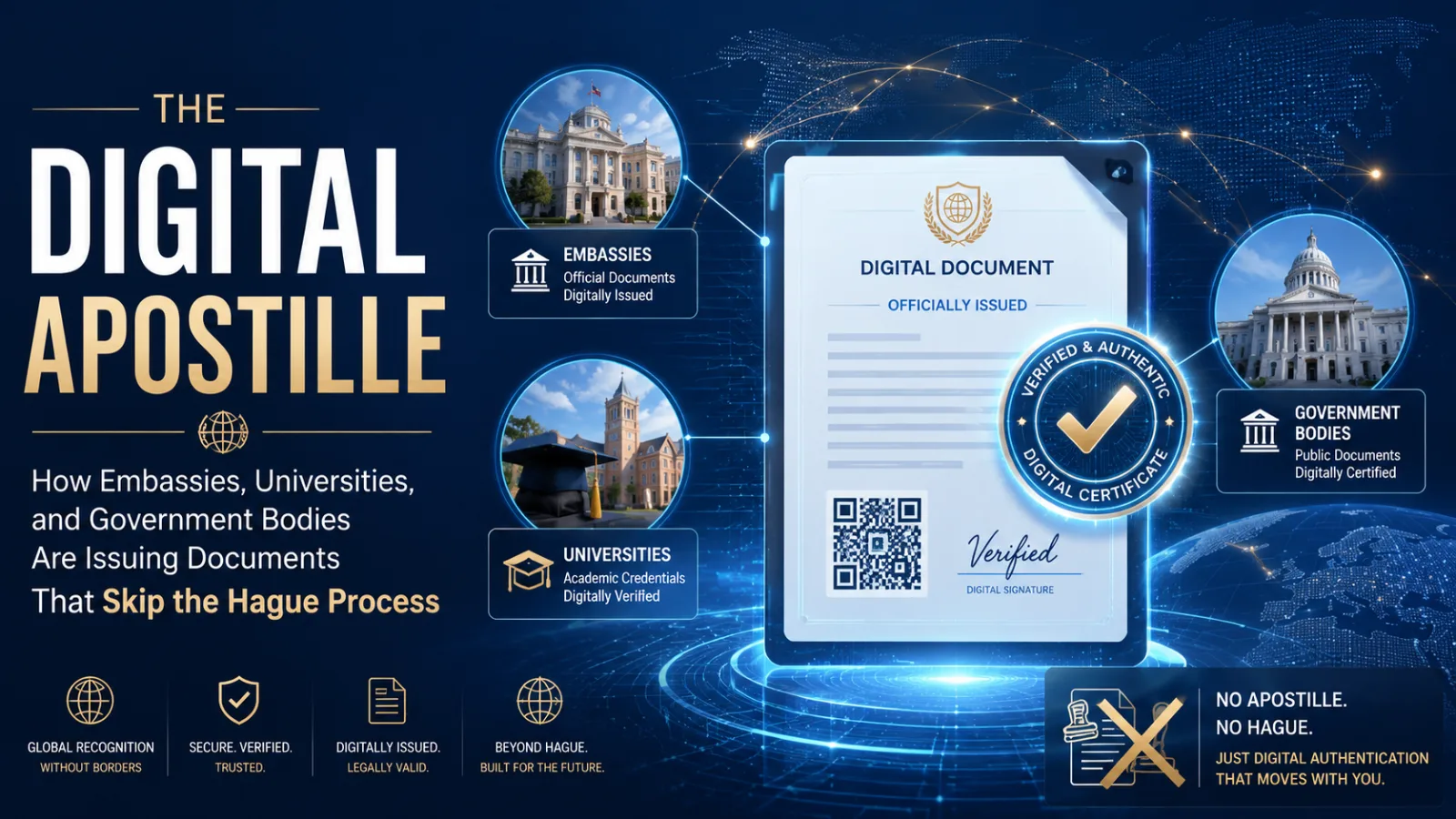
This article is about the digital alternative. Not a replacement for the Hague Apostille Convention itself — which remains the legal framework for cross-border document authentication and isn't going anywhere — but the digital authenticity layer that, for an increasing share of documents, makes the apostille step either redundant or substantially faster. Embassies, universities, professional bodies, registrar offices, and government agencies that issue documents in verifiable form give recipients the ability to confirm authenticity in seconds, with no consular pipeline, no courier shipments, and no physical stamps. The Hague framework remains in force; the practical workflow underneath it changes.
For document-issuing authorities considering whether verifiable issuance belongs alongside their existing apostille and legalisation workflows, this guide covers the e-Apostille programme that the Hague Conference on Private International Law has been quietly running since 2006, the regulatory and technical landscape in 2026, the document categories where verifiable issuance most directly displaces or supplements apostille workflows, and the implementation pattern for issuers operating across jurisdictions.
The Hague Apostille Convention, briefly
The Convention of 5 October 1961 Abolishing the Requirement of Legalisation for Foreign Public Documents — the formal name for the Hague Apostille Convention — established a simplified procedure for cross-border document authentication between contracting states. Before the convention, a public document issued in one country and intended for use in another typically required a chain of authentications: the document was authenticated by the issuing country's local authority, then by the issuing country's foreign ministry, then by the receiving country's embassy or consulate in the issuing country. The convention replaced this chain with a single apostille certificate, issued by a designated competent authority in the country of origin, which the receiving country agreed in advance to accept without further legalisation.
The convention has been an enormous practical success. As of 2026, there are 127 contracting parties. Recent accessions have expanded the framework significantly: China acceded effective 7 November 2023, dramatically simplifying document flows between China and the rest of the contracting parties; Rwanda acceded effective 5 June 2023; Pakistan acceded effective 9 March 2023; Senegal acceded effective 23 March 2023; Singapore acceded effective 16 December 2021. Countries that haven't acceded — Canada is a notable absence, along with most of the Middle East and parts of Africa — still require the older chain-of-legalisation procedure for cross-border document use, which is the route the Lagos doctor at the start of this article had to navigate.
Within the framework, the apostille itself is a standardised certificate (Form Annexe, defined by the convention) that attests to four things: the authenticity of the signature on the document, the capacity in which the signatory acted, the identity of any stamp or seal on the document, and (where appropriate) the document's authenticity as a public document of the issuing country. The certificate does not vouch for the content of the document — only for its authenticity as having been issued by the asserted authority. This is an important nuance: an apostille on a diploma confirms the diploma is a real diploma issued by the named university, not that the underlying degree was earned through legitimate study.
The apostille is issued by a designated competent authority in the country of origin. The list of competent authorities varies widely: in the US, it's typically the Secretary of State of each individual state (for state-issued documents) plus the US State Department (for federal documents); in the UK, it's the Legalisation Office of the Foreign, Commonwealth and Development Office; in Germany, it's various state and federal authorities depending on the document type; in India, it's the Ministry of External Affairs; in Brazil, it's the Conselho Nacional de Justiça delegating to state courts. The variation in competent authorities is one of the reasons the apostille process is slow — the document has to find its way to the right authority, often through intermediate notarisation or authentication steps, before the apostille can be issued.
The convention works. It's also, by 2026 standards, a paper-and-stamps process running on top of cross-border documents that are increasingly digital in every other respect. The Hague Conference itself recognised this in 2006 with the launch of the electronic Apostille Programme.
The e-Apostille programme and the digital authentication landscape
The electronic Apostille Programme (e-APP), formally launched by the Hague Conference on Private International Law and the US National Notary Association in April 2006, was designed to extend the apostille framework into the electronic domain. The programme has two components: electronic apostilles (e-Apostilles), which are digitally-signed apostille certificates that can be issued and verified electronically, and electronic registers (e-Registers), which are online databases that any recipient can query to verify whether a particular apostille certificate is genuine and what document it was issued against.
In 2026, the e-APP has been adopted by a meaningful but uneven set of contracting parties. Belgium, Spain, Netherlands, Colombia, Ecuador, the Republic of Moldova, and several others have implemented full e-Apostille systems with public e-Registers. The US has implemented e-Apostille capability in some states; the UK has implemented an online verification register for apostilles issued by its Legalisation Office; Germany has implemented partial e-Apostille capability; France has implemented an online verification system for apostilles issued through its Cour d'Appel system. China's recent accession came with substantial digital infrastructure for issuing and verifying apostilles. The progression toward digital is real, ongoing, and accelerating — but uneven enough that, in practice, a document moving between any two given contracting parties might be authenticated electronically, on paper, or in a hybrid form depending on the specific authorities involved.
The e-Apostille framework is, importantly, a layer on top of the same authentication model the paper apostille uses. It still requires the document to be issued, authenticated, and apostilled through the chain of authorities. What it changes is the medium: the apostille certificate is a cryptographically-signed electronic document rather than a paper certificate with a wet stamp, and recipients verify it through an online register rather than by inspecting the physical stamps. The e-Apostille is meaningfully faster and cheaper than the paper apostille for the contracting parties that have implemented it well — typically days rather than weeks, and lower in fee structure — but it's still the apostille process, with the apostille step still required.
Verifiable document issuance — the architectural pattern we've covered in Verifiable Document Issuance: The 2026 Category Guide — is a different layer. It puts authenticity proof inside the underlying document at issuance, rather than producing a separate authentication certificate after the fact. A verifiably-issued diploma carries cryptographic proof of the university's identity directly. A verifiably-issued government permit carries cryptographic proof of the issuing ministry. A verifiably-issued professional registration carries cryptographic proof of the regulatory body. The recipient — regardless of jurisdiction — verifies in seconds with a phone scan, without needing the document to have first transited through any apostille or legalisation process.
For documents whose authenticity question is "is this real?", verifiable issuance answers the question directly at the source. For documents whose authenticity question is also "is the issuing authority recognised by the receiving country's framework?", the apostille framework (or its bilateral equivalents) is the answer the verifiable issuance layer cannot replace — because that question is about treaty law, not about cryptographic proof. The two layers serve different parts of the cross-border authentication problem, and the relationship between them is what most of this article is about.
Where verifiable issuance directly displaces apostille workflows
There are several document flows where verifiable issuance from the original issuing authority makes the apostille step either redundant or substantially simpler. The pattern in each case: the receiving authority's question is fundamentally about document authenticity, not about treaty-recognised authentication of the issuing authority's capacity. When the receiving authority can confirm authenticity directly through verifiable issuance, the apostille step adds friction without adding evidence.
Academic credentials and transcripts. Universities issuing verifiable diplomas and transcripts — with QR codes linking to verification pages on the university's own domain, cryptographically signed by the registrar, with the verification page showing degree details, dates, and graduate information — give receiving institutions in any jurisdiction the ability to verify the credential directly with the issuing university. For receiving institutions whose primary concern is whether the diploma is real (most academic admissions departments, most professional licensing bodies, most employers running background checks), this is dispositive. Some jurisdictions still require an apostille on the credential for visa or licensing purposes — that's a treaty-recognition question, not an authenticity question — but the substantive verification work is complete before the apostille step. We've covered this pattern in detail at How to Verify a Degree Certificate or Transcript with QR Codes.
Professional credentials and registrations. Professional regulatory bodies — medical councils, engineering institutes, bar associations, chartered accountancy bodies — issuing verifiable registration certificates give receiving authorities in other jurisdictions a direct authenticity verification path. The Lagos doctor's medical degree, if verifiably issued by her university and accompanied by a verifiable registration certificate from the Medical and Dental Council of Nigeria, presents a German licensing body with cryptographic proof of both credentials. The German body still needs to assess whether the credentials meet the German licensing standard — a substantive professional review that no authentication layer can replace — but the authenticity question is answered before that review begins.
Birth, marriage, and death certificates. Vital records — among the most apostilled document categories globally because they're required for visa applications, immigration applications, marriage and family law, inheritance, and pension entitlements — are issued by national or sub-national civil registries. Civil registries issuing verifiable vital records (cryptographically signed by the registry, with QR codes that any recipient can verify) give receiving authorities direct authenticity confirmation. The apostille step, where treaty-required, can proceed; the substantive verification can happen instantly through the verifiable issuance layer.
Government permits, licences, and certifications. Permits, licences, regulatory certifications, and government attestations — the broad category of public documents most commonly subject to apostille — benefit directly from verifiable issuance. A food safety certificate issued by a national food authority, a business registration issued by a corporate registry, a tax clearance issued by a revenue authority, a customs declaration issued by a customs office — each of these, when issued verifiably, can be authenticated by any recipient with a phone, regardless of whether the recipient is in a Hague contracting state, a bilateral treaty state, or a third-country jurisdiction with no authentication relationship at all. We've covered the underlying pattern at Government Permits and Licences: Stopping Forged Documents at the Counter with QR Verification.
Court documents and judicial certifications. Court orders, divorce decrees, judgments, and judicial certifications — frequently apostilled for cross-border family law, inheritance, and litigation purposes — can be issued verifiably by the issuing court. The verifiable issuance layer doesn't change the court's substantive authority, but it provides recipients in any jurisdiction with a direct authenticity verification path.
Commercial documents — certificates of incorporation, board resolutions, commercial registrations. Cross-border commercial activity generates large volumes of authenticated documents flowing between corporate registries, regulatory authorities, and counterparties in other jurisdictions. Verifiable issuance from the originating registry or authority gives counterparties direct confirmation of the document's status as of the verification date — which, for commercial documents whose underlying facts can change (current company status, current board composition, current ownership structure), is structurally more useful than a snapshot-in-time apostille that confirms the document was authentic when issued but doesn't reflect subsequent changes.
In each of these categories, the verifiable issuance layer gives recipients in any jurisdiction direct authenticity verification — independent of whether the issuing and receiving countries have a treaty relationship, independent of whether an apostille step has been completed, and independent of whether the document is being verified in the country of issuance or anywhere else. The apostille framework remains in force for the treaty-recognition function it serves; the verifiable issuance layer replaces or supplements the authenticity-verification function the apostille has historically also been used for.
What verifiable issuance doesn't replace
The architectural honesty of this argument requires being clear about what verifiable issuance doesn't replace, because it doesn't replace everything.
The treaty framework of the Hague Convention. When a receiving country's domestic law requires apostille authentication of foreign public documents — and many countries do, for specific document categories like vital records, court documents, and government certifications — verifiable issuance from the original issuer doesn't substitute for the apostille. The receiving country's legal framework recognises apostilles as proof of treaty-recognised authentication; it doesn't (yet) recognise verifiable issuance as a treaty equivalent. This is changing slowly — the e-APP programme is one expression of the shift, and the EU's eIDAS 2.0 framework creates a separate cross-border recognition layer for Verifiable Credentials presented via the EUDI Wallet — but the broader treaty recognition of verifiable issuance is still in early stages and varies by jurisdiction.
Consular legalisation for non-contracting states. For documents flowing between a contracting state and a non-contracting state (or between two non-contracting states), the apostille framework doesn't apply at all, and consular legalisation remains the legally-recognised authentication route. Verifiable issuance from the original issuer can supplement this — and often does, by making the underlying document's authenticity easier for the consular officer to confirm — but it doesn't substitute for the consular legalisation step itself.
Substantive review of the document's content. No authentication layer — apostille, verifiable issuance, or any other — confirms that the underlying document represents legitimate substantive facts. A verifiably-issued diploma confirms the university issued the diploma; it doesn't confirm the student earned the degree legitimately. A verifiably-issued birth certificate confirms the civil registry issued the certificate; it doesn't confirm the underlying birth facts. Substantive review of document content remains the responsibility of the receiving authority, and is outside the scope of any authentication framework.
Documents not issued by the original authority. When the document being authenticated is a notarised copy, a translation, or an attestation produced by an intermediary, the verifiable issuance layer at the original issuer doesn't extend to the intermediary's work. Some intermediaries (notaries, translators, attestation services) are themselves adopting verifiable issuance for their outputs, which extends the verifiable chain — but the chain has to be built deliberately at each step.
The honest framing for verifiable issuance vs apostille is: verifiable issuance handles the authenticity-verification function efficiently and directly; the apostille (and its e-Apostille and consular-legalisation alternatives) handles the treaty-recognition function. In document flows where authenticity is the substantive question, verifiable issuance makes the apostille step lighter or unnecessary. In document flows where treaty recognition is the substantive question, the apostille framework remains the answer.
The implementation pattern for issuing authorities
The practical question for embassies, universities, government bodies, professional registries, and other authorities considering whether to add verifiable issuance to their existing workflows is what implementation looks like.
The pattern is similar in shape to the patterns we've covered in earlier articles for other document categories, with specific considerations for the cross-border use case:
Signing identity hierarchy. For larger institutions issuing across multiple jurisdictions, business units, or document types, the signing infrastructure should support a hierarchy of issuer identities under a common institutional root. A national education ministry issuing verifiable credentials should have separate signing identities per university operating under its authority, so that recipients verifying a credential see the specific university's identity (not the ministry's) on the proof page. A multinational professional body should have separate signing identities per country chapter. The hierarchy keeps the verification experience accurate to the issuing entity while preserving the broader institutional anchor.
Hosted proof pages on issuer-controlled domains. For cross-border verification specifically, the hosted proof page must clearly belong to the issuing authority — recipients in other jurisdictions need to be able to confirm, at a glance, that the verification page is the real authority's page and not a fake. Branded subdomain configuration (verify.[authority].edu or verify.[ministry].gov or similar), clear visual identity, multilingual support for the language pairs the issuer's documents commonly cross, and accessibility standards meeting the receiving jurisdictions' requirements all matter.
Long-term verifiability across decades. Cross-border documents frequently need to remain verifiable for very long periods. A diploma issued today may need to be verified in 2050 by a regulatory body in a country that doesn't yet exist with current borders. The implementation must use PAdES-LTA (Long-Term Archival) or equivalent for documents intended to remain verifiable across decades, embedding the validation material at signing time so verification continues to work after signing certificates expire and certificate authorities rotate.
Multilingual document support. Cross-border documents are commonly issued in the language of the issuing country and translated for use in the receiving country. The verifiable issuance layer should support multilingual originals where appropriate and provide multilingual proof pages where the recipient pool warrants it. The cryptographic signature is language-independent; the proof page experience benefits from localisation.
Alignment with e-Apostille infrastructure where available. For issuers operating in jurisdictions that have implemented the e-APP programme, verifiable issuance can complement the e-Apostille system: documents issued verifiably from the original authority can subsequently be apostilled through the e-Apostille system if the receiving country requires apostille, with the e-Apostille register linking back to the underlying verifiable issuance for additional authenticity confirmation. The two layers stack cleanly when both are implemented.
Alignment with eIDAS 2.0 and the EUDI Wallet for EU-relevant documents. For credentials intended for use within or across EU jurisdictions, verifiable issuance in W3C Verifiable Credentials format — suitable for presentation through the European Digital Identity Wallet ecosystem — provides a parallel cross-border recognition path that doesn't require the apostille step at all within the EU framework. Detailed background at eIDAS 2.0 and the EUDI Wallet.
The integration point for most issuing authorities is the document generation system where the credential, certificate, or attestation is produced. For universities, this is the registrar or student information system. For ministries and government bodies, it's the licensing or registration system. For professional bodies, it's the membership or registration platform. The verifiable issuance layer sits at the output of these systems, signing and QR-stamping the generated documents before they leave the issuing authority's infrastructure. The deeper integration pattern is described in The VerifyDoc.ai API: Embedding Verifiable Issuance Into Your Product.
The receiver-side and citizen-side experience
To make the practical experience concrete, here's what the verifiable-issuance-plus-apostille workflow looks like from each party's perspective.
The issuing authority — a university registrar, a ministry licensing office, a professional regulatory body — produces the document in their existing system the way they always have. The verifiable issuance layer signs and QR-stamps the document at the output step. The signed document is issued to the holder (the student, the licensee, the registered professional) through the existing delivery channel. The authority's workflow time is essentially unchanged.
The document holder — the Lagos doctor, the São Paulo engineer, the Colombo accountant — receives a verifiable document from the issuing authority. They forward it to whichever receiving party needs it. If the receiving party's jurisdiction requires apostille, they may still need to obtain the apostille certificate through the competent authority — but the underlying verifiable issuance simplifies the apostille authority's work (the authenticity is confirmable instantly) and provides a parallel verification path the receiving authority can use independently.
The competent authority issuing the apostille — the Secretary of State, the Ministry of External Affairs, the Cour d'Appel, the FCDO Legalisation Office — can confirm the underlying document's authenticity through the verifiable issuance layer before issuing the apostille. This is the major workflow improvement on the apostille side: the authority no longer has to phone the issuing university, fax the ministry, or inspect the document for forgery indicators. The QR code scan answers the authenticity question in seconds, and the authority can focus its work on the treaty-recognition function (confirming the signatory's capacity, applying the apostille certificate) rather than on the underlying authentication.
The receiving authority in the destination country — the German licensing body, the Portuguese professional registry, the UK employer — receives the document with the apostille (or, in some cases, without apostille if the receiving authority is willing to rely on direct verifiable issuance verification). They scan the QR code on the document, confirm authenticity directly with the issuing authority through the verification page, and proceed with whatever substantive review is required for licensing, admission, employment, or other purposes. The substantive review is the same; the authentication step is faster.
In every step, the verifiable issuance layer makes the workflow faster without breaking the existing legal framework. The apostille remains for documents whose treaty recognition requires it. The direct verification supplements (and increasingly substitutes for) the apostille's authentication function.
The trajectory in 2026 and beyond
Several trajectories converge on verifiable issuance becoming the dominant authentication pattern for cross-border documents over the next decade.
The e-APP programme's expansion continues. More Hague contracting parties implement electronic Apostille systems each year; the public e-Registers become more numerous and more interoperable; the friction in the apostille process itself reduces. The trajectory points toward apostille issuance becoming substantially faster and cheaper, and the residual friction concentrating in the document-collection-and-submission phase rather than the apostille-issuance phase.
eIDAS 2.0 in the EU creates a parallel framework for cross-border credential recognition through the EUDI Wallet. EU Member States are required to make wallets available to citizens by 24 December 2026 and designated relying parties must accept wallet-presented credentials by 6 December 2027. For documents flowing within or across EU jurisdictions, the EUDI Wallet route doesn't require apostille at all — and the trajectory of EU acceptance of EUDI Wallet credentials for non-EU purposes is one to watch.
Bilateral and regional digital authentication frameworks are emerging in parallel. The African Continental Free Trade Area (AfCFTA) creates pressure for harmonised cross-border document recognition across African Union member states. ASEAN initiatives on cross-border credential recognition are advancing. The Pacific Alliance and Mercosur in Latin America have their own digital authentication initiatives. Each of these creates additional cross-border recognition layers that operate in parallel with the Hague apostille framework.
Receiving-side adoption is the strongest near-term driver. Universities, professional bodies, employers, government licensing authorities, and other receiving institutions increasingly prefer credentials from issuing authorities that issue verifiably — because the verification work is dramatically faster, the residual risk of accepting forged credentials is lower, and the workflow improvements for the receiving institution's own operations are substantial. Once a meaningful share of any given receiving population (German licensing bodies for foreign-trained doctors, UK universities for international student admissions, US employers for foreign work-authorisation documents) starts preferring verifiable issuance, the issuing authorities respond by adopting it.
AI-driven forgery pressure affects the apostille framework the same way it affects every other document workflow. Convincing fake apostille certificates are, in 2026, no harder to produce with AI tools than convincing fake diplomas — and the receiving authorities relying on apostilles face the same residual-risk problem they face with the underlying documents. Verifiable issuance from the original authority provides a structural defence: the apostille certificate can be forged, but the underlying document's verifiable issuance can't, and the recipient verifying through the underlying issuance layer has cryptographic confirmation regardless of the apostille's status.
The shorter version: the Hague Apostille Convention isn't going away — it remains the legal framework for cross-border document authentication for the foreseeable future — but the practical workflow underneath it is shifting toward verifiable issuance as the authenticity layer, with apostille and e-Apostille remaining as the treaty-recognition layer. The issuing authorities adopting verifiable issuance today are positioned correctly for the trajectory; the ones waiting will face a longer transition when their receiving counterparts make verifiable issuance the expected default.
- Frequently asked questions
Does verifiable issuance replace the apostille?
For the authenticity-verification function the apostille has historically served — confirming that a document is genuinely from the asserted issuing authority — verifiable issuance does the same job faster, cheaper, and more reliably. For the treaty-recognition function the apostille serves under the Hague Convention — confirming that the issuing authority is one whose documents the receiving country has agreed by treaty to accept without further legalisation — verifiable issuance is not yet a treaty substitute. Receiving countries whose domestic law requires apostille authentication of foreign public documents continue to require apostille; verifiable issuance can supplement that workflow but doesn't replace the legal requirement.
Is the e-Apostille the same as verifiable issuance?
No, but they're complementary. The e-Apostille is a digitally-signed apostille certificate produced by the competent authority in the country of origin, replacing the paper apostille certificate. It operates on top of the same authentication model the paper apostille uses, with the document still required to be issued, authenticated, and apostilled through the chain of authorities. Verifiable issuance puts authenticity proof inside the original document at the moment of issuance by the original authority. The e-Apostille speeds up the apostille step; verifiable issuance simplifies (or in some cases eliminates) the underlying authenticity question that the apostille has historically also been used for.
Does my country need to be a Hague contracting state for verifiable issuance to work?
No. Verifiable issuance works regardless of treaty membership because the verification is performed locally by the recipient with their phone, against the issuing authority's verification page on the authority's own domain. Treaty membership affects whether the apostille framework is available as the authentication route for cross-border use, but verifiable issuance operates independently of that question. An issuing authority in a non-contracting state can implement verifiable issuance and provide direct authenticity verification to recipients in any country; the apostille question is separate and depends on the bilateral or regional authentication framework between the specific countries involved.
What about documents that need to be physically presented somewhere?
A verifiably-issued document is a PDF (or a Verifiable Credential in wallet form) that can be printed, photocopied, scanned, faxed, and re-printed. The QR code prints. Verification works on paper documents in 2026 the same way it works on PDFs — point a phone camera, see the result. For receiving authorities that require physical document submission, the verifiable issuance layer adds an authenticity verification capability to the physical document; it doesn't require the document to remain in digital form. This is one of the most overlooked properties of QR-based verifiable issuance: it bridges digital and paper workflows without requiring the receiving authority to change anything about its physical-document handling.
How does this work for translations?
Cross-border documents are commonly translated by sworn or certified translators for use in the receiving country. The translator's work is itself a separate document that may require its own authentication. Some translators are adopting verifiable issuance for their outputs, which extends the verifiable chain. For now, the typical pattern is: the original document is verifiably issued by the original authority; the translation is produced by a sworn translator; both documents are presented to the receiving authority; the receiving authority verifies the original through the verifiable issuance layer and accepts the translation either on the translator's professional certification or through whatever additional authentication framework applies. As more sworn translators adopt verifiable issuance, the full chain becomes verifiable end-to-end.
Will receiving authorities actually accept verifiable issuance instead of apostille?
This varies by receiving authority, by jurisdiction, and by document type. Some receiving authorities — particularly progressive universities, employers, and professional bodies — are increasingly willing to accept direct verification through verifiable issuance in lieu of apostille for document categories where the receiving authority's legal framework permits flexibility. Other receiving authorities — particularly those bound by domestic law requiring apostille for specific document categories — continue to require apostille and treat verifiable issuance as a useful supplement rather than a substitute. The trajectory over time favours broader acceptance of verifiable issuance, but the current state is uneven. For document holders, the safest pattern is to provide both verifiable issuance (which the receiving authority can verify directly) and apostille (where the receiving authority's legal framework requires it).
What about countries that don't recognise apostille at all?
For documents flowing between non-contracting states, or between contracting states and non-contracting states, the Hague apostille framework doesn't apply, and consular legalisation remains the legally-recognised route. Verifiable issuance from the original issuer supplements consular legalisation by making the underlying document's authenticity directly verifiable by the consular officer (and ultimately by the receiving authority) — which simplifies the consular workflow and reduces the residual risk of accepting forged documents through the legalisation chain. Verifiable issuance doesn't substitute for the consular legalisation requirement itself.
How does VerifyDoc.ai handle cross-border verification specifically?
The verifiable issuance architecture is jurisdiction-agnostic by design. The cryptographic signature on a document issued by a Brazilian university verifies the same way for a recipient in Portugal, Germany, the UAE, or Singapore — through the QR code resolving to the university's branded verification page, which loads in any browser on any phone in any country. For documents intended for EU use specifically, we issue in W3C Verifiable Credentials format suitable for presentation through the EUDI Wallet ecosystem; for documents intended for traditional PDF workflows globally, we issue in PAdES-signed PDFs. The hosted proof pages support multilingual configurations and accessibility standards that work across receiving-country requirements.
Is VerifyDoc.ai the same as verifydoc.com for cross-border document workflows?
No. VerifyDoc.ai is the issuer-side platform — embassies, universities, ministries, and professional bodies use it to issue verifiable documents that recipients in any country can verify in one scan. verifydoc.com is a separate company in the recipient-side fraud detection category. The full architectural distinction is in VerifyDoc.ai vs verifydoc.com: What's the Difference?.
How long does implementation take for a typical issuing authority?
For universities and professional bodies running modern student information or registration systems, a working pilot covering one credential type (typically degree certificates, professional registrations, or transcripts) can run in four to eight weeks. Full production rollout covering the main credential categories typically takes three to six months. For government ministries and embassies with more complex IT environments and stricter change-control processes, the timeline extends to six to twelve months but the architectural pattern remains the same. The integration point is the document generation system that already produces the credential; the verifiable issuance layer sits at the output step.
What does this cost?
Pricing for verifiable issuance is volume-based — based on the number of documents issued per month — rather than per-citizen or per-credential-holder. For most issuing authorities, the cost per document is meaningfully lower than the loaded cost of the inbound authentication workload that verifiable issuance reduces, before accounting for the strategic positioning benefit of being among the early-adopter issuing authorities. Current pricing tiers at verifydoc.ai/pricing.
Where to go from here
If you're at a university or professional regulatory body considering verifiable issuance for credentials, the natural next reading is How to Verify a Degree Certificate or Transcript with QR Codes for the credential-specific workflow, and Verifiable Document Issuance: The 2026 Category Guide for the broader category context.
If you're at a government ministry, embassy, or licensing authority, the natural next reading is Government Permits and Licences: Stopping Forged Documents at the Counter with QR Verification for the government document workflow, and the same category guide for the architectural foundations.
If you're at a competent authority responsible for issuing apostilles, verifiable issuance from the underlying document issuers in your jurisdiction simplifies your own workflow substantially — the authenticity verification you currently perform manually or through phone contact with the issuing authority becomes a phone scan. The trajectory toward integration between national apostille systems and verifiable issuance infrastructure is one we expect to accelerate over the next several years; positioning your office to support both layers in 2026 is the operationally and strategically correct posture.
If you're a document holder navigating cross-border authentication for your own credentials, the practical advice is: where possible, choose issuing authorities that issue verifiably (this is increasingly possible for academic, professional, and government documents), and supplement the verifiable issuance with apostille where the receiving country's legal framework requires it. The combination is faster and more reliable than apostille alone, and it positions you correctly for the trajectory of cross-border document workflows over the coming years.
The fundamental shift is the one this article opened with: cross-border document authentication is, in 2026, transitioning from a paper-and-stamps process running on top of digital documents to a verifiable issuance architecture that puts authenticity proof inside the document at the moment of issuance. The Hague Apostille Convention remains in force as the legal framework for treaty-recognised cross-border authentication; the practical workflow underneath it is what's changing. Issuing authorities that adopt verifiable issuance early are the ones whose credentials work cleanly in receiving jurisdictions worldwide; the ones who wait will face a longer transition when their receiving counterparts make verifiable issuance the expected default.
This is the eighth article in our series on verifiable document issuance. For the foundational category context, see Verifiable Document Issuance: The 2026 Category Guide; for the buyer's diagnostic, see Issuer-Side vs Recipient-Side Document Trust; for the developer guide, see The VerifyDoc.ai API; for use cases, see Verifiable Certificates of Insurance, Verifiable Right-to-Work Documents, and Verifiable Issuance for Banks; for the architectural argument, see Why VerifyDoc.ai Doesn't Do Fraud Detection. The distinction between VerifyDoc.ai (issuer-side) and verifydoc.com (recipient-side) is covered in VerifyDoc.ai vs verifydoc.com: What's the Difference?.